Church of Santa Maria Assunta: A Historic Parish Church in Esine, Italy


Site at a Glance
- Rating
- 4.8
- Popularity
- Low
- Country
- Italy
- Primary era
- Medieval
- Eras represented
- Medieval, Early Modern
- Civilizations
- Venetian
- Site type
- Religious
- Remains
- Church
On this page10 sections
History
The Church of Santa Maria Assunta is a Catholic church in Esine, Italy, dedicated to the Assumption of the Virgin Mary and belonging to the Diocese of Brescia, the Roman Catholic jurisdiction responsible for the area. Standing north-west of the settlement, it may have been Esine’s first Christian place of worship, with origins possibly in the sixth or seventh century. The church was rebuilt around the first millennium, and it later underwent a major fifteenth-century reconstruction before receiving its celebrated fresco decoration between 1491 and 1493. Its historical and artistic value has led to its designation as a national monument.
Early Christian foundations and parish status
Two architectural elements supporting the gallery, together with frescoes in the second and third bays of the nave, point to a rebuilding around the first millennium. The earlier Christian foundation may have preceded the Church of the Holy Trinity, which is recorded in 771 and initially served as the principal church of the area.
During the fourteenth century, the location of the Holy Trinity became inconvenient as the settlement developed. The churches of San Paolo and Santa Maria Assunta stood closer to the growing community and consequently assumed greater importance. Their changing roles led to a prolonged dispute between the prebendary priests of the two churches. Prebendary priests were clerics supported by revenues assigned to a church office.
In 1459, Benvenuto Vanzio, acting for Bishop Bartolomeo Malipiero, recognized Santa Maria Assunta as the principal parish church. The ruling rested on the belief that it was the older foundation and on the fact that it was the first church in Esine to possess a baptismal font. Vanzio also ordered the distribution of olive branches for Palm Sunday at Santa Maria Assunta. Later episcopal visitations shifted in their preference between the two churches. In 1574, Tranquillo Soldi, representing the bishop, restored the ruling made in 1468.
Fifteenth-century rebuilding and fresco commission
A radical rebuilding of Santa Maria Assunta began in the fifteenth century and continued until 1485. The new church was then decorated by Giovanni Pietro da Cemmo between 1491 and 1493. The commission came from Isaac de Favis of Gandino, rector of the Church of the Holy Trinity in Esine, and was financed by the Beccagutti and Federici families.
The frescoes were securely attributed to da Cemmo in 1912 through the insight of the historian Fortunato Carnevali. Before that, the painter had been thought to be an Augustinian friar because he signed himself “cemigena.” Personal records later established that he was the father of two children. His work at Santa Maria Assunta combines scenes from Christian salvation history with images intended for popular devotion and reflects a pronounced Franciscan inspiration.
Reforms, disputes, and changing devotion
After Cardinal Carlo Borromeo’s visitation in 1580, a screen was installed between the nave and presbytery. A presbytery is the part of a church reserved for the altar and clergy. The screen followed directives associated with the Council of Trent, the sixteenth-century Catholic council whose reforms influenced worship, church administration, and the separation of liturgical areas.
The Rosary Chapel was begun in 1573 at the commission of Giacomo Mozzi of Cividate, the parish priest. Its construction required the removal of part of a wall and destroyed a fresco from 1492 that probably represented the Last Judgment. The chapel was connected with the Rosary confraternity, a lay religious association organized around shared devotional and charitable activities and focused here on devotion to the Virgin Mary through the rosary.
The rivalry with San Paolo finally ended with a ruling on 10 February 1710, which assigned the two churches substantially equal status. San Paolo was later enlarged, while expansion at Santa Maria Assunta would have required the sacrifice of its frescoes. The Rosary confraternity also assumed responsibility for the chaplaincy founded by Francesco Federici. A chaplaincy is a religious benefice or office served by a chaplain. Federici had transferred his entire estate to the confraternity after the premature deaths of his two sons, both of whom had been priests. The chaplaincy survived the Napoleonic suppression.
Popular devotion declined steadily during the nineteenth century. The statue of the Madonna in the Rosary Chapel, which had attracted devotion for centuries, was eventually transferred to San Paolo. From about 1930, Don Alessandro Sina encouraged renewed study of the church’s artistic heritage and maintained extensive communication with the Milan cultural-heritage authority. Serious deterioration led to authorization for structural consolidation and a major restoration of the frescoes.
Remains
Exterior and bell tower
The church stands slightly above the road and is approached across a cobbled forecourt. Its west-facing façade dates from 1776 and has an articulated two-level design. Four pilasters on tall bases divide the lower level into three sections. Their Tuscan capitals support a tiled cornice, while the central entrance has stone pilasters, an entablature, and a round-headed pediment.
The upper level contains a central window that lights the nave. Two lateral volutes extend toward the ends of the façade, each topped by a vase and terminating in an angle. A triangular pediment crowns the composition. Two hanging pinnacles flank a central pinnacle bearing an iron cross. This replaced the earlier fifteenth-century façade, which had a gabled form and a round oculus, or circular window.
The sixteenth-century bell tower is built of yellowish stone and ends in a conical spire. Its bell carries the inscription “Soli Deo honor et gloria, Sancta Dei genitrix ora pro nobis 1535,” meaning “To God alone be honor and glory; Holy Mother of God, pray for us,” followed by the date 1535.
Interior arrangement
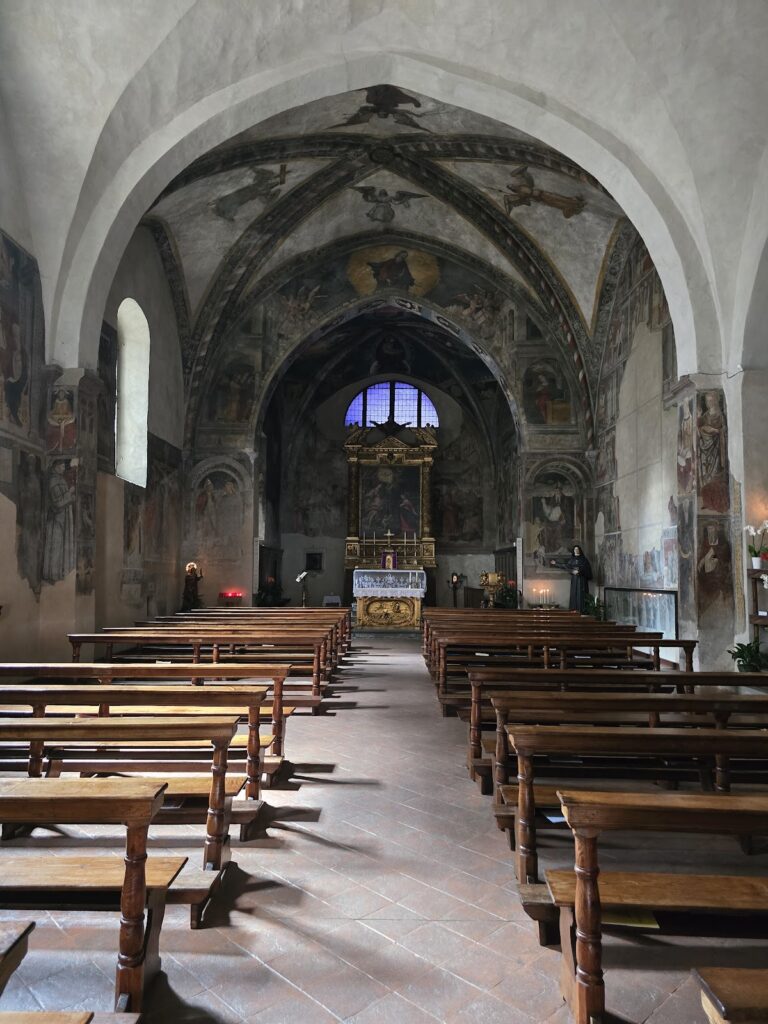
The interior follows a single-nave plan, a form characteristic of rural parish churches. A gallery occupies the entrance end, while the nave has a gabled roof and a wooden covering. The presbytery is enclosed by a masonry vault. The chancel arch, which marks the transition between the nave and presbytery, carries the beginning of the main painted programme.
Fresco cycle
Nave and chancel arch
Giovanni Pietro da Cemmo’s fresco cycle, painted between 1491 and 1493, covers the nave and presbytery. Its two principal groups are arranged according to location and subject. The chancel arch and presbytery present the history of salvation, while ordered panels along the nave contain devotional images. Prophets appear on the parapet of the entrance gallery, and the Annunciation begins the cycle on the chancel arch.
Presbytery scenes
The cross vault of the presbytery shows celestial hosts gathered around a Christ Pantocrator, a representation of Christ as universal ruler. The figure is more than three metres high and appears within a mandorla, an almond-shaped aureole indicating divine glory. Seventy-two figures surround him in distinct groups that include saints, martyrs, patriarchs, emperors, and prophets.
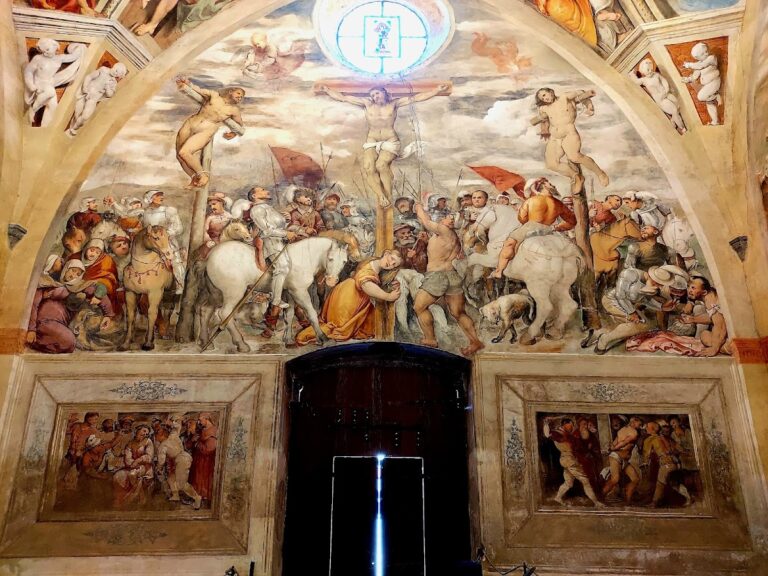
The presbytery walls contain scenes of the Nativity and the Adoration of the Magi. The Crucifixion occupies the rear wall, while the Assumption of the Virgin appears on the west wall. Heraldic emblems of Camunian noble families, especially the Beccagutti and Federici families, form part of the decoration. The coat of arms of Isaac de Favis of Gandino appears high on the right wall beside the abbreviation “F.F.”, meaning facit fecit, or “he had it made.”
The cycle is noted for its theological unity and refined execution, although the irregular organization visible in parts of the work has been regarded as characteristic of da Cemmo’s working method. The later construction of the Rosary Chapel altered this painted interior by removing part of a wall and destroying the fresco dated 1492 that probably depicted the Last Judgment.