Basilica della Madonna della Neve: Mother Church of Copertino


Site at a Glance
- Rating
- 4.8
- Popularity
- Very Low
- Country
- Italy
- Primary era
- Medieval
- Eras represented
- Medieval, Early Modern
- Civilizations
- Kingdom of Naples, Kingdom of Sicily, Norman, Spanish
- Site type
- Religious
- Remains
- Basilica
On this page7 sections
History
The Basilica della Madonna della Neve is the mother church of Copertino, Italy. The Norman count Goffredo of Conversano founded it in 1088, and the church was originally dedicated to the Virgin of the Assumption. Its present character combines Romanesque and Baroque elements, reflecting successive rebuilding, expansion, and restoration.
Foundation and thirteenth-century rebuilding
In 1255, Manfredi, prince of Taranto and count of Copertino, ordered the church to be rebuilt and raised it to the status of a royal basilica. He dedicated it to the Virgin of the Snows. Manfredi also gave the church a fifteenth-century image of the Madonna della Neve, which had been brought from the Chapel of San Marco in Copertino Castle. The image is preserved in the altar dedicated to the Virgin of the Snows, linking the basilica’s title with the medieval patronage of the count.
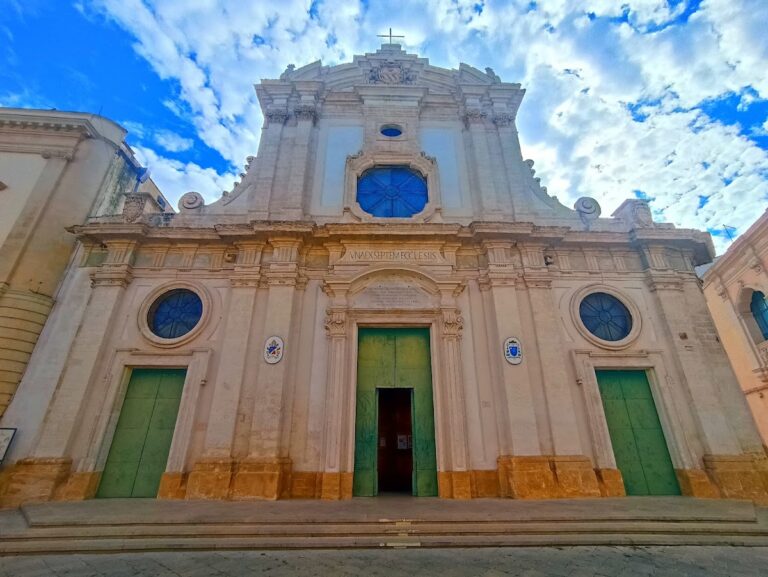
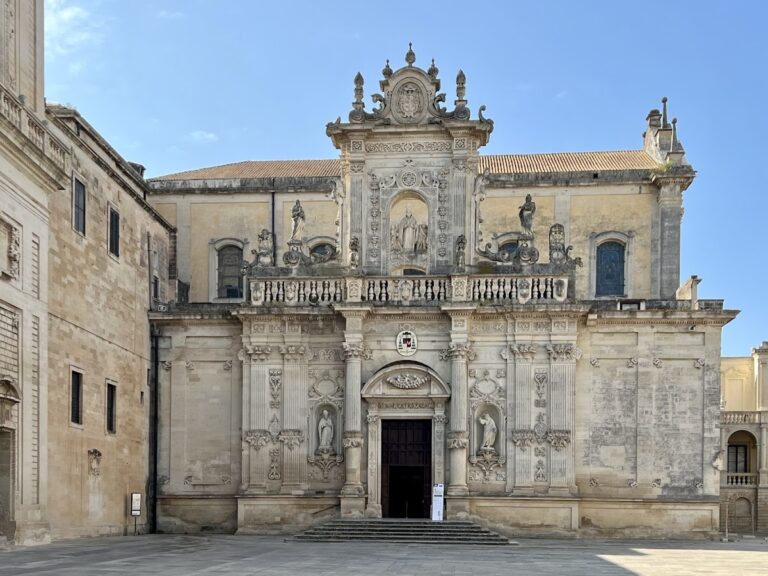
The principal facade retains medieval corbel arches from the second half of the thirteenth century, when Manfredi’s rebuilding took place. The church belongs to the Catholic Diocese of Nardò-Gallipoli and continued to develop through later architectural phases.
Expansion and later recognition
From 1563, the building was enlarged with side aisles, spaces running alongside the main nave. A pentagonal apse, the terminating space at the end of the church, was constructed in 1580. Restoration took place at the beginning of the eighteenth century, when important interior elements were altered. The Romanesque columns were enclosed within quadrangular piers, and the trussed roof was covered by a suspended ceiling enriched with refined stucco work.
The basilica is closely associated with Saint Joseph of Copertino, the Italian Franciscan friar who lived from 1603 to 1663. He was baptized in the church on 17 June 1603 as Giuseppe Maria Desa, the son of Felice and Franceschina Panaca. The baptism was administered by the archpriest Don Delfino Fulino, with Carlo Clarello and Antonia Bizzarra serving as godparents. Saint Joseph is traditionally associated with ecstatic levitation and is also regarded as a patron of students and examinees.
On 3 July 2011, the church received the dignity of a minor pontifical basilica, a Catholic designation granted through papal recognition. Its 925th anniversary and the 350th anniversary of Saint Joseph of Copertino’s death were commemorated in 2013–14. Spain issued a commemorative postage stamp on 4 July 2013 in connection with these anniversaries, and the President of the Italian Republic presented presidential medals.
The bell tower
The bell tower formed part of an ambitious intervention commissioned by the Universitas in support of the collegiate church. The earliest surviving document concerning its construction dates to 1588, when the contract was awarded to Giovanni Maria Tarantino, a master builder from Neretine. This phase added a separate vertical landmark to the basilica’s long architectural development.
Remains
The basilica presents a longitudinal interior with a main nave, side aisles, a transept crossing the nave, and a pentagonal apse. Romanesque columns with elaborate figurative capitals support the building, although the eighteenth-century quadrangular piers now enclose them. Above, the former trussed roof is concealed by a suspended ceiling decorated with stucco work. The principal entrance has a bronze door made by Raffaele del Savio.
Interior furnishings and chapels
The right nave contains three altars. In the transept, one altar is dedicated to the Glory of Saint Joseph Desa, while the Chapel of the Blessed Sacrament contains paintings by Gianserio Strafella. The apse holds wooden choir stalls made in 1793 by Raffaele Monteanni.
The left transept contains the altar of the Virgin of the Snows, built in 1630 by Donato Chiarello. An oval opening in the altar frames the fifteenth-century image of the Madonna della Neve. The same transept also contains an altar dedicated to Saint Sebastian, with a painting by Fra Angelo of Copertino, two further altars, and a panel depicting the Deposition by Gianserio Strafella.
Near the exit at the end of the nave are the funeral monument of Tristano di Chiaromonte and a wooden baptismal font. Together with the baptismal association of Saint Joseph of Copertino, these features connect the church’s furnishings with both the religious life of Copertino and the memory of its historical figures.
Bell tower
The bell tower rises 35 metres and has a square plan divided into two orders. The lower order uses simple volumes, while the upper order carries more pronounced sculptural decoration. Its substantial walls are built of calcarenite, a limestone formed largely from cemented carbonate sand, and the interior contains three chambers. The first level is entered from the church’s transept, and a stair system links the three chambers.
Each facade is decorated with four symmetrically arranged columns. Their shafts are partly recessed and stand on pedestals encircled where the tower narrows. Stone capitals with anthropomorphic forms support an architrave decorated with floral and symbolic motifs, above which rises a composite crowning cornice. The remaining wall surfaces contain augustales, architectural decorative elements supported by brackets and set opposite two niches.