Derbent Mosque: Russia’s Historic Shiite Friday Mosque and Madrasa


Site at a Glance
- Rating
- 4.8
- Popularity
- Medium
- Country
- Russia
- Primary era
- Medieval
- Eras represented
- Medieval, Modern
- Civilizations
- Russian, Shirvanshah, Umayyad
- Site type
- Religious
- Remains
- Mosque
On this page9 sections
History
Derbent Mosque is a Shiite Friday mosque and madrasa in Derbent, Russia, built in 733–734 CE during the early Islamic period. It is regarded as the oldest mosque in Russia and the Commonwealth of Independent States. Construction is attributed to Maslama ibn Abd al-Malik, an Umayyad prince and military commander, while another tradition describes the building as an Iranian foundation from before Derbent separated from Iran under the Treaty of Gulistan after the Russo-Persian War.
Early Islamic foundation
In 733, mosques were established in each of Derbent’s seven mahallahs, or urban neighborhoods organized as local communities. A larger mosque was built for communal Friday prayer, creating the religious center that became Derbent Mosque. By 1796, the city had 15 mosques.
When completed, the mosque was the largest building in Derbent. An earthquake later damaged it, and restoration took place in 1368–1369 under Tazhuddin of Baku. Its present overall form developed by the end of the fourteenth century. Construction of the madrasa, an Islamic educational institution, began in 1474–1475, while the expansion and formation of the entire complex continued until completion in 1815.
Soviet-era closure and religious revival
During the atheism campaign of the 1930s, the mosque was closed. From 1938 to 1943, the building served as a city prison. A decree from Moscow returned it to Derbent’s religious authorities in 1943, allowing it to resume use as a mosque.
In the 1940s, a mosque charter was established and a 20-member governing board was elected. Meshedi Ali-Huseyn became its first chairman. The Sunni and Shiite communities of Derbent have separate imams. During the Soviet period, the mosque was the largest in the North Caucasus and for a time the only mosque in southern Dagestan, drawing Muslims from across the region for Friday prayers.
Heritage protection
Restoration work took place in 2015 during preparations for celebrations of Derbent’s 2,000th anniversary. Derbent Mosque is a federally significant cultural-heritage property of the Russian Federation. It also forms part of the UNESCO World Heritage property “Citadel, Ancient City and Fortress Buildings of Derbent,” inscribed in 2003 under cultural criteria iii and iv.
Remains
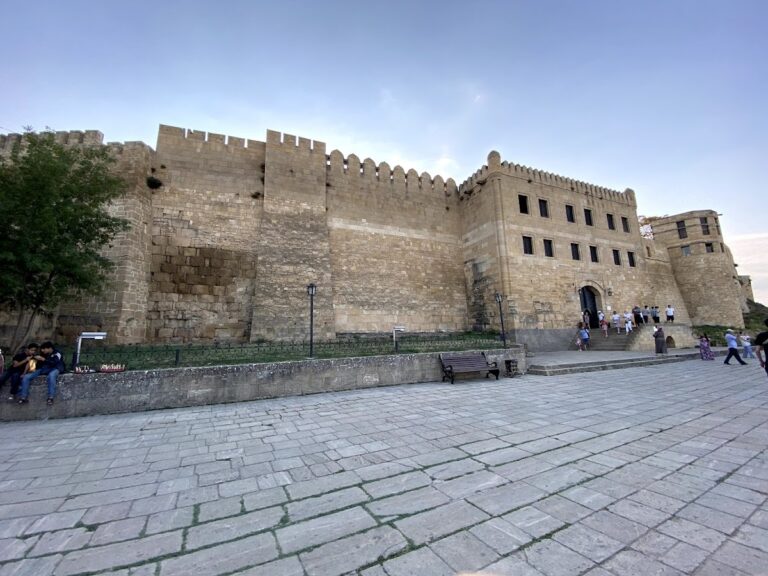
The complex contains the main mosque, the madrasa, and living quarters for the clergy. The mosque is built of shell stone and measures 68 meters from west to east and 28 meters from south to north. It has a single dome rising 17 meters and an interior area of approximately 1,900 square meters. The building is well preserved and remains in active religious use.
Main mosque
The prayer hall measures approximately 70 by 20 meters and has three naves. Two rows of square pillars divide the interior, with shaped or moulded capitals supporting lancet arches across the spaces between them. The central nave is 6.3 meters wide, while each side nave measures 4 meters.
An attached square hall contains the mihrab, the niche indicating the direction of prayer. It is covered by a spherical dome with a pointed crown. On the same axis, another domed room occupies the central nave. This room was probably a maksurah, a reserved area historically associated with Shirvanshah representatives or local feudal rulers. The Shirvanshahs were the ruling dynasty of Shirvan, a historical region of the eastern Caucasus.
Ancient building elements and the mosque’s elongated basilical plan, with a central nave and side naves, have led to an interpretation that it may have been rebuilt from a Christian church associated with the Christian countries of the Transcaucasus. This remains an interpretation rather than a certain identification.
Courtyard and madrasa
Madrasa
The mosque opens onto a spacious square paved with stone slabs. The madrasa stands opposite it and faces the mosque across the square. Its pointed-arch arcade contains hujras, small cells used by students or religious scholars.
Courtyard
The courtyard measures 55 by 45 meters and contains four old plane trees. In 2012, the trees were recognized as natural monuments of all-Russian significance and placed under the protection of the Council for the Preservation of the Natural Heritage of the Nation within Russia’s Federation Council.