Tomb of Askia: A Songhai Monument and Mosque Complex in Gao
Site at a Glance
- Popularity
- High
- Country
- Mali
- Primary era
- Medieval
- Eras represented
- Medieval, Modern
- Civilizations
- Songhai Empire
- Site type
- Religious
- Remains
- Tomb
On this page8 sections
History
The Tomb of Askia is a mud-built monument in Gao, Mali, constructed for Songhai ruler Askia Mohammad Ture in the Sudano-Sahelian tradition, which combines Islamic forms with regional building practices. It was built in the late fifteenth century and is traditionally dated to 1495. Ture, the first ruler of the Askia dynasty, presided over the expansion of the Songhai Empire.
The Rise of Askia Mohammad Ture
Sonni Ali Ber ruled Songhai from 1464 to 1492, uniting and extending its territory. After his successor refused to become Muslim, Muhammed Aboubacar Sylla, governor of Hombori, led a revolt and founded the Islamic Askia dynasty. He took the title Askia Mohammad Ture. Under his rule, the empire expanded west into former Mali territory and east into the Hausa lands, areas inhabited by Hausa peoples in what is now Nigeria.
Building and Burial Traditions
Ture’s pilgrimage to Mecca strengthened his standing among Muslims in the western Sahel. Impressed by the Egyptian pyramids, he decided to build a tomb. Mud and wood for the project were brought from Mecca, and tradition says his caravan included thousands of camels. A mason from Andalusia led hundreds of workers from Macina, a region along the Niger River, with others joining from different parts of the empire.
The building was first planned as a residence, with several rooms and passageways, then sealed after Ture’s death. Although it is traditionally called his tomb, his burial place is uncertain. Gao tradition places it at an undisclosed site northeast of the monument, probably kept secret to deter grave robbers. Other Askias were buried in the courtyard, while notable people were interred in the surrounding grounds through 1989.
Religious Use and Modern History
The name Tomb of Askia dates from the colonial period. Local residents also call the building Askia Djira, meaning Askia’s mosque. Ture used it for prayer, and it remains an active mosque as well as a publicly owned cultural centre for Gao.
The complex was inscribed on UNESCO’s World Heritage List in 2004, a list recognizing places of outstanding universal cultural or natural value. Erosion has damaged the building, and political instability has hindered maintenance. Although restoration has taken place, UNESCO added the site to its List of World Heritage in Danger in 2012, which identifies listed places facing serious threats. When Islamist fighters took control of Gao, residents defended the mosque, which nevertheless sustained damage.
Remains
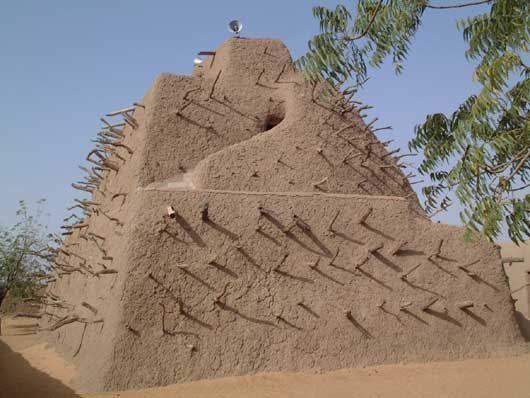
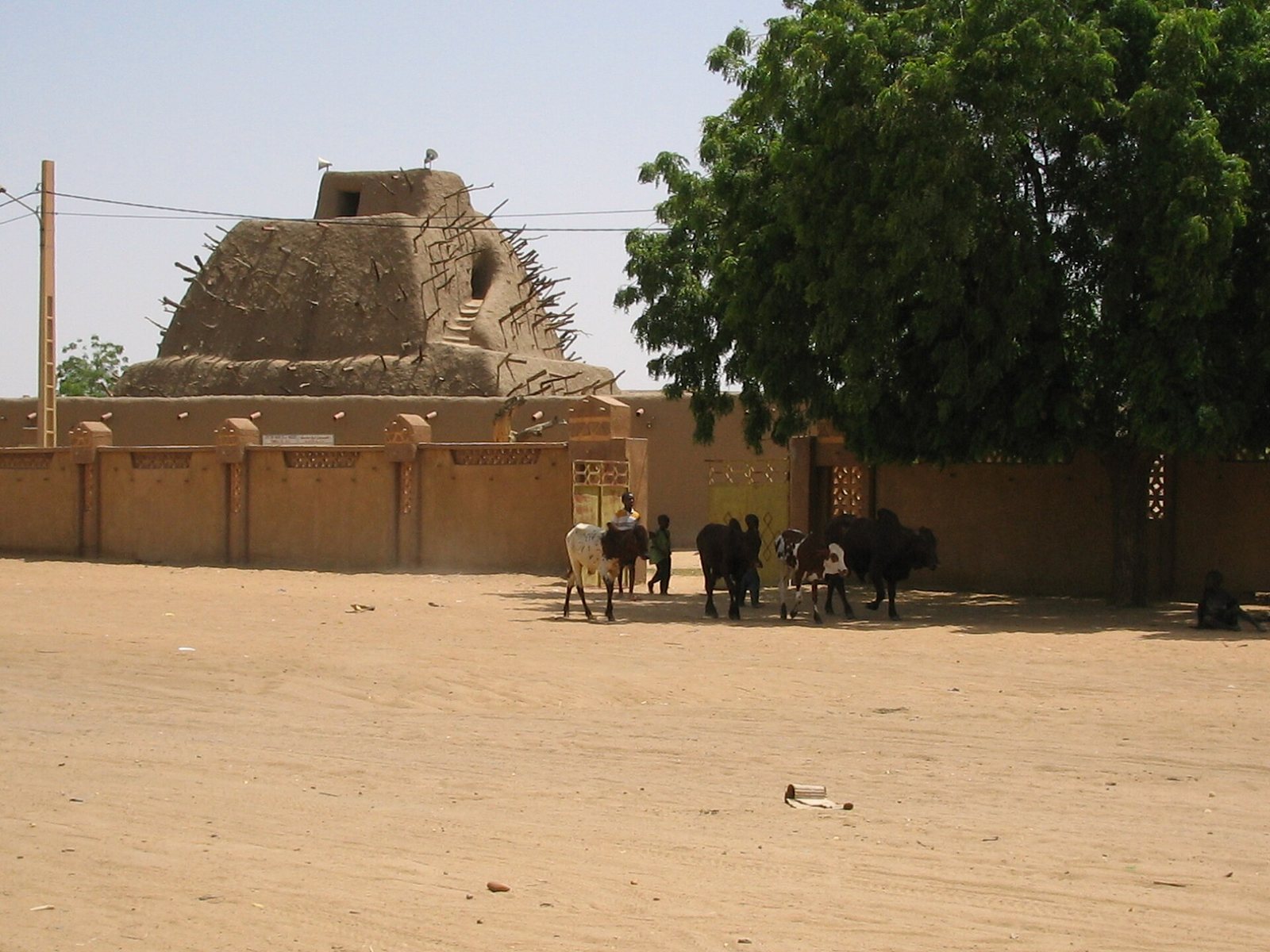
The complex is arranged around a pyramidal tomb and includes two mosques, a cemetery, an assembly ground, and a perimeter wall. Its buildings are made of mud and reflect the regional construction traditions associated with Sudano-Sahelian architecture.
The Tomb
The central mud-brick tower rises 17 metres and has a footprint of about 17 by 12 metres. Stairs encircle the building, starting on its east side and ending on its west. Projecting beams on each side support workers as they apply fresh mud plaster. Rain erodes the outer coating, so it requires renewal. Electrification in the early 2000s brought lighting and ceiling fans to the complex, and a loudspeaker was mounted at the top of the tower.
The Mosques
Low, rectangular mosque buildings stand east and west of the tomb, joined by a wall. Their roofs are supported by pillars. The larger building, about 50 metres by 15 metres, serves as the men’s mosque; the smaller one serves as the women’s mosque. Both were enlarged during the 1960s and 1970s.
Cemetery, Assembly Ground, and Enclosure
The cemetery extends east, north, and west of the buildings. An assembly ground forms part of the complex, which is enclosed by a perimeter wall built in 1999.