Thaenae: A Phoenician Settlement and Roman Colony in Tunisia
Site at a Glance
- Popularity
- Medium
- Country
- Tunisia
- Primary era
- Classical
- Eras represented
- Classical
- Civilizations
- Roman
- Site type
- Settlement
- Remains
- Town
On this page22 sections
History
Thaenae was an ancient Phoenician settlement and later Roman town near present-day Thyna, on the outskirts of Sfax in southeastern Tunisia. It began as a coastal trading post or colony and became an important town under Roman rule.
Phoenician settlement and Carthaginian rule
Its Punic name was Tainat. The settlement later came under Carthaginian control and, during the Third Punic War, the final conflict that ended with Carthage’s fall, lay near the frontier of Carthage’s remaining territory. After Carthage fell, Thaenae passed under Numidian control before Rome took it in 46 BC.
Roman colony and regional prominence
Thaenae became a Roman colony under either Emperor Hadrian or Emperor Antoninus Pius. A Roman colony held formal status within the Roman system. An inscription dated 321 gives its colonial name as Aelia Augusta Mercurialis Thaenit(anorum).
Around the time of Julius Caesar and Augustus, Rome’s first emperor, Thaenae issued bronze coins. They showed a female head, identified either as Serapis, a Greco-Egyptian deity, or Astarte, a Phoenician goddess, alongside a four-columned temple. The town’s name appeared in Punic script, the writing system of Carthage and other Phoenician communities in the western Mediterranean.
The town flourished especially in the second and third centuries, and its prominence under Rome lasted into the fifth. In the first half of the fourth century, its enclosure grew beyond the earlier rampart of the High Empire, the period of Rome’s greatest territorial power and stability. The enlargement may have reflected rising importance in trade across southern Byzacena, a region of what is now Tunisia, rather than a new military threat. Pliny the Elder, a Roman author, placed Thaenae at the boundary between Africa Vetus and Africa Nova, Roman territorial names for parts of North Africa. The ancient geographer Strabo described it as the beginning of the Gulf of Little Syrtis.
Christian bishopric and later history
In late antiquity, the later period of the ancient world, Thaenae became the seat of a Christian bishopric. A life of Saint Fulgentius of Ruspe, a bishop of the period, states that a council was held in the town. Six bishops are known by name. Eucrazio attended the Council of Carthage in 256, convened by Bishop Cyprian to address Christians who had renounced their faith under persecution. At the Council of Carthage in 411, the rival bishops Latonio, a Catholic, and Securo, a Donatist, represented opposing Christian communities; Donatism was a movement that developed in North Africa.
Pascasio attended a church synod, an assembly of bishops, called by the Vandal king Huneric in 484 and was later exiled. Pontian took part in a Carthaginian council in 525, and Felix attended an anti-Monothelite council in 646, which opposed the belief that Christ had only one will. Thaenae’s former diocese is retained as a titular see of the Roman Catholic Church, a bishopric title without an active local diocese.
Excavations from 1900 to 1914 brought the large burial ground and bath complex to light. Work in 1948–49 exposed the town’s fortified enclosure, and archaeologist Jean Thirion led another excavation campaign in 1954.
Remains
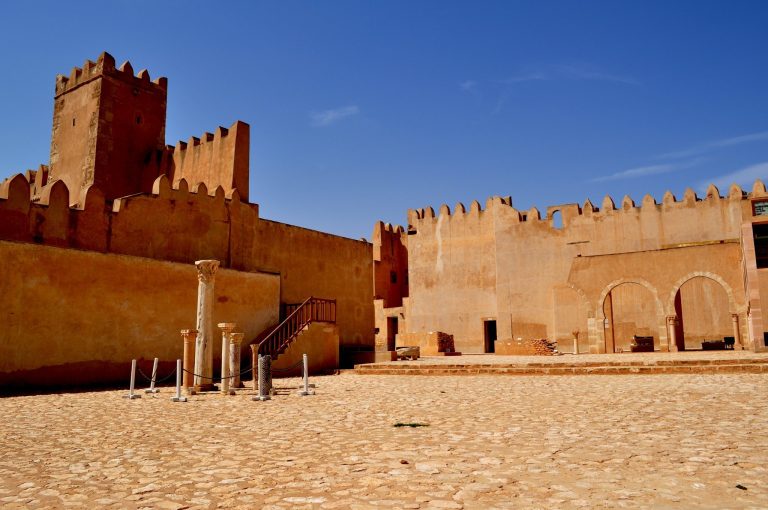
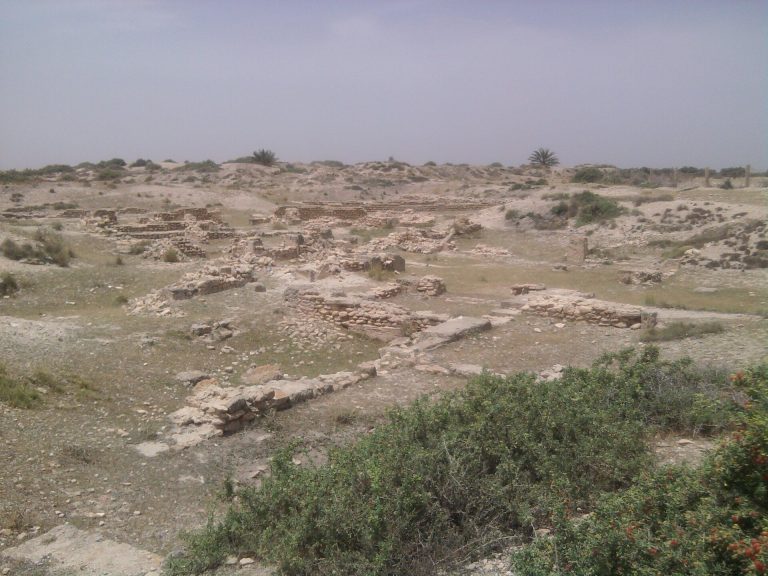
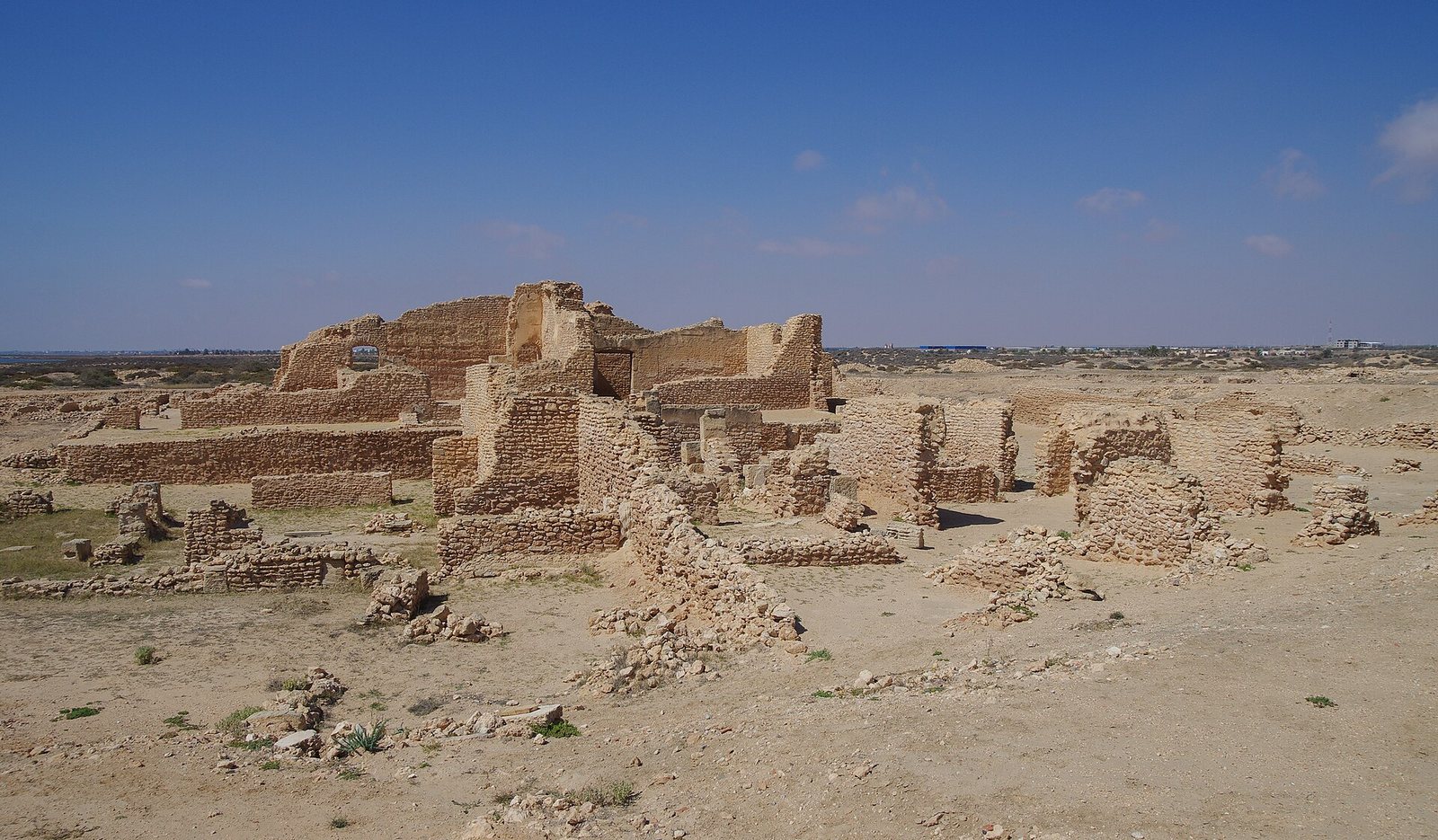
The remains include a fortified urban enclosure, public baths, houses, religious buildings, and places for public entertainment. An aqueduct is also among the surviving features. The town’s structures and burial areas occupy a substantial archaeological landscape.
Fortifications and water supply
Fortified enclosure
The enclosure extended for 2,500 metres and included towers and monumental gates. Its enlargement brought parts of earlier burial grounds and suburban areas within the town’s boundary.
Aqueduct
An aqueduct forms part of the remains, though its construction and layout are not described in detail.
Bath complexes
Great Baths
The Great Baths, also called the Baths of Arion, were partly excavated in 1904. Their name comes from a floor mosaic showing Arion of Methymna, a legendary Greek poet and musician, seated on a dolphin.
Baths of Aesculapius
The Baths of Aesculapius take their name from a headless statue found there. Aesculapius was the Roman god of healing.
Baths of the Pugilists
A mosaic of two fighters in combat gave the Baths of the Pugilists their name.
Baths of the Months
A separate complex is known as the Baths of the Months.
Public buildings and entertainment
Theatre
A theatre stood in the southeastern part of the town.
Amphitheatre
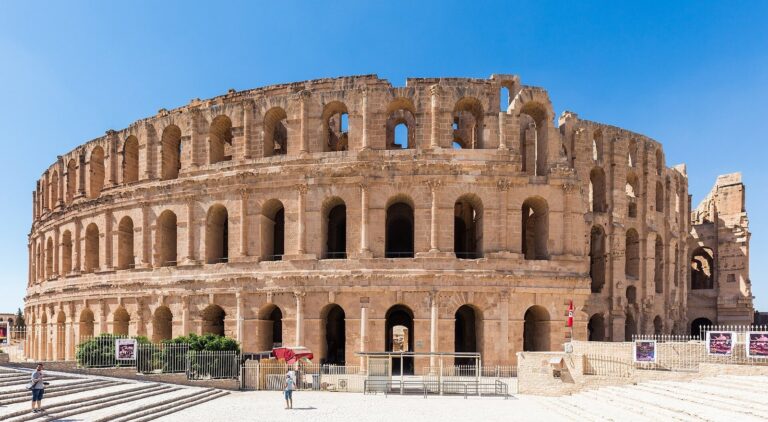
The amphitheatre lay outside the walls, west of the town. Part of it was built against the surrounding ground, while the rest stood free of it. Its arena measured 42 by 29.5 metres.
Circus
A small circus, a Roman racecourse, lay north of the town.
Religious buildings
The site included sanctuaries dedicated to Aesculapius, Minerva, and Venus, as well as a temple to Ceres. Minerva was associated with wisdom and crafts, Venus with love, and Ceres with agriculture. An early Christian basilica, a large church building, also survives among the remains.
Houses and decoration
Houses
Several houses have been partly excavated, including a wealthy residence, housing associated with lower social classes, and the House of Dionysus.
Mosaics and wall paintings
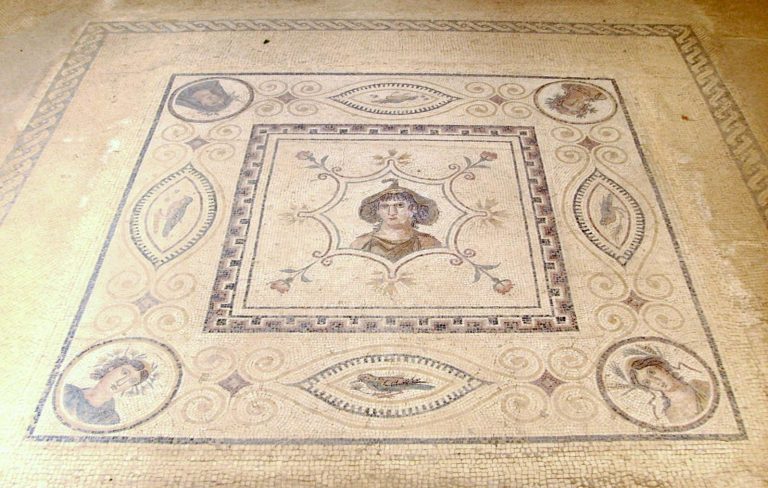
Mosaic pavements were found in houses as well as in the bath complexes. Wall paintings were also recovered. One, now in the Bardo National Museum, depicts the youthful, nude Dionysus, the Greek god associated with wine and theatre, riding a panther among theatrical masks and his followers.
Burial grounds
A large necropolis, or burial ground, contained numerous inscriptions and funerary mosaics associated with both pagan and Christian practice.