Suruktakh-Khaya Rock Art: A Bronze Age Site in Yakutia
Site at a Glance
- Popularity
- Medium
- Country
- Russia
- Primary era
- Bronze Age
- Eras represented
- Bronze Age
- Civilizations
- Unclassified
- Site type
- Civic
- Remains
- Rock Art
On this page6 sections
History
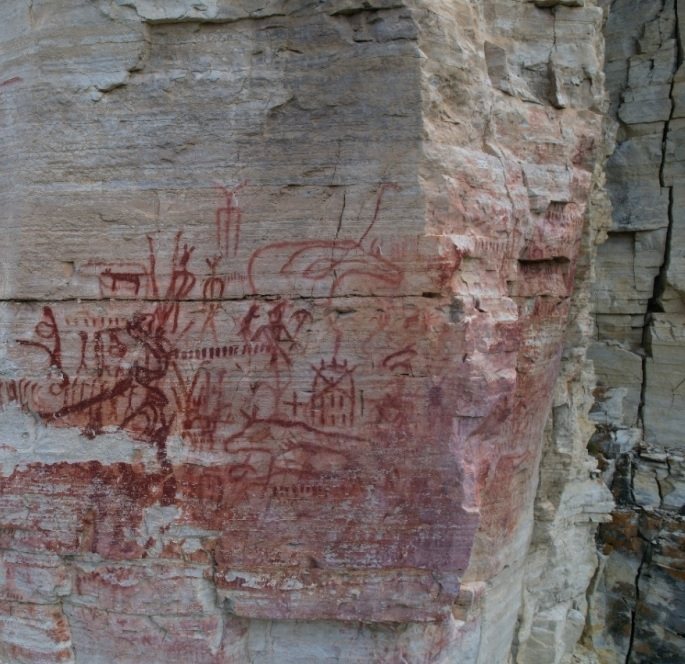
Suruktakh-Khaya Rock Art is an isolated rock-art site on the Markha River’s right bank in Yakutia, Russia, approximately 100 kilometres northwest of Khatyn-Tumul village. Its images, about 3,500 years old, belong to the Bronze Age, an archaeological period distinguished partly by the use of bronze for tools and objects. The site forms part of the Middle Lena rock-art complex. Official records classify its two groups as Suruktakh-Khaya I, a sacrificial site, and Suruktakh-Khaya II, the rock-art site.
Early accounts and investigations
Newspaper notes in the first half of the 1920s briefly mentioned the rock, drawing mainly on information from local hunters and fishers. The first organized investigation followed in 1939, when A. A. Savvin, a researcher of peoples and cultures, studied the site for the Institute of Language and Culture under the Council of People’s Commissars of the Yakut ASSR, an autonomous republic within the Soviet Union. Savvin described a sacred place with many images and sacrificial sites, and gathered local folklore and oral accounts. Local elders told him that the inscriptions had existed since the creation of heaven and earth and the beginning of humanity.
Archaeologist A. P. Okladnikov’s Lena Historical and Archaeological Expedition began work along the Lena River in 1940 and visited Suruktakh-Khaya in 1941 while investigating sites in the river’s middle reaches. Images of the rock were published after the expedition. Deposits from the Stone, Bronze, and Iron Ages, broad archaeological periods distinguished partly by the materials used for tools and objects, led the team to conclude that the site had served worship and sacrifice for about 3,500 years.
Research and heritage recognition
The Republic of Sakha recognized the site as a cultural heritage property in 2008. In 2011, an expedition from the Museum of Archaeology and Ethnography at M. K. Ammosov North-Eastern Federal University made the first detailed photographic record of the rock and its images. In 2022, university researchers proposed its inclusion on the UNESCO World Heritage List and began preparing a scholarly justification. The site is also designated a cultural heritage site of federal significance in Russia.
Remains
The limestone outcrop and images
The site centres on a single outcrop of Cambrian limestone, from an early period in Earth’s geological history. Its layers lie nearly horizontally. About 117 images cover the rock, making it the greatest concentration on one rock among Yakutia’s rock-art sites. They reach heights of about 20 metres above ground.
Objects found at the rock
An armor plate was found on the summit. Near the foot of the outcrop were a stone arrowhead, a burin, a pointed stone tool used for engraving or cutting, and two wooden objects of unidentified type.