S’ Argamassa Roman Fish Farm and Coastal Processing Settlement

Site at a Glance
- Rating
- 4
- Popularity
- Very Low
- Country
- Spain
- Primary era
- Classical
- Eras represented
- Classical
- Civilizations
- Roman
- Site type
- Economic
- Remains
- Production Complex
On this page7 sections
History
S’ Argamassa Roman Fish Farm is a Roman industrial and maritime-rural settlement in Spain, near Santa Eulària des Riu on Ibiza, built around 146 BC after the Roman occupation of the island. Its facilities combined fish farming, coastal processing, and water management during a period when fishing, agriculture, and salt mining brought considerable wealth to Ibiza.
Roman occupation and foundation
The site was established after Rome defeated and destroyed Carthage, an event that reshaped control of the western Mediterranean. Ibiza then held confederate status within the Roman system, meaning that it maintained a distinct civic identity while belonging to Rome as an allied community. The island was known as Ebusus Federatae Civitae, and S’ Argamassa formed part of the productive landscape that developed under Roman rule.
The settlement included a fish farm, a fish-processing installation, and an aqueduct. The aqueduct drained water from flooded galleries in the S’ Argentera silver-lead mines near San Carlos de Peralta, which were intensively worked during the Roman period. Its construction therefore connected mining activity inland with an industrial and coastal complex at S’ Argamassa.
Fishing and fish products
Roman fishing around Ibiza used almadraba, a fixed-net system that guided migrating fish into a confined holding area. A labyrinth of nets and approximately fifty boats channelled large shoals, especially tuna, toward the enclosures. At S’ Argamassa, surplus fish could be kept alive in aquatic tanks instead of being killed immediately, allowing the settlement to manage the supply reaching its processing facilities.
Fish was filleted, dried, and salted into a preserved product. Other parts were used to produce garum, a fermented Roman fish sauce made by preserving fish parts in salt and sun. The remaining sediment, called allec, was left after the liquid sauce had been drawn off. Garum was stored in locally made amphoras, large ceramic vessels used for transporting goods, and exported throughout the Roman Empire.
Later protection and management
The remains of the villa and aqueduct received Spanish Cultural Interest status as a historic monument in 1998 and 1999. The surviving remains are managed by the Consell d’Eivissa, the island government council of Ibiza.
Remains
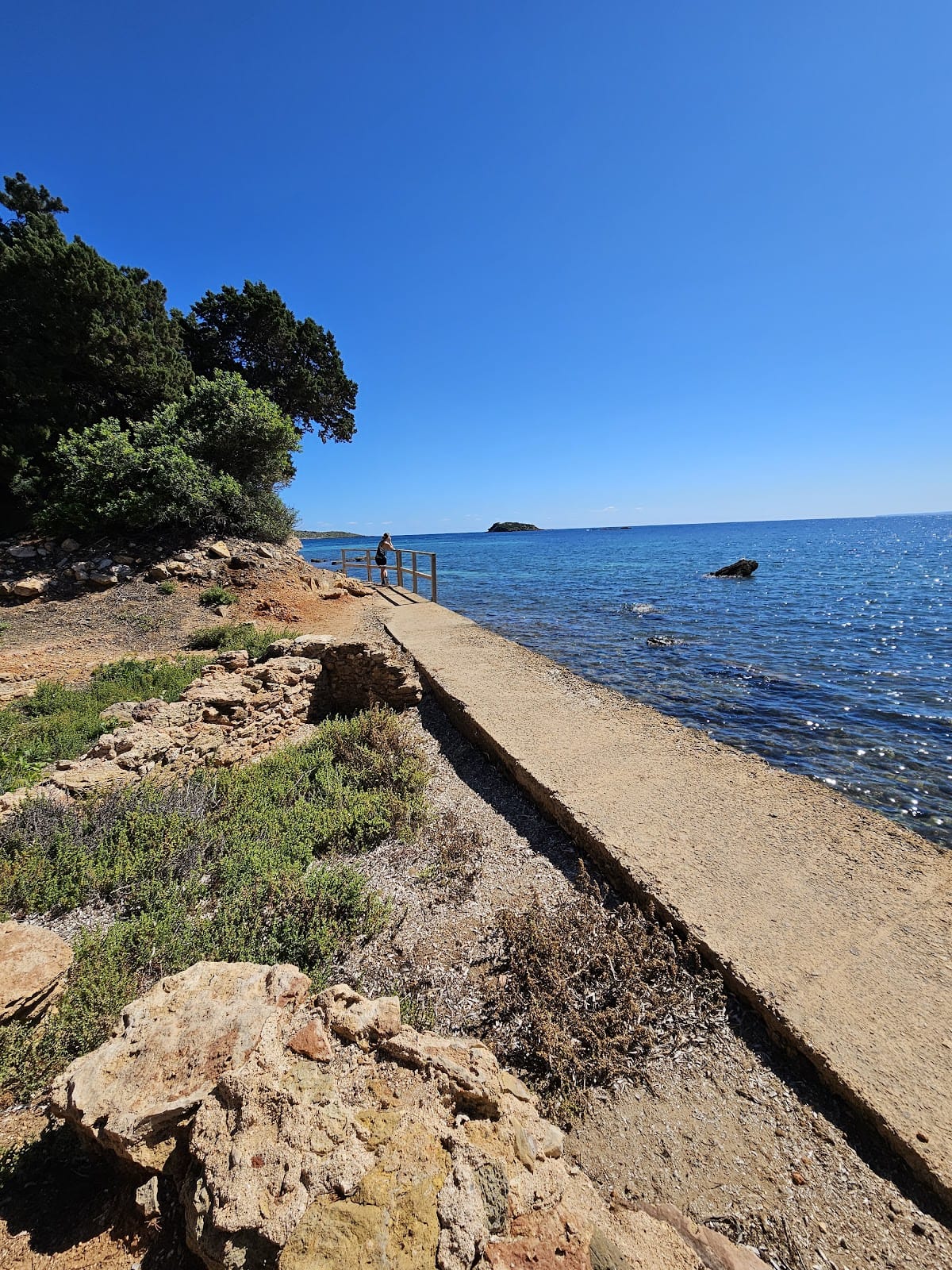
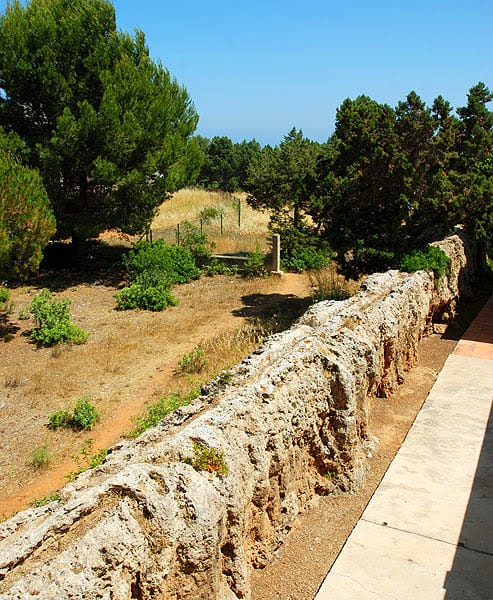
S’ Argamassa consists of a long water conduit and the surviving structures of an industrial installation and coastal settlement between Cala Pada and Cala Martina. The aqueduct runs northwest to southeast toward the sea, while associated processing remains stand near the shoreline. Its construction uses roughly worked stones of different sizes set in Roman concrete, or opus caementicium, made with lime and coarse-grained sand.
The aqueduct
The aqueduct can be traced for approximately 425 metres. At its southern end near the coast, the wall reaches about 2.8 metres in height, then gradually falls to around 0.3 metres at the northwestern end. Sections of the channel remain along the top. The channel is irregular in shape, averaging about 0.2 metres in width and 0.3 metres in depth. Prolonged contact with water has heavily consolidated and calcified the mortar.
Near the coast, the conduit divided into eastern and western branches, with the main channel between them continuing toward the sea. Erosion has removed part of the main conduit. The western branch has been partly excavated and is severely ruined; it probably supplied a cistern whose location has not yet been found. Vegetation and the gardens of a nearby hotel conceal the eastern branch. The aqueduct survives in a ruined and partly neglected condition alongside the modern hotel complex.
An earlier channel, almost square in section but made with the same construction method, preceded the surviving replacement channel. A further section of wall was later built over it, preserving evidence of changes to the water system.
Fish-processing structures
Rectangular structural remains at the aqueduct’s coastal end have been identified as fermentation tanks for producing garum. Their position near the shoreline and their association with the water conduit place them within the wider industrial complex that handled and processed fish at S’ Argamassa.