Pompano Beach Mound: A Tequesta Burial Mound in Florida
Site at a Glance
- Rating
- 4.7
- Popularity
- Very Low
- Country
- United States
- Primary era
- Medieval
- External website
- Open
- Eras represented
- Medieval
- Civilizations
- Unclassified
- Site type
- Burial
- Remains
- Burial Mound
On this page9 sections
History
Pompano Beach Mound is a Tequesta burial mound in Pompano Beach, Florida, United States, built as early as 500 CE. The Tequesta were an Indigenous people of southeastern Florida whose settlements included burial mounds. The mound is the only surviving Indian burial mound in urban Broward County and is associated with the Glades culture, the archaeological tradition of southern Florida, which is divided into three chronological periods.
Tequesta burial practices
The Tequesta placed the dead in a designated location where the bodies decomposed. Afterward, the bones were cleaned and prepared for burial in a mound. Pompano Beach Mound formed part of a wider tradition that produced approximately 20 to 50 Tequesta burial mounds across central and southern Florida.
Nearby artifacts indicate that an associated village may have continued in use as late as 1763. The mound’s long archaeological sequence includes ceramics representing all three periods of the Glades culture.
Early descriptions and preservation
The first published reference to the mound may have appeared in J. M. Hawks’s 1887 book The East Coast of Florida: A Descriptive Narrative, which described a journey made in 1869. James W. Pearce settled in the area and farmed around 1895.
The mound became a park in 1926, making it an early example of historic preservation in Florida. It became a City of Pompano Beach park in the late 1950s. During the city’s fiftieth-anniversary celebrations in 1958, the site was rededicated for historical preservation, two historical markers were installed, and the area was designated a rare bird sanctuary.
Excavation and archaeological study
Amateur and professional archaeologists studied the mound from 1929 onward. John Mann Goggin carried out the first excavation there by a formally trained archaeologist in 1937. His work contributed to the development of a chronology for Florida’s cultures and helped establish his archaeological career.
In 1938, William C. Orchard supervised an excavation financed by the Heye Foundation Museum of the American Indian. Community objections caused the city to withdraw Orchard’s permission to continue. Excavation and looting in 1940 recovered further human burial remains. Between 1946 and 1954, Orin Fogle excavated the mound, removing artifacts and bones from at least seven individuals. He later sold his collection to the Florida Museum of Natural History.
Later surveys and legal recognition
Robert S. Carr surveyed the site in 1974 and recorded a second, smaller mound nearby. Residential construction destroyed that smaller mound before Carr’s 1993 survey. Christopher Eck surveyed Pompano Beach Mound in 2003 and conducted limited excavations near it to assess the effects of plans to replant native coastal-hammock vegetation.
Human remains reported by the National Park Service in 2010 are to be repatriated to the Miccosukee Tribe of Indians of Florida under the Native American Graves Protection and Repatriation Act, a federal law governing the treatment and return of Native American human remains and certain cultural objects. Pompano Beach Mound was added to the National Register of Historic Places on April 17, 2014. The register is the United States’ official inventory of properties recognized for importance in American history, architecture, archaeology, engineering, or culture.
Remains
Mound and setting
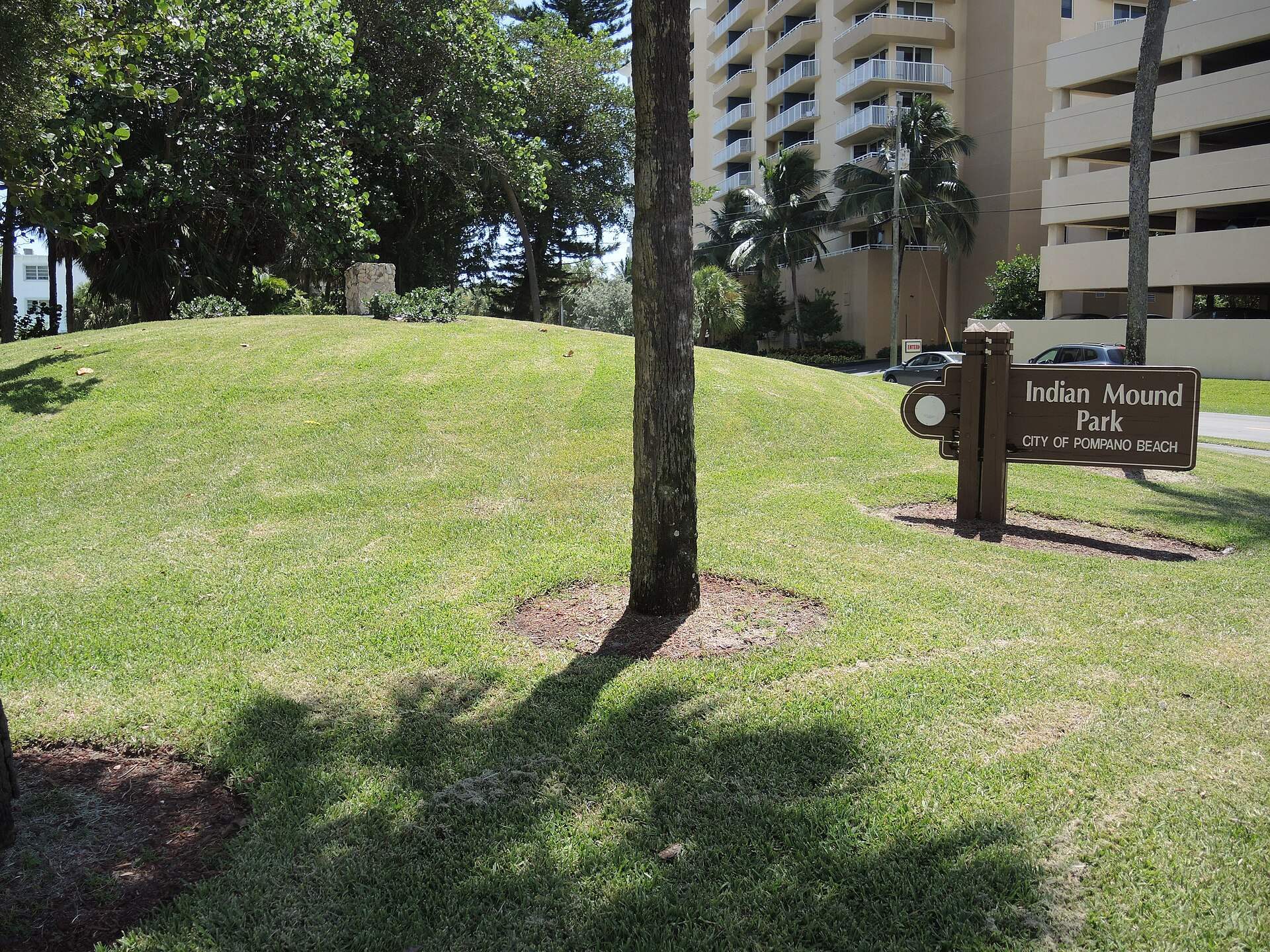
Pompano Beach Mound is an oval earthwork approximately 100 feet (30 m) wide and 7 feet (2.1 m) high, occupying less than one acre. It stands at the southeastern edge of Pompano Beach on the western shore of a long, narrow Atlantic coastal barrier island. Its prehistoric setting was a tropical hardwood hammock opposite Lake Santa Barbara, near the mouth of Cypress Creek. Sand dunes and related vegetation protected the eastern side from the Atlantic Ocean. The mound is now within Indian Mound Park in a densely developed mixed-use residential neighborhood.
Base and archaeological materials
A basal layer about 6 inches (15 cm) thick consists of black dirt, shell, and refuse. This material probably represents an earlier seasonal camp or village beneath the mound. The surviving earthwork therefore incorporates evidence of activity that preceded its use as a burial place.
A wooden figure uncovered during the 1938 excavation dates to about 700 CE. Amateur archaeologists and the local press called it the “Keeper of the Mound.” Other material removed during that excavation included most of a small check-stamped bowl, a shell cup and bead, parts of a shell celt and stone celt, most of an iron knife, pottery sherds, and the burial remains of one individual.
Collections from the excavations
Objects removed by Orin Fogle between 1946 and 1954 include a Busycon pick, a Strombus celt, a bone awl, a fragment of fossilized bone, and pottery sherds. Busycon and Strombus are marine shell genera used in the region to make tools and other objects. Fogle’s collection is held by the Florida Museum of Natural History, while additional artifacts from the site are curated at the Smithsonian Institution. The excavated material includes human burial remains, including bones from at least seven individuals removed by Fogle.