Plain of Jars: A Megalithic Mortuary Landscape in Laos
Site at a Glance
- Rating
- 4.2
- Popularity
- Very Low
- Country
- Laos
- Primary era
- Iron Age
- Eras represented
- Bronze Age, Iron Age
- Civilizations
- Unclassified
- Site type
- Burial
- Remains
- Necropolis
On this page14 sections
History
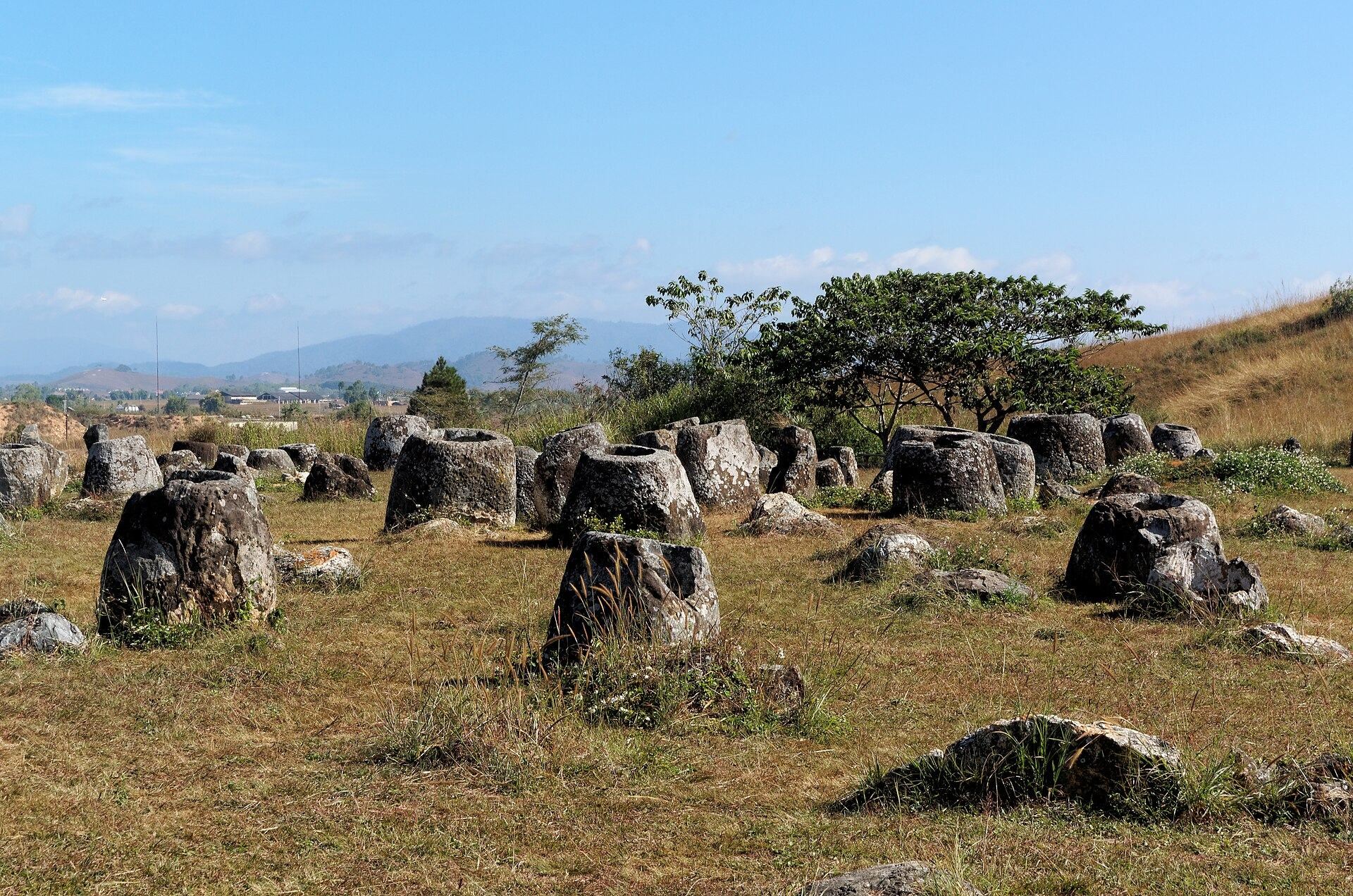
The Plain of Jars is a megalithic archaeological landscape at Site 1 in Laos, formed by stone vessels distributed across the Xiangkhoang Plateau’s valleys, plains, foothills, ridges, and surrounding hills. Some jars were placed as early as 1240–660 BC, while the wider landscape is associated with the Iron Age, conventionally dated here to about 500 BC–AD 500. Separate burial phases at Site 1 continued from the eighth to the thirteenth centuries AD.
Origins and funerary interpretation
Madeleine Colani, a French archaeologist and geologist, began investigating the landscape in the early 1930s. She recorded and excavated twelve sites and published her findings in 1935. Her interpretation connected the jars with funerary practices. Material inside some jars showed evidence of cremation, while burials around them contained unburnt bones that had been placed there after an earlier treatment.
Lao and Japanese excavations later recovered human remains, burial goods, and ceramics around the jars, strengthening the interpretation of the landscape as mortuary. At Site 1, a survey and mapping project led by Eiji Nitta and Thongsa Sayavongkhamdy in November 1994 suggested that the surrounding burial pits were contemporary with the jars. Nitta proposed that the vessels served as symbolic monuments marking those burials and associated the funerary context with the late second or early first millennium BC.
Sayavongkhamdy’s surveys and excavations from 1994 to 1996, supported by the Australian National University, led him and Peter Bellwood to interpret the jars as places for primary or secondary burials of central individuals, surrounded by secondary burials of family members. A secondary burial is a final interment made after an earlier process such as decomposition or cremation.
Later investigations and competing interpretations
Archaeological work connected with unexploded-ordnance clearance in 2004–2005 and 2007 also indicated that the jars and surrounding burials were contemporary. Julie Van Den Bergh proposed that some jars may initially have been used to “distill” bodies before secondary burial, with cremated remains representing a later phase. This interpretation remains tentative. The evidence is difficult to reconcile fully because cremated remains occur inside some jars, while unburnt secondary burials occur around them. The cremated remains appear to belong mainly to adolescents, although the relationship between the different practices is unresolved.
Excavations by the joint Lao–Australian Plain of Jars Archaeological Project from 2016 to 2020 confirmed that Site 1 was used for secondary burials between the eighth and thirteenth centuries AD. Several individuals were placed in shared mortuary contexts. Preliminary excavation at Site 75 in 2023 uncovered uncremated human remains inside a stone jar. Further excavation reported in 2026 recovered the remains of at least 37 adults and children from a large vessel known as Jar 1. The remains dated to AD 890–1160 and indicated repeated use over several generations as part of a secondary-burial practice.
R. Engelhardt and P. Rogers proposed in 2001 that the jars may have functioned as “distilling vessels,” drawing an analogy with royal mortuary practices in parts of Southeast Asia in which bodies were placed in urns before cremation and later burial. This comparison is interpretive rather than proof of the vessels’ original purpose.
Landscape, exchange, and social organization
The distribution of the sites may have been connected with trade, mining, and long-distance overland routes. The Xiangkhoang Plateau lies at a relatively accessible crossing point at the northern end of the Annamese Cordillera, near two major iron-ore deposits. The sites may therefore reflect networks of intercultural communities linking the Mekong basin with the Gulf of Tonkin system.
Differences in jar size, placement, associated grave goods, and the labor needed to quarry, shape, and transport vessels weighing up to 14 tons have been interpreted as evidence for social hierarchy, specialized craft production, organized labor, and differing ritual status. These remain archaeological interpretations rather than directly documented social categories.
Local traditions describe a race of giants ruled by Khun Cheung, who created the jars to brew and store large quantities of rice wine after a military victory. Other traditions say that the vessels were made from clay, sand, sugar, and animal products and fired in a cave at Site 1. These accounts conflict with the archaeological evidence that the jars were carved from stone.
War, clearance, and heritage protection
Between 1964 and 1969, during the Secret War in Laos, United States forces targeting North Vietnamese and Pathet Lao forces heavily bombed the Plain of Jars. More than 262 million cluster munitions were dropped in Laos, and an estimated 80 million failed to detonate. The bombing damaged, displaced, and restricted access to the jars while leaving a continuing danger from unexploded ordnance, meaning munitions that failed to detonate and remain hazardous.
Mines Advisory Group, working with UNESCO and with funding from the New Zealand government, cleared unexploded ordnance from three principal sites in 2004–2005 and four additional sites in 2007. The work enabled seven sites to be opened along cleared routes, but the hazard has continued to limit archaeological investigation. Less than 10 percent of the megaliths have been thoroughly investigated.
In 2019, UNESCO inscribed the landscape on the World Heritage List as the “Megalithic Jar Sites in Xiengkhuang – Plain of Jars” under cultural criterion (iii), which concerns testimony to a living or vanished cultural tradition or civilization. The designated area covers 174.56 hectares, with a 1,012.94-hectare buffer zone. Site 1, also known as Ban Ang, is the most extensively investigated site. Other cleared sites include Sites 2, 3, 16, 23, 25, and 52.
Remains
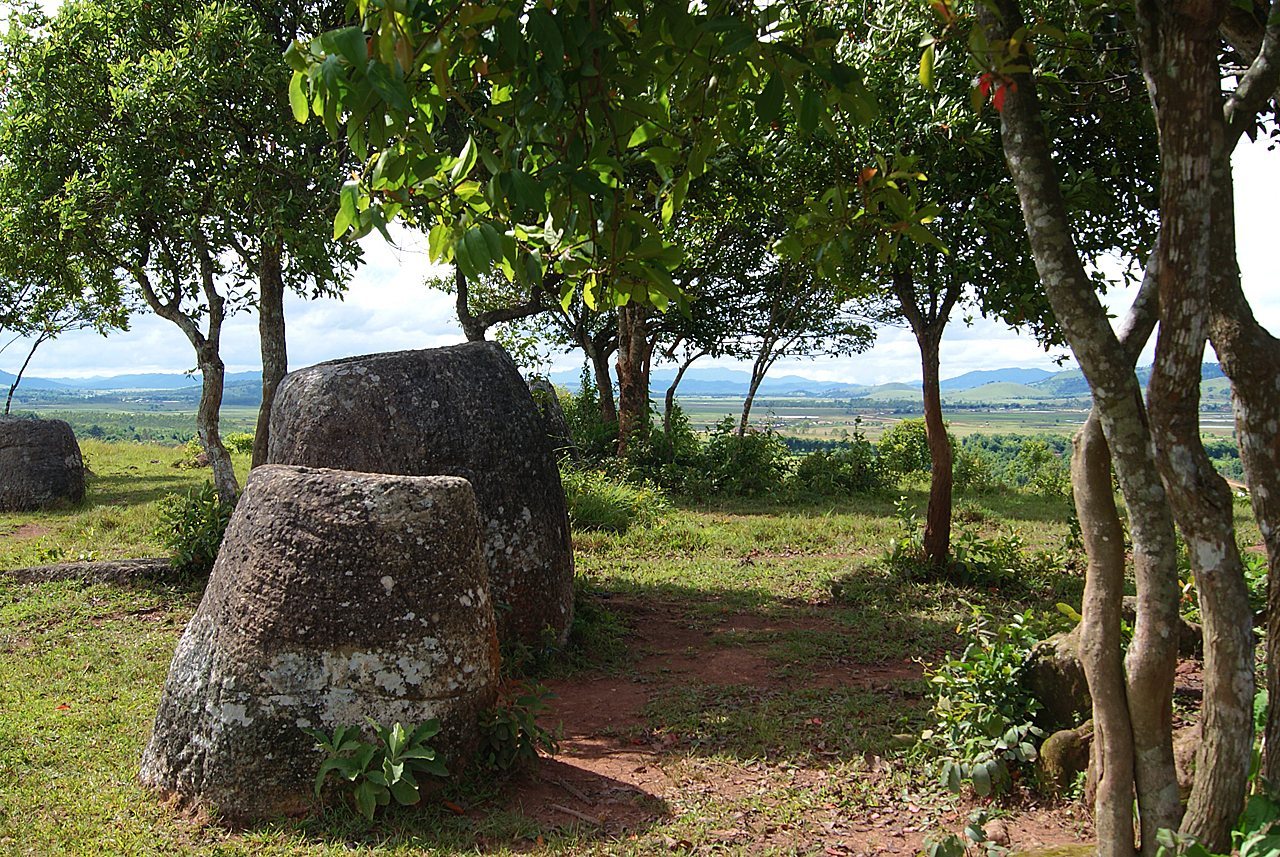
The landscape contains 129 confirmed jar sites in Xiangkhouang Province and surrounding areas, with more than 2,100 documented jars. Individual sites contain between one and 400 vessels. The groups occupy elevated foothills, ridges, spurs, and valley margins with broad views over the lowlands. Despite regional differences in form, material, and quantity, their shared setting is associated with elevated burial landscapes.
Stone jars and quarrying
Forms and materials
The jars are generally cylindrical, with bases wider than their openings, and measure approximately 1 to 3 metres in height and diameter. They were hewn from rock, and the largest examples are reported to weigh up to 14 tons. Most are made of sandstone, while granite, conglomerate, limestone, and breccia are also documented. Breccia is a rock composed of angular fragments cemented together. Differences in material and form often reflect the choice and manipulation of local rock sources.
Six principal rim styles have been identified: flat, recessed inner, outer, recessed inner with outer, prominent, and collar rims. Some sites contain unusual aperture arrangements, including jars with small openings or two openings. The vessels are generally undecorated. A documented exception at Site 1 is a jar bearing a carved human figure in bas-relief, known as a “frogman” because of its posture. The figure has been compared with full-frontal figures with raised arms and bent knees in rock paintings at Huashan in Guangxi, China, dated to approximately 500 BC–AD 200.
Quarries and regional stone types
Quarries have been recorded near several jar sites. Those near Sites 2 and 3 contain partially shaped jars still embedded in bedrock, demonstrating extraction and initial shaping at the quarry. Detrital-zircon analysis indicates that the stone used for jars at Site 1 was transported from a presumed quarry approximately 8 kilometres away. Another quarry nearly 100 kilometres distant may have supplied stone for other vessels.
Iron chisels have been proposed as tools for shaping the jars, but no conclusive evidence confirms their use. Experiments have shown that stone tools could also have produced the required forms. Granite jars in Khun District are often strongly weathered and many are small, possibly because granite required greater effort to extract. Conglomerate jars, formed from gravel- and cobble-sized pieces in a fine matrix, are often fragmented and poorly preserved.
Limestone jars include weak, honeycombed varieties that weather severely and stronger, fine-bedded reef limestone that weathers less but remains poorly preserved. Limestone examples are recorded at Site 39, Ban Tha, Site 41, and Site 43. Breccia jars are known from Ban Nom Hom, a site on a major fault associated with a steep-sided valley and local hot springs.
Burial markers and mortuary features
Discs, lids, and standing stones
Stone discs occur less frequently than jars. They have at least one flat side and were found near jars, sometimes placed beside or over burial pits. They are interpreted as possible burial markers rather than lids because none was found on a jar or fitted a jar opening.
Stone lids have been reported at a few sites, including Ban Phakeo and Site 52. Some bear low-relief images interpreted as monkeys, tigers, or frogs. Many jars have rim forms suggesting that they may once have been covered, while the scarcity of surviving stone lids may indicate that some covers were made from perishable materials.
Other markers consist of deliberately placed, largely unworked stones. A large network of such stones, burial pits, and chambers north of Xiangkhouang is known as the Standing Stones of Huaphanh and has been dated to the Bronze Age.
Site 1 cave
Site 1 contains a natural limestone cave with a northwest-facing opening and two human-made holes in its roof. The holes have been interpreted as chimneys for a crematorium. Material excavated by Colani in the early 1930s was considered compatible with that interpretation.
Burials and recovered objects
Excavations at Site 1 recovered coloured glass beads, spindle whorls, ear discs, ceramic vessels and weights, iron and bronze tools and ornaments, knives, jewellery, stone beads, charcoal, pottery fragments, burnt teeth and bone fragments, and human remains. Some remains were found inside jars, while other burials lay in pits around them.
At Site 75, Jar 1 is approximately 1.3 metres high and more than 2 metres wide. It contained undisturbed human remains, glass beads, and other associated materials. The contents provide evidence for repeated secondary-burial use within the vessel, with the remains dated to AD 890–1160.
Bomb damage and present condition
Bombing left craters and damaged, overturned, or displaced jars. Unexploded ordnance continues to limit access and research, so movement through the landscape remains restricted to cleared and marked routes. Site 52 is the largest known jar site, with 392 jars, and is accessible only on foot.