Pipestone National Monument: A Sacred Quarry in Minnesota
Site at a Glance
- Popularity
- High
- Country
- United States
- Primary era
- Unclassified
- Eras represented
- Unclassified
- Civilizations
- Unclassified
- Site type
- Economic
- Remains
- Quarry
On this page9 sections
History
Pipestone National Monument, just north of the city of Pipestone in southwestern Minnesota, United States, protects quarries where Indigenous peoples have obtained stone for ceremonial pipes for more than 3,000 years. Many nations, including the Dakota and Lakota, have regarded pipestone as sacred. The quarries also served as neutral ground where different peoples could gather stone for pipes central to Plains religious practices.
Indigenous use and regional control
Iowa people lived near the quarries between the fifteenth and eighteenth centuries, and the Omaha are also among the peoples associated with the area. From the early eighteenth century, the Yankton, a Dakota people, controlled the quarries and traded pipestone across the Great Plains. By the late eighteenth century, Sioux, a broad historical name for Dakota, Lakota, and Nakota peoples, were dominant in the region. The Yankton used pipestone and other goods in efforts to subordinate peoples farther west and restrict their access to territory and resources.
Nineteenth-century encounters and trade
White observers knew about pipes made from pipestone by the seventeenth century, though they paid little attention to the stone’s source. A fuller account of the quarries appeared around 1831 or 1832. Around 1835, Joseph LaFramboise, a trader with the American Fur Company, probably obtained stone there. George Catlin visited in 1836, painted Indigenous quarry workers, and described the spiritual importance of the stone and pipes.
In 1838, an expedition led by geographer Joseph Nicollet and explorer John Charles Fremont visited the quarries. Nicollet later published the first map to show them. Around this time, pipe bowls were made in forms including animals, human figures, disks, and the familiar T-shape. Pipestone carving served ceremonial purposes and also became a source of income; the pipes attracted white buyers. The Dakota and Lakota name for the red stone is ínyanša.
In 1849, the Minnesota Territorial Legislature resolved to send a block of pipestone collected by territorial governor Henry H. Sibley to Washington, D.C., as a memorial stone for the Washington Monument. Henry Wadsworth Longfellow’s 1855 poem The Song of Hiawatha, drawing substantially on Catlin’s writing, opens at the quarries. It portrays Gitche Manito, a Great Spirit figure in Ojibwe tradition, smoking a ceremonial pipe and calling Indigenous peoples to peace and cooperation. The poem helped establish the quarry landscape as a familiar setting in white popular imagination.
Treaty rights and land disputes
In 1851, Sisseton and Wahpeton Dakota signed the Treaty of Traverse des Sioux, ceding southwestern Minnesota, including the quarry area, to the United States. The Yankton, who also claimed land there, did not take part in the treaty. Article 8 of the 1858 Yankton Treaty secured their unrestricted access to the quarries and a one-mile-square reservation of more than 600 acres. Yankton chiefs had traveled to Washington in connection with these rights. The Yankton later moved about 250 kilometres west to a reservation near Fort Randall, in present-day South Dakota.
The reservation was surveyed in 1859, but the government did not stop settlers from encroaching. In 1862, the firm Hubbell and Hawley obtained large amounts of pipestone and traded it to Indigenous peoples farther west for bison hides. Settlers began arriving under the Homestead Act, a federal law that allowed people to claim land under specified conditions, from 1871; one claimed land within the reservation. The nearby town of Pipestone was founded in 1876 and became a regional trading centre as disputes over Yankton land intensified. In 1880, commercial quarrying of quartzite for building material began on reserved land. A homesteader who had built there initially won a court case.
The United States took 100 acres of the reservation in 1891 for the Pipestone Indian School and began proceedings to take possession of the reservation in 1899. The Yankton challenged the seizure. In 1926, the U.S. Supreme Court ruled in their favour and ordered compensation, after which the land came under full federal control. The Yankton sold the quarries to the federal government in 1928. The school closed in 1953, and its remaining acreage passed to the Minnesota Department of Natural Resources for the Pipestone Wildlife Management Area. In 1956, the original reservation boundaries were changed, reducing the reserved area to 108 acres.
Monument status and continuing use
Congress established Pipestone National Monument on August 25, 1937. The law reaffirmed Indigenous quarrying rights, and an enrolled member of a federally recognized American Indian tribe may apply for a free permit to quarry stone. The National Park Service consults representatives of 23 affiliated tribal nations on management, historic preservation, exhibit design, and related matters. The historic area is listed on the National Register of Historic Places as Cannomok’e, meaning “pipestone quarry” in Dakota. The quarries are also a Minnesota State Historic Site.
Monument management has restored about 260 acres to native tallgrass prairie and periodically burns sections to encourage native grasses and control weeds. Indigenous craftworkers continue to demonstrate pipemaking with quarry stone, carrying on techniques passed through generations; some demonstrators come from third- or fourth-generation pipemaking families.
Remains
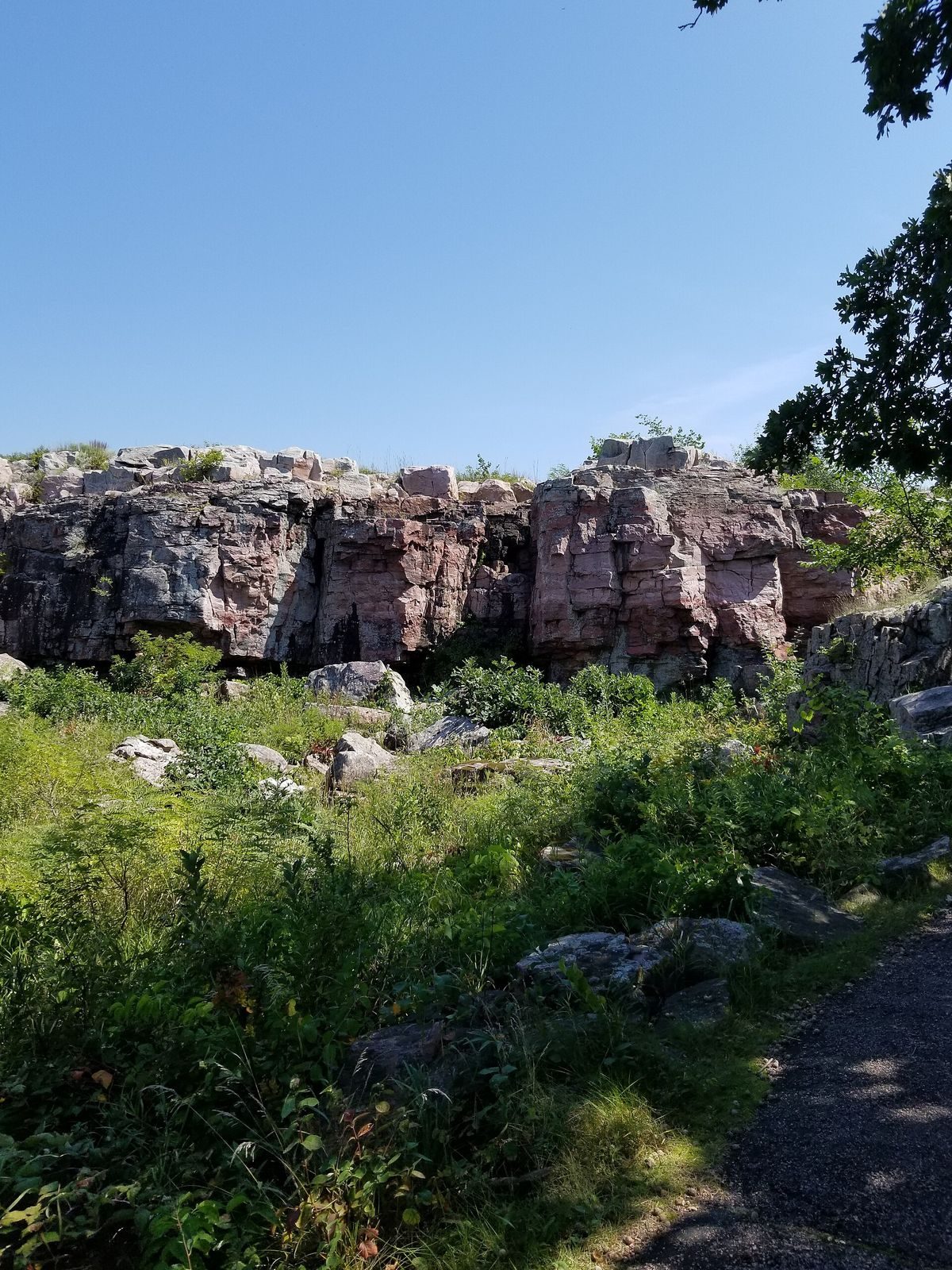
The 281.78-acre monument is a quarry landscape set within tallgrass prairie, with a small river flowing through the protected area. Its pits, exposed stone, cliffs, and waterfall form the principal physical features described across the site.
Quarries and stone
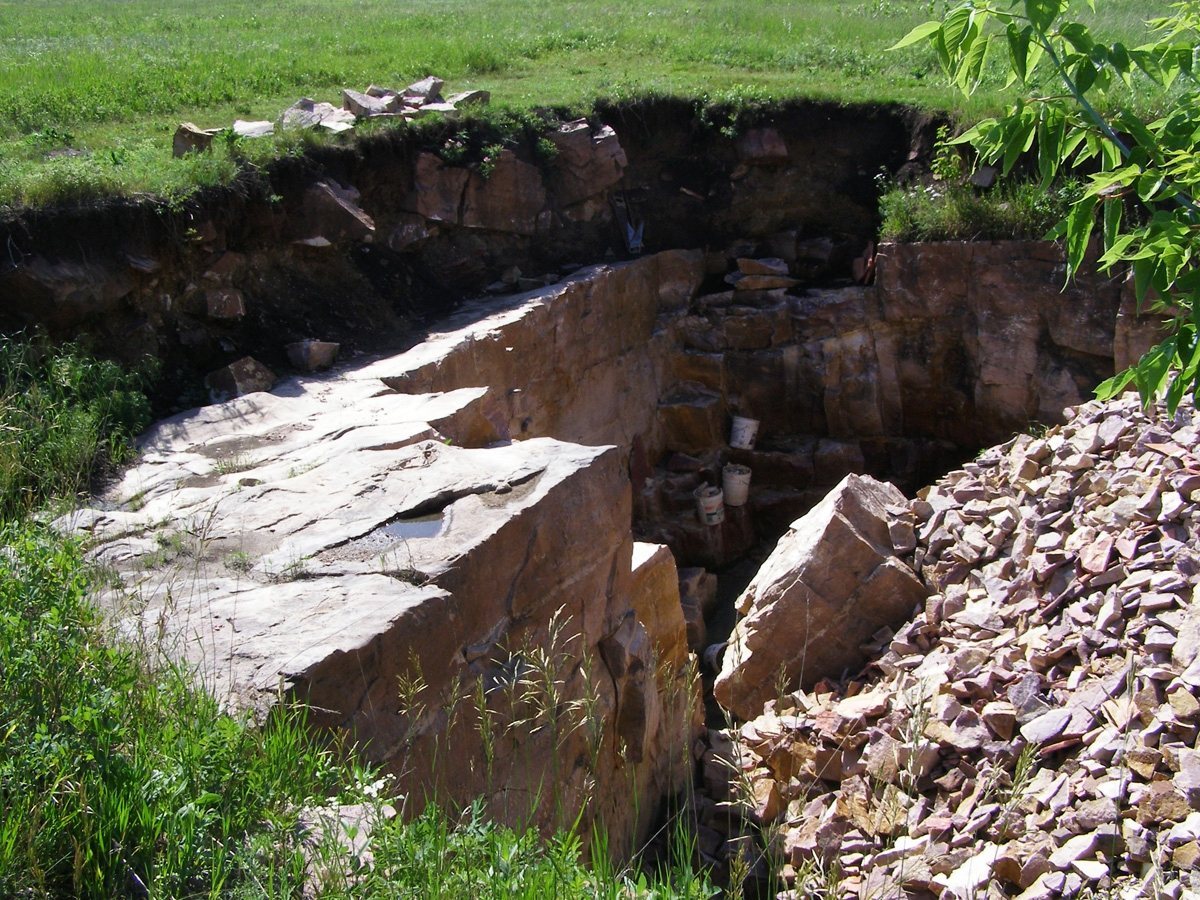
The quarry area contains 54 pits, each four to six metres deep. Quarrying is done by hand: workers break away hard quartzite to reach catlinite, the soft red claystone commonly called pipestone. Catlinite occurs in thin beds beneath and between much thicker quartzite layers. Five thin catlinite beds are known within a narrow belt about one kilometre long, and this stone occurs only within the present protected area. Traces of hematite give it its red colour, and its softness allowed it to be carved with bone tools. The quartzite formed when sand was transformed under pressure into very hard rock between about 1.63 and 1.75 billion years ago.
Prairie, river, and waterfall
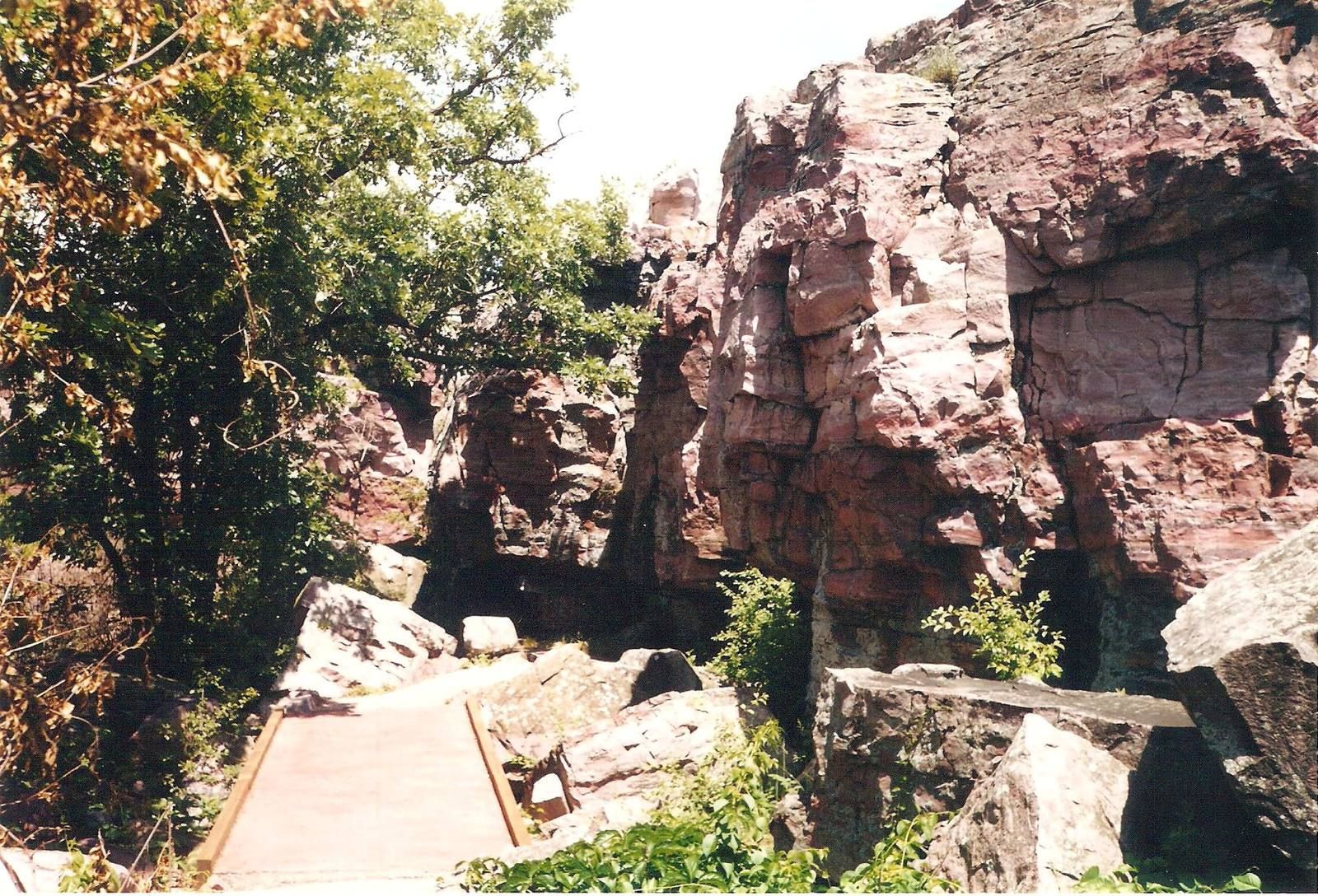
The pits lie in one of North America’s few remaining tallgrass prairie areas that has never been cultivated. Bobolinks and eastern kingbirds are among the wildlife found there. A three-quarter-mile (1.2-kilometre) trail passes the quarries and Winnewissa Falls, with red quartzite cliffs along its course. Six signatures left on a quartzite cliff by members of the 1838 Nicollet and Fremont expedition remain visible.
Carvings and pipestone objects
Images carved or pecked into rock, known as petroglyphs, have been found around the quarry; examples appear in the visitor-centre displays. The Smithsonian’s National Museum of the American Indian holds 705 catlinite objects attributed to the Pipestone quarry, including 585 pipes. Catlinite objects have also been found in North American burial mounds, and artifacts made from the stone are known from a broad region that includes present-day Ohio, South Dakota, and the Kansas River area.