Padah-Lin Caves: Prehistoric Archaeological Sites in Myanmar
Site at a Glance
- Popularity
- Medium
- Country
- Myanmar
- Primary era
- Stone Age
- Eras represented
- Stone Age
- Civilizations
- Unclassified
- Site type
- Civic
- Remains
- Rock Art
On this page10 sections
History
Padah-Lin Caves are prehistoric limestone caves in Shan State, Myanmar, associated with long-term human occupation and rock art. The name also appears as Padalin or Badalin. Historian Than Tun proposed that Padah-Lin developed from a local name describing a cave with a raised profile like a frog’s head. Another explanation links the name to the shine of cave formations, attributed to phosphorus.
Prehistoric occupation and rock art
Carbon dating of seven charcoal and bone pieces from the rock shelter gives ages between 13,000 and 1,750 years before present (BP, a convention used in archaeological dating). A four-foot-thick ash deposit and repeated hearth use point to prolonged occupation. Unfinished stone tools, animal bones, shells, and charcoal suggest that people used the shelter both as a living area and as a place to make tools. Its occupants are interpreted as hunter-gatherers.
The cave paintings and engravings have no direct dates but are attributed to the Neolithic, an archaeological period generally associated with later prehistoric communities. The animal imagery has been interpreted as connected with hunting. One proposed explanation is that people performed rites or acted out hunting techniques in the hope of securing game.
Investigation and conservation
The American South-East Expedition for Early Man made a preliminary survey in 1937–1938. Geologist U Khin Maung Kyaw identified the rock paintings in 1960. From 1969 to 1972, archaeology official U Aung Thaw led a broader investigation and excavation with specialists from Yangon Arts and Science University.
In August 1994, rock-art conservation specialist Lu Jun cleaned the sun-disk painting. Myanmar added the caves to UNESCO’s World Heritage Tentative List in the Cultural category on 4 October 1996. A tentative-list entry is a proposal for possible future nomination, not a World Heritage inscription. Researchers from Yangon University and the Australian National University recorded previously unnoticed rock art during a 2004 expedition. The Ministry of Culture’s Department of Archaeology carried out further excavation around 2008.
In 2016, archaeologist Ben Marwick led an excavation in the larger cave. It revealed deposits dating as far back as 65,000 BP and flaked stone tools dated to 25,000 BP.
Remains
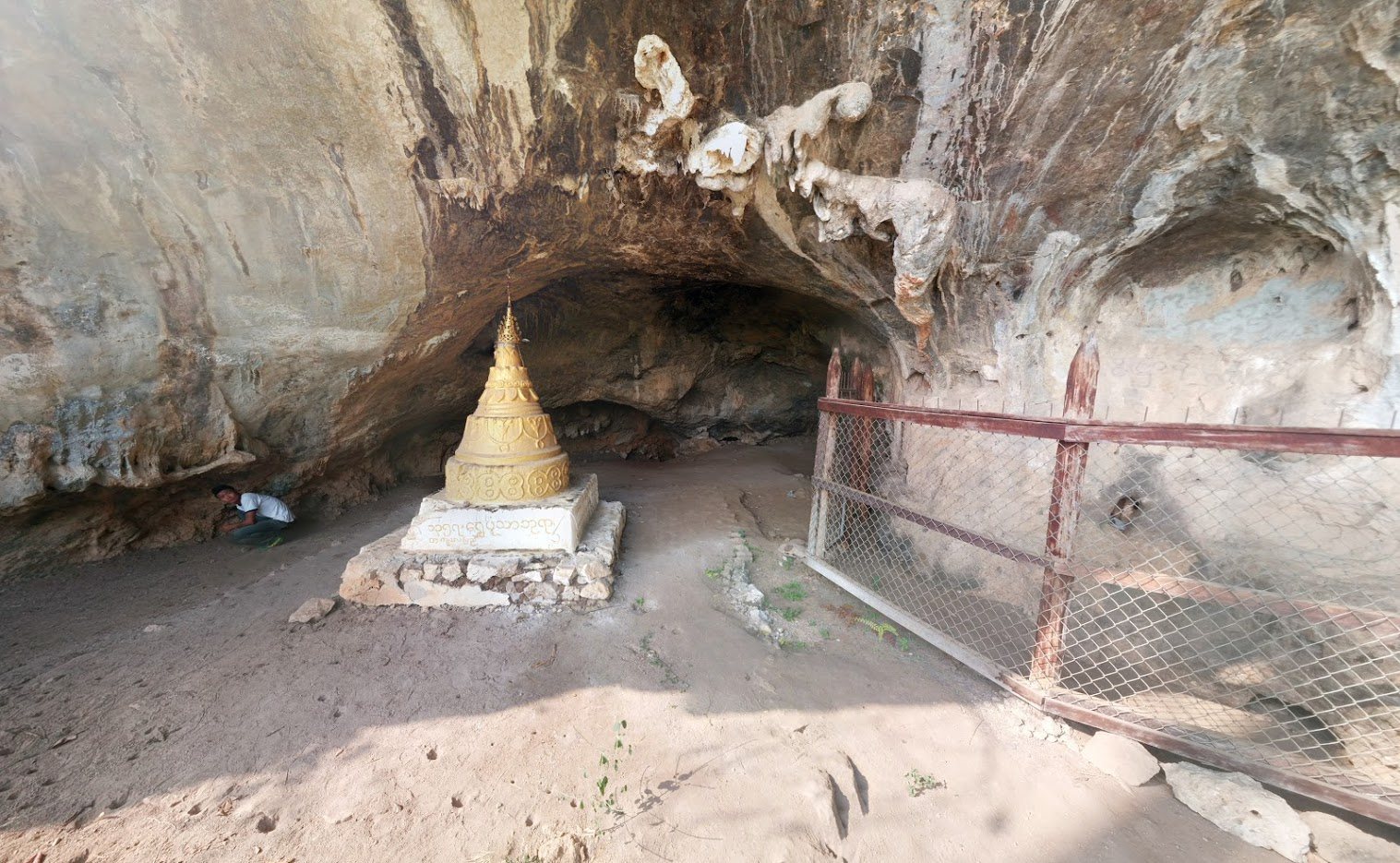
The site consists of a smaller rock shelter and a larger cave, both in limestone and both facing south. They lie on a spur of the Nwalabo Mountains in Panlaung Reserved Forest, on the western slope of the Shan Plateau, about 1,000 feet above sea level and roughly 70 feet above a footpath.
The larger cave
Arranged along a north–south axis, the larger cave extends about 800 feet and has nine chambers joined by narrow passages. It reaches approximately 300 feet at its widest point and 90 feet at its highest. Three large natural openings in the roof admit daylight. The cave contains limestone pillars, stalactites (mineral forms hanging from cave ceilings), stalagmites (mineral forms rising from cave floors), crystal formations, and ongoing mineral growth. Its formation through underwater currents roughly two million years ago has been proposed.
The rock shelter
The smaller cave measures about 80 feet long, 20 feet wide, and 14 feet high. Its rock art is on a wall that projects eastward, around 10 to 12 feet above the floor.
Paintings
Roughly a dozen paintings have been described, with subjects recognizable in about nine. Made with red ochre, a naturally occurring iron-rich pigment, they depict human hands, fish, cattle, bison, deer, elephants, and other animals. The images include two handprints and five centipede-like figures, each about 3 feet 1 inch long and 1 foot wide. A sun disk and several cattle scenes are also present, including a particularly clear mother-and-calf image measuring about 8 by 4 inches.
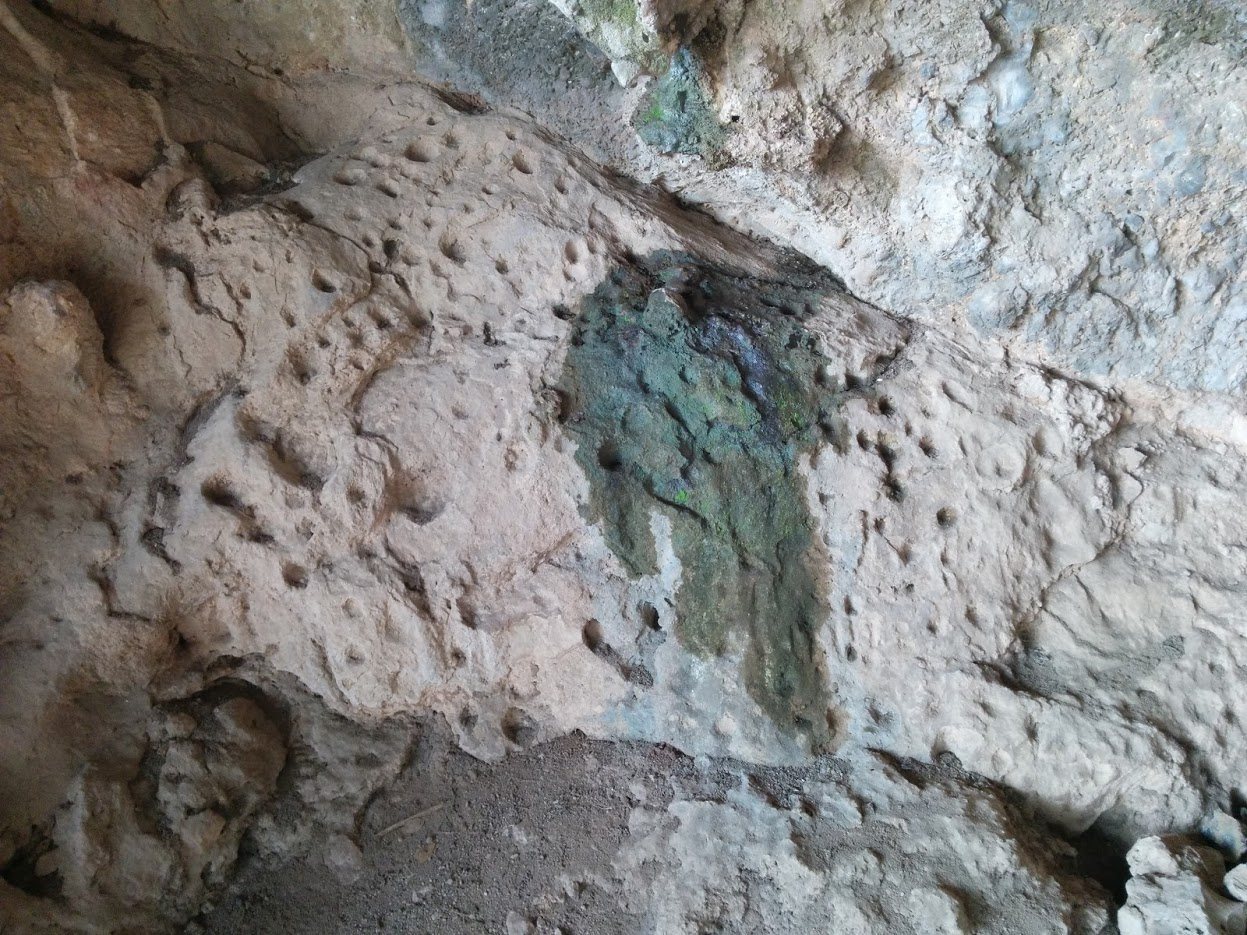
A second mother-and-calf scene is mostly obscured by a limestone deposit, while a wild-pig image is indistinct. Other paintings include an 8-by-12-inch bison, a faded animal figure about 10 inches long, and an unclear figure about 3 inches long that may represent a serow or calf. Some images survive as pigment spots. The lively figures are largely outlined, and their style has been compared with Paleolithic cave art in western Europe. Moisture and mineral deposits have damaged or obscured parts of the paintings; the sun disk’s two ridges are now indistinct.
Engravings
Engraved patterns also cover parts of the shelter walls. More than 300 cupules, small cup-shaped hollows in rock, are present. Some hollows have been linked by researchers to fertility beliefs, and traces of pigment occur in some places.
Excavated finds
Excavations in the shelter recovered more than 1,600 stone artifacts, along with bone pieces, animal remains, mollusc shells, charcoal, ash, and lumps of red ochre. The stone objects include choppers flaked on one face, chopping tools shaped on both faces, perforated stone rings, adzes (tools with a cutting edge set across the handle), and scrapers.
Buddhist monuments
A small Buddhist stupa, a monument often associated with relics and worship, stands at the eastern end of the rock shelter. Several other stupas of different sizes occupy chambers in the larger cave.