Man Mound: A Late Woodland Anthropomorphic Effigy Mound
Site at a Glance
- Rating
- 4.6
- Popularity
- Low
- Country
- United States
- Primary era
- Medieval
- External website
- Open
- Eras represented
- Medieval
- Civilizations
- Unclassified
- Site type
- Religious
On this page5 sections
History
Man Mound is a Late Woodland anthropomorphic effigy mound, an earthwork shaped as a human figure, near Baraboo, Wisconsin, in the United States. Late Woodland peoples constructed it between AD 750 and 1200 as part of Wisconsin’s effigy-mound tradition. These communities built animal- and human-shaped mounds that could have served burial or religious purposes, although Man Mound’s precise function remains uncertain because it has not been excavated.
Late Woodland construction
The regional tradition of effigy-mound construction began around AD 750 and declined between AD 1000 and 1200. The figure represented at Man Mound may have been a ceremonial leader, while its horns may have formed part of a horned headdress. The mound may therefore have held religious or ceremonial meaning, but its original interpretation cannot be established with certainty.
Identification and preservation
William Canfield became the first European settler to identify and survey Man Mound in 1859. His findings attracted interest during contemporary surveys of Wisconsin’s mounds, but the site received little further attention from Western academic researchers during the late nineteenth century. After two archaeologists rediscovered it, the Wisconsin Archaeological Society and the Sauk County Historical Society purchased the site in 1907. The organizations designated it a county park in 1908 to support its preservation.
Man Mound was added to the National Register of Historic Places, the United States’ official list of historically important places, in 1978. In 2016, it became a National Historic Landmark, a designation for properties judged to possess exceptional importance in the nation’s history. It is one of five known human-shaped effigy mounds in North America, all in Wisconsin, and the only one of the five that still stands. The other identified examples were La Valle Man Mound in Sauk County, and Eagle Township Man Mound and Twin Man Mounds in neighboring Richland County. Several other possible humanoid mounds in southern Wisconsin remain unconfirmed.
Remains
The surviving earthwork
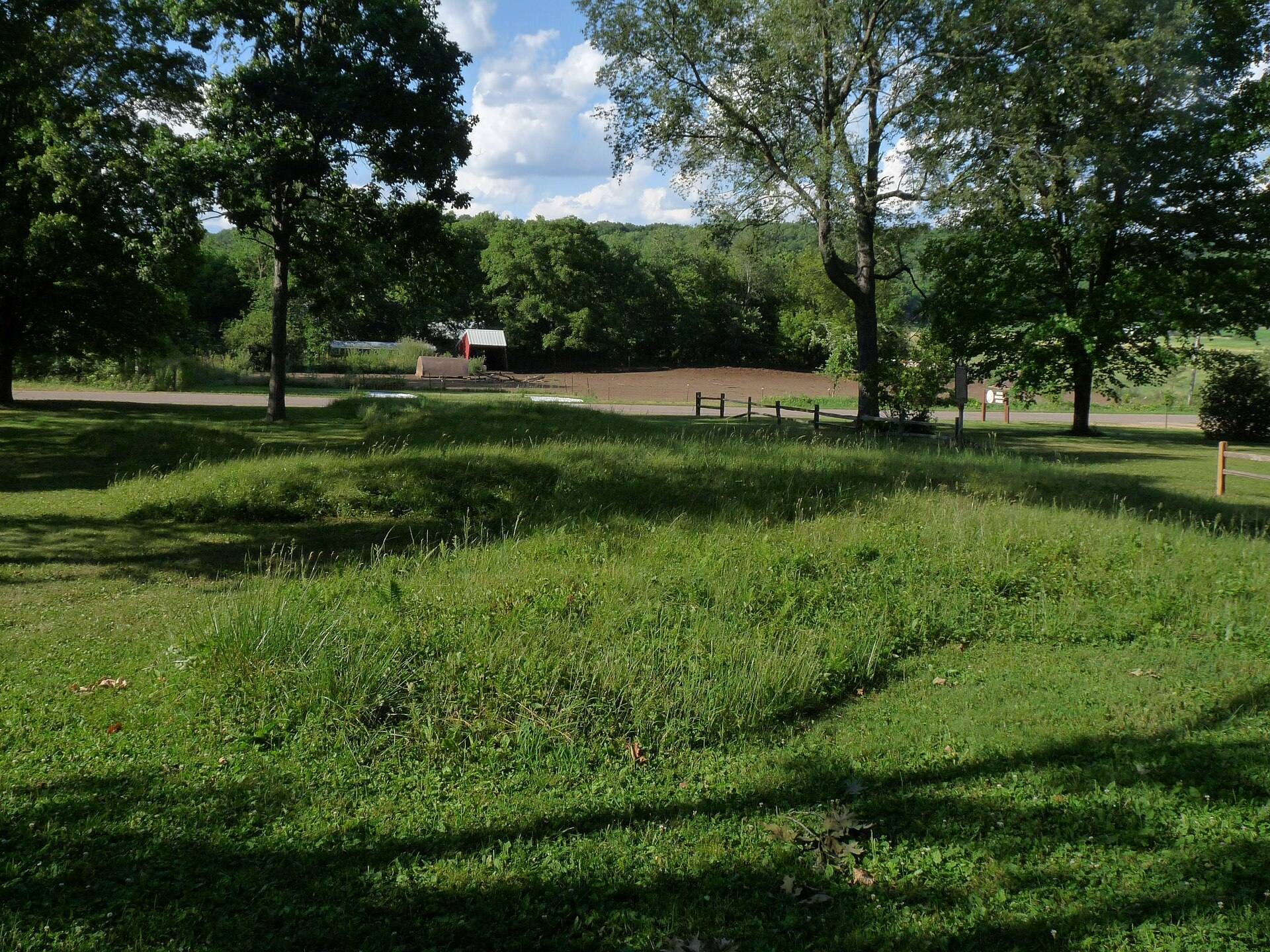
Man Mound is a large earthen figure with its head oriented southward. When constructed, it measured 214 feet (65 meters) long and rose about 2.5 feet (0.76 meters) above the surrounding ground. Its original feet pointed westward, and the head included two horns that may represent a headdress.
Construction of Man Mound Road and later use of a cow pasture destroyed the figure’s legs and feet, shortening the surviving prehistoric earthwork by about 50 feet (15 meters). The missing legs have been repainted across the road, while plastic cutouts representing the feet have been placed in the pasture. These additions help indicate the figure’s former outline but are not part of the surviving prehistoric mound. The relatively intact earthwork retains potential to clarify the religious and cultural meaning of Late Woodland effigy mounds.