La Galgada: A Preceramic Ceremonial Center in Peru
Site at a Glance
- Popularity
- Medium
- Country
- Peru
- Primary era
- Bronze Age
- External website
- Open
- Eras represented
- Bronze Age
- Civilizations
- Unclassified
- Site type
- Religious
- Remains
- Sanctuary
On this page11 sections
History
Preceramic ceremonial center
La Galgada is a preceramic ceremonial and administrative center in the Tauca area of Peru, built by Andean communities beginning around 2700 BCE. Its main phase belonged to the Preceramic period, before ceramic technology developed in the Andes, and lasted until about 2000 BCE. Agricultural communities had occupied the surrounding area by about 3000 BCE, building small chambers apart from their homes, apparently for ceremonial purposes.
During the Preceramic period, at least eleven settlements grew along both sides of the Tablachaca Canyon over a stretch of at least eight kilometres near the modern village of La Galgada. Archaeologist Terence Grieder described La Galgada as an important place for ceremonies and burials within this densely settled district, which he characterized as almost metropolitan in scale. Across the Tablachaca River, Pajillas is assigned an earlier date than La Galgada.
La Galgada served as a center for administration and community ceremonies. Its position on a route between the coast and the interior may have encouraged exchange with highland communities and possibly people from the rainforest, as well as the arrival of broader Andean cultural influences. The site is generally associated with the Sierra, meaning the Andean highlands, though its river connections and environment have also prompted associations with the coastal sphere. Its ceremonial enclosures belong to the Mito tradition, also called the Tradition of the Altars of Sacred Fire and included within the Kotosh Religious Tradition. This Andean ceremonial tradition is associated with chambers containing hearths and underground air channels. Related examples include Kotosh-Mito, Piruro, and Huaricoto.
As the complex developed, ceremonial chambers were reused for burials, and a later ceremonial structure was built over burial chambers. In the final architectural phase, three platforms in a U-shaped arrangement replaced the earlier buildings. This form suited large outdoor ceremonies and was especially developed on the coast. The main phase ended around 2000 BCE, although occupation may have continued into the Early Formative, the Andean period that followed the Preceramic, around 1800 BCE. The change in ceremonial architecture and subsequent abandonment point to wider changes in the Andean world at the beginning of the Formative period.
Protection and excavation
The archaeological name La Galgada came from a coal-mining settlement about two kilometres to the north; local people called the site San Pedro. Looting for valuable objects threatened the remains by the 1960s. Local governor Teodoro E. López Trelles recognized their archaeological value and introduced protective measures. In 1969, he showed the site to Terence Grieder of the University of Texas, prompting Grieder to consider investigating it after completing work at Patash.
Grieder and Alberto Bueno Mendoza returned in 1976 and began seeking support for excavation after identifying the site’s preceramic age. Excavations ran from 1978 through 1985. Work began at the South Mound in 1978, followed by investigations of the North Mound during the 1979 and 1980 seasons. Grieder was associated with the University of Texas at Austin, while Bueno Mendoza worked with Peru’s National Institute of Culture and the University of San Marcos.
Remains
Mounds and ceremonial architecture
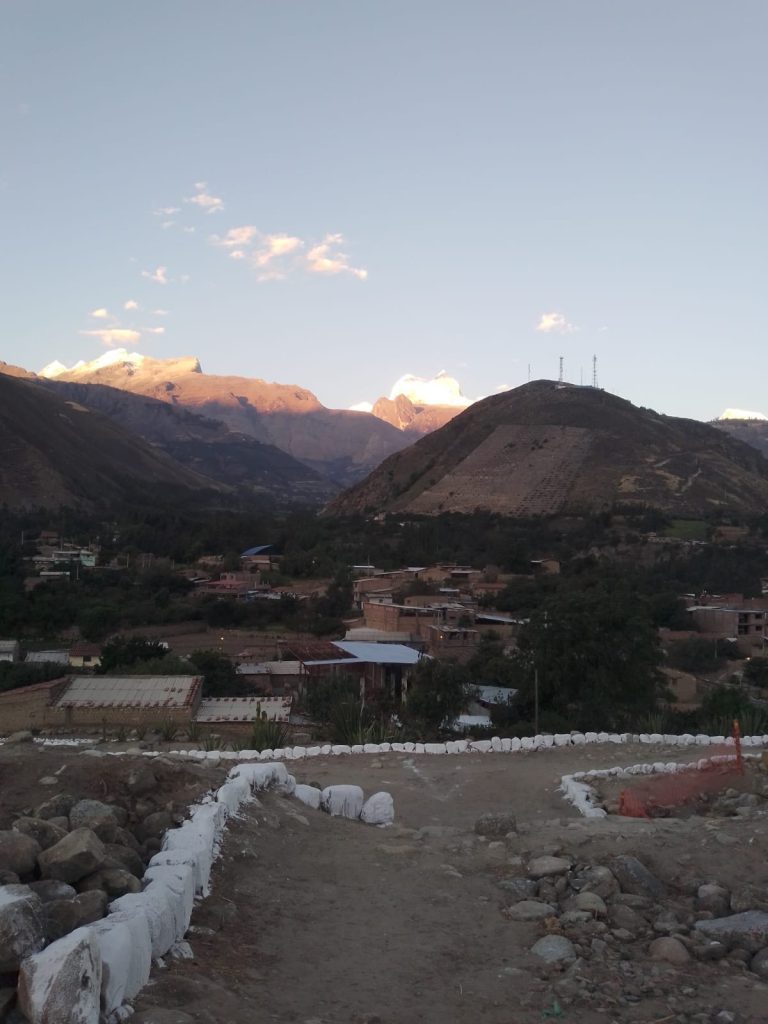
The complex lies at about 1,100 metres above sea level on the eastern, or right, bank of the Tablachaca River, also known as the Chuquicara, a major tributary of the Santa River. Its principal remains are two mounds in the Andean canyon: the earlier North Mound and a smaller, later South Mound. Associated buildings have oval, circular, and rectangular plans.
North Mound
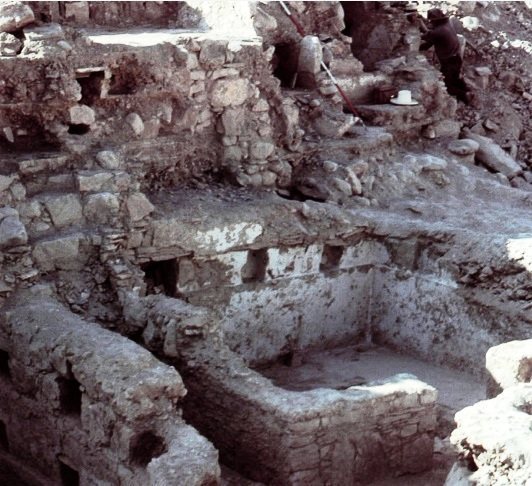
The North Mound is a compact, solid structure with a slightly rectangular plan and rounded corners. About 13 metres high, it rises in stepped profiles to a flattened top, forming a truncated pyramid. A large staircase faces a sunken circular plaza. At least 40 successive rebuilding stages, described as “floors,” have been identified in the mound. Its interior contains rooms with curved walls and small niches at different heights. Radiocarbon analysis dates the mound to about 2300 BCE.
South Mound and associated buildings
The South Mound is smaller and later than the North Mound. The associated structures have a range of simple plans, including oval, circular, and rectangular forms.
Mito ceremonial chambers
The ceremonial chambers are square or rectangular, each with one entrance. Their floors combine a lower central space with a raised bench around it. A small central pit served as a hearth, where offerings were probably burned; a narrow air channel ran beneath the floor to the exterior. A chamber in the North Mound also has a square central court framed by a bench, with a hollow at its center that may have served as an oven or hearth. The floor around this hearth is white.
Burials and ritual finds
Burials in chamber F-12:B-2
Chamber F-12:B-2 held three people, a man and two women, all older than 50. Their bodies were tightly flexed, placed on their left sides, and arranged with arms crossed over their chests. The man was tied with dark-brown cotton cord about 1.3 millimetres thick. Its fibers were twisted in a Z direction, without strands being twisted together. The women’s yellow cotton cords had an S-direction spin and were then twisted together in a Z direction; each cord was wrapped around its burial 20 to 25 times. Grieder considered these unusual ways of making the cords potentially meaningful.
Tufts of human hair lay around the bodies, particularly near the torsos and hips. The deceased had no hair on their heads and wore coverings resembling bags or a basket; the man also had a bag over his head. Grieder proposed that the hair might have belonged to the deceased and that placing it beside them kept spiritually important hair close to the body, reflecting Andean beliefs about the soul’s connection with hair.
Barkcloth accompanied two of the burials. Strips about three to four centimetres wide covered much of the man and lay inside the binding cords but outside the hair tufts; one woman had fewer similar strips. Grieder suggested that mourners might have regarded the material as spiritually powerful. The man also had a decorated cotton mantle, a fiber net covering, and a mat beneath him. The women were dressed in a similar manner. Near their heads were polished bone needles, pieces of anthracite, beads, and rock crystal.
Later burials and other finds
A somewhat later chamber contained three more people: two elderly women and a young pregnant woman. Their burial group included necklaces made with Spondylus, a marine shell used for ornaments, and stone, as well as reed baskets and other utensils. Burial preparations varied, especially in how bodies were positioned, while textiles and offerings occurred repeatedly.
Other finds include petroglyphs, refuse deposits, and archaeological material on the surface. Excavations also recovered chili remains from hearths, feathers in white, orange, and green, and a fragment of deer antler, among other evidence associated with ceremonial activity.