Jinsha Site: An Ancient Shu Settlement and Archaeological Centre in Chengdu
Site at a Glance
- Popularity
- High
- Country
- China
- Primary era
- Bronze Age
- Eras represented
- Bronze Age
- Civilizations
- Unclassified
- Site type
- Settlement
- Remains
- City
On this page19 sections
History
Settlement and political role
The Jinsha site is an ancient settlement in Chengdu, China, associated with Shu, an ancient polity in what is now Sichuan. Pottery places its main occupation in the late Shang and early Western Zhou periods, successive early Chinese dynasties. The Jinsha culture is broadly dated to about 1250–650 BCE and flourished around 1000 BCE, while the Shi’erqiao culture is associated with about 1200–800 BCE. Most recovered objects belong to the late Shang and early Western Zhou; a smaller group dates to the Spring and Autumn period, which followed the Western Zhou.
After nearby Sanxingdui, about 50 kilometres away, declined, Jinsha is thought to have become the Shu state’s capital and a successor political centre. Similarities between finds at the two sites point to a close connection, although their material cultures were not identical. Jinsha was a large urban settlement where people lived, made objects, buried their dead, and carried out ritual activities. Its role has also been interpreted as cultural and political, with ritual functions; workshops may have formed part of the settlement.
Decline and abandonment
The settlement came to an abrupt end sometime between about 500 and 200 BCE, but the reason remains uncertain. Political upheaval, earthquakes, and flooding have all been proposed. Studies of sediments and radiocarbon dates point to repeated major earthquakes in the Chengdu Plains, while coarse river deposits support flooding as another possibility. An earthquake might also have triggered floods or landslides, or prompted people to relocate. These explanations need not be mutually exclusive.
Discovery and modern study
Investigations in Huangzhongcun, including the Sanhe Huayuan and Jindu Huayuan localities, began in 1995 and continued through 2000. The work covered about 3 square kilometres; the broader archaeological site is described as extending across more than 5 square kilometres. The name Jinsha site came into use after an unexpected discovery on 8 February 2001, during construction of the Shufeng Huayuancheng development about 5 kilometres from central Chengdu. Construction exposed a drain containing bronze, jade, stone, and ivory objects. A team from the Chengdu Municipal Institute of Cultural Relics and Archaeology secured the area, and excavation around the drain started the next day. Work at Lan Yuan ran from July 2001 to January 2002, while investigations at Tiyu Gongyuan concentrated on October and November 2001.
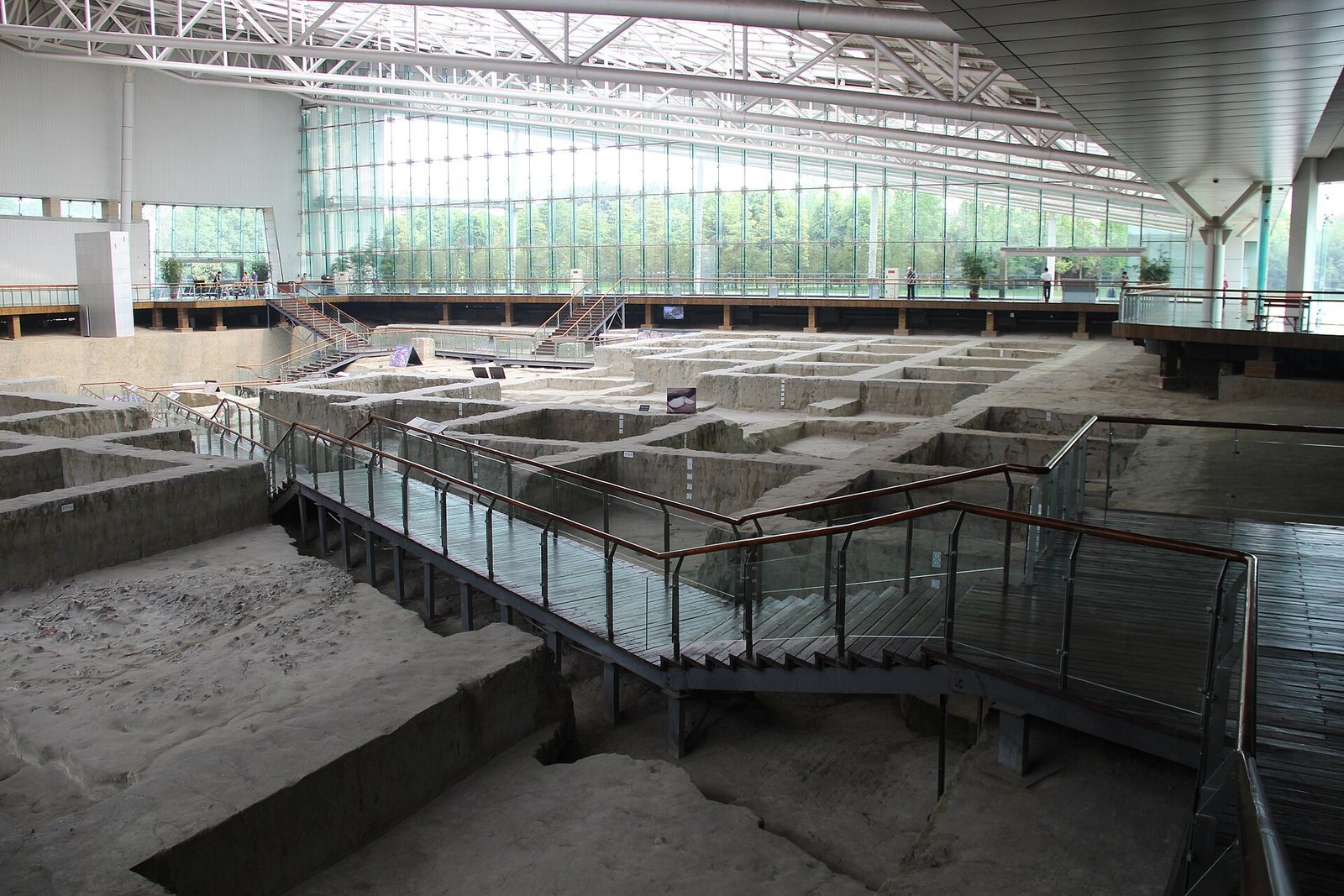
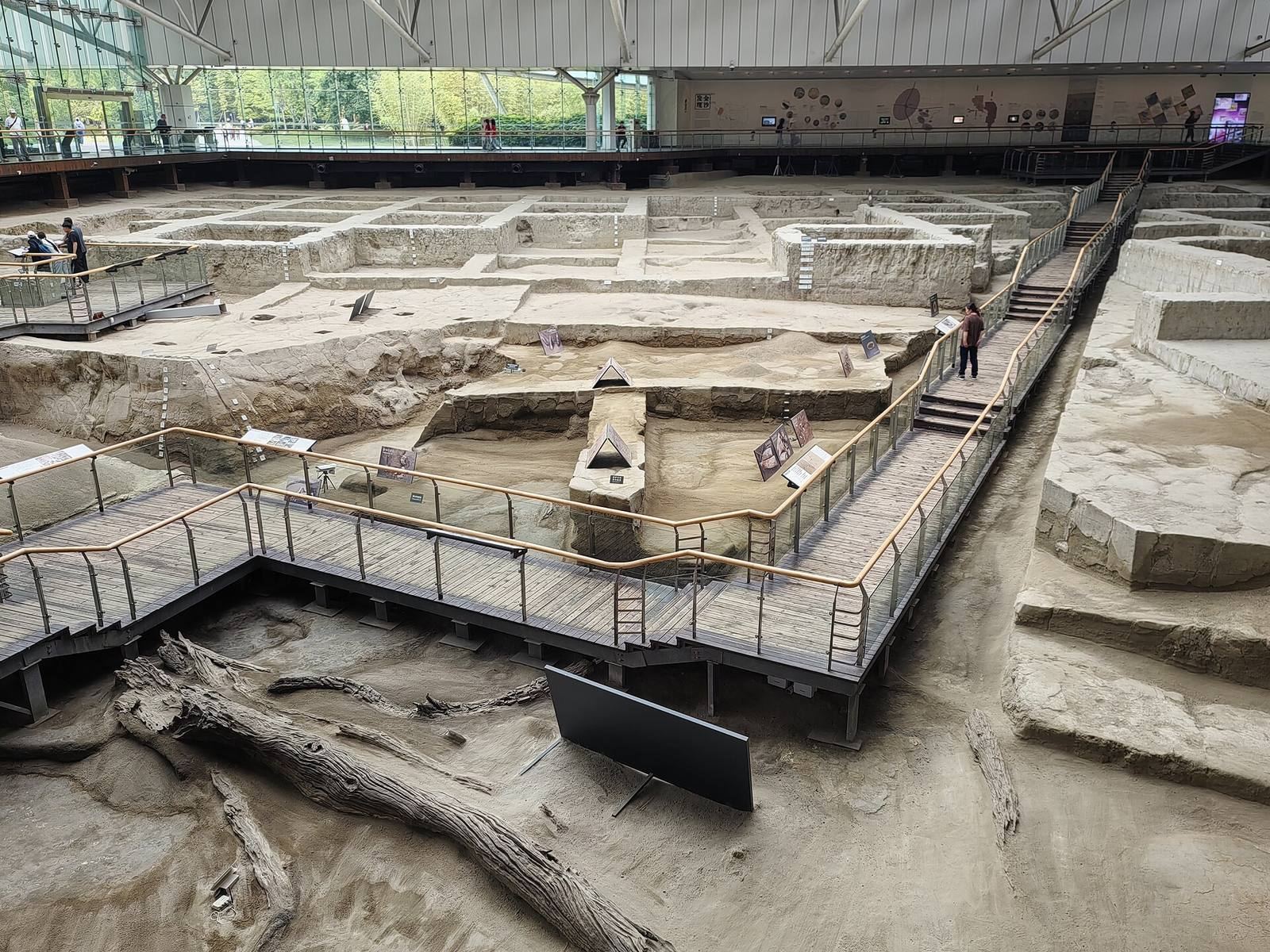
A museum built at the site in 2007 displays archaeological finds and the on-site ritual area. It has also led conservation work, including temperature and light controls. In 2007, teams from the Jinsha and Chengdu museums treated moss and cracking; in 2009 they used a biocide to remove surface moss and finely ground sand to fill cracks, later adjusting the sand’s colour to blend with the original surface. Jinsha received provincial-level protected cultural-property status in 2002 and national-level status in 2006. It is also on UNESCO’s World Heritage Tentative List.
Remains
Setting and archaeological localities
Terrain and site layout
Jinsha lies on the eastern Chengdu Plains, on mostly level ground with variations of up to 5 metres. The Modi River separates the site into northern and southern areas, and Shuhan, Qingyang, Sanhuan, and Qingjiang roads bound its extent. The principal archaeological localities are Mei Yuan, Lan Yuan, and Tiyu Gongyuan.
Mei Yuan and the tusk pit
Mei Yuan covers 22 hectares on the river’s south bank. Finds there include gold, bronze, jade, stone, ivory, and bone objects, as well as Asian elephant tusks, stone weapons, boar tusks, antlers, and deer remains. A rounded pit in the locality’s eastern corner measured 160 by 60 centimetres. Construction work disturbed it, but its lower, sand-filled layer preserved tusks set out in eight even layers. The longest measured 150 centimetres, and bronze and jade objects were also recovered from the pit.
Lan Yuan and Tiyu Gongyuan
Lan Yuan, adjoining Mei Yuan, covers 15 hectares. Buildings were found in its northern part, while burials occurred in the south and west; the locality also contained tombs, kilns, refuse pits, and storage pits. Tiyu Gongyuan, next to Lan Yuan, covers 9 hectares. It contained larger residential buildings of a palace-like character and burial pits, including a dense group of 15 burials within 81 square metres.
Buildings and production areas
Houses
Fifty buildings have been identified, oriented either northwest or southwest. Smaller structures had floors with small postholes, which held upright posts. Larger buildings also had larger postholes spaced about 1 metre apart. Their walls used a wood or bamboo framework with mud applied to the inner face.
Pottery kilns
About 200 kilns have been found in Lan Yuan, Sanhe Huayuan, and Jindu Huayuan, both near burial pits and within buildings. The oval kilns covered about 4 square metres each and had a working surface, fire chamber, entrance, and chamber for firing pottery. Their concentration in particular areas suggests that potters worked near one another, a pattern associated with consistent production.
Burials
About 300 burial pits have been excavated at Lan Yuan and Tiyu Gongyuan. Most were aligned southwest, with others facing northwest. The dead were placed on their backs, their hands resting over their chests. Roughly half the pits held a body alone; the others contained burial goods, usually pottery. Jade and bronze objects appeared in only five burials. Chambers held one person or a pair, and the overall pattern has been interpreted as reflecting no pronounced social hierarchy in burial treatment.
Objects and ritual finds
Gold sunbird ornament
The gold sunbird ornament is a circular sheet 125 millimetres across and 0.2 millimetres thick, with a gold content of 94.2 percent. Made from natural gold dust, it bears an openwork sun at its centre, with 12 rays curving clockwise, and four openwork birds facing left around the edge. The central sun design measures 52.9 millimetres across. The ornament is displayed on the Jinsha Museum’s second floor and serves as the museum’s logo. It has also been adopted as a symbol of Chinese cultural heritage and an unofficial emblem of Chengdu. In 2005, China’s State Administration of Cultural Heritage described it as a symbol of Chinese history. One interpretation connects its design to a story in the Classic of Mountains and Seas, an ancient collection of geographical and mythological material, in which four birds draw the sun down at sunset. Jinsha’s sun worship has also informed readings of the ornament as an emblem of authority.
Other gold objects
The gold finds include a small mask, another large mask, a fish-patterned belt, frog-shaped foil, and trumpet-shaped and box-shaped pieces. The small mask, beaten from thin gold sheets, measures 3.7 centimetres high and 4.7 centimetres wide. Its crescent-shaped eyes and partly open mouth give it a smiling expression. It was attached to figures during worship and prayer, helping Jinsha people connect with deities. The large mask resembles bronze masks from Sanxingdui in style. The belt shows an arrow piercing a fish and a bird, a design comparable to one on a gold staff from Sanxingdui; one interpretation links the motif to a legendary Shu king.
Stone figures and ritual objects
Twelve kneeling human figures carved from stone were found with their hands bound and their hair braided around a central parting. Their faces have angular features and high nose bridges. Cutting, polishing, carving, and hollowing show the care taken in making them. Their identity is uncertain: they have been interpreted as shamans or ritual performers, sacrificial victims, or enslaved people or captives. Stone tigers and snakes, together with bronze and pottery ritual objects, were found with the figures. The tiger and snake objects are associated with ritual activity at Mei Yuan. Other stone finds include figures, tigers, snakes, and turtles; the stone tiger has a simple, lively form.
Bronze and jade objects
Most bronze finds are small. They include a standing human figure, a tiger, a bell, a bronze bi, a flat round disc with a central hole, and a standing bird. The human figure resembles a standing bronze figure from Sanxingdui in style. Jade finds include a green, ten-section cong, a type of jade object with a round opening and squared exterior. About 22 centimetres high, it carries fine, hair-thin engraved decoration and a human figure. Its style resembles that of the earlier Liangzhu culture, and it is considered more than 1,000 years older than the Jinsha site.
Pottery, ivory, and other materials
More than a thousand valuable objects were recovered, including over 30 gold objects, over 400 jade objects, over 400 bronze objects, 170 stone objects, and 40 ivory objects. The excavated ivory weighed nearly one tonne, and large quantities of pottery were also found. Pottery, stone, and bone objects generally served household or everyday purposes; bronze, gold, ivory, jade, and other precious stones were more often associated with religious or decorative uses. Common pottery forms include plain jars with small bases, pointed-bottom saucers and cups, and lids with tall beak-like forms. Their simple, undecorated style is characteristic of the Shi’erqiao culture in this period. The excavated collection also includes wooden objects, boar tusks, and deer antlers.