Jesuit College in Pinsk: A Centre of Education and Mission in Belarus
Site at a Glance
- Rating
- 4.7
- Popularity
- Medium
- Country
- Belarus
- Primary era
- Early Modern
- Eras represented
- Early Modern
- Civilizations
- Grand Duchy of Lithuania, Polish–Lithuanian Commonwealth
- Site type
- Civic
- Remains
- School
On this page10 sections
History
The Jesuit College in Pinsk is a former Catholic educational and religious complex in Belarus. Jesuit activity began there in 1630, and the institution became a college in 1638, remaining under Jesuit administration until the Society of Jesus was suppressed in 1773. Its surviving brick building is associated with Baroque architecture. The college served as a centre for education and Catholic mission in Polesia, a region described at the time as predominantly Orthodox.
From mission to college, 1630-1648
The Jesuits, members of the Catholic Society of Jesus, first operated in Pinsk as a mission station. In 1630, local official Mikołaj Jelski established a mission house and gave the order a house for its use. The community became a residence in 1632, when Albrycht Stanisław Radziwiłł, Grand Chancellor of Lithuania and local administrator, endowed it and issued a foundation charter on 10 October. The Commonwealth parliament, the Sejm, approved the charter in 1635. The institution belonged to the Jesuit Lithuanian Province, an administrative division of the order, and to the Diocese of Lutsk, a church district overseen by a bishop.
A school began teaching grammar in 1633, the same year the Jesuits opened a public chapel near their residence. They replaced Jelski’s donated house with a new residence in 1634. In 1638 the Jesuit residence became a college, headed by rector Andrzej Wołłowicz. He added rhetoric to the teaching, and in 1646 rector Szymon Ugniewski introduced philosophy. A two-year philosophy course was also available to lay students. The college’s broader educational programme included languages, literature, logic, history, geography and physics. By the end of the seventeenth century, enrollment had grown from about 40 pupils to around 700, drawn from across the Polish-Lithuanian Commonwealth, the state formed by the union of Poland and Lithuania.
The college supported Catholic missionary work in Polesia, seeking to strengthen the Counter-Reformation, the Catholic Church’s response to Protestant expansion and reform, and to encourage the nobility to join the Catholic Church. Its network included missions at Turow and Łahiszyn. Anna Alojza Chodkiewicz founded the Turow mission in 1631, initially under the college at Ostrog; Mikołaj Rosochacki established the Łahiszyn mission in 1670. Both continued until the Jesuit suppression in 1773. The Pinsk institution also maintained a school theatre, a music boarding house founded in 1645, a hospital operating by at least 1635 and, from 1694, a pharmacy. A religious association met at the church, and the Brotherhood of the Good Death was founded in 1726.
The church’s construction began in 1636 and was completed in 1646. Mikołaj Krasicki, auxiliary bishop of Lutsk, consecrated it in 1647. The college’s endowments and land helped sustain its work. Later benefactors included Jan Karol Kopeć, who sold the Jesuits the village of Krzywicze in 1673 and gave money to support their Polesian mission, and Anna Dolska, whose 1698 donation enabled a four-year theology course for Jesuits in training to begin in 1703.
Warfare and rebuilding, 1648-1700
The Khmelnytsky uprising, a Cossack-led revolt against Polish-Lithuanian rule that began in 1648, brought warfare to the region. Pinsk was threatened, and fighting destroyed much of the city, including the Jesuit college and church. After hostilities eased following the 1651 Treaty of Bila Tserkva, the Jesuits began rebuilding with financial help from Radziwiłł. Warfare destroyed their property again in 1655, but they resumed their work in 1657.
That year, two Jesuit missionaries sent by Wołłowicz were killed by Cossacks. Szymon Maffon died at Horodek on 15 May, and Andrzej Bobola was killed at Janów the following day. Further plundering in 1660 led rector Szymon Wdziękoński to send the community to safer places. Cossacks nevertheless burned the college, church, school, music boarding house and hospital. The Jesuits returned in 1661 and started rebuilding, but Russian-Cossack forces burned the college again in 1663. The 1667 Truce of Andrusovo brought greater stability to the Commonwealth’s eastern territories, allowing the Jesuits to resume their work.
In 1667 the community resolved to build a new masonry college. The uppermost storey of the three-storey structure collapsed during construction in 1671, delaying the project; the walls were completed in 1675, while the building itself was finished in the 1730s. Defensive walls and a gate on the Pina River side were built between 1673 and 1693. After Radziwiłł’s death in 1656, other patrons supported the college. Further gifts included 20,000 zlotys from Pinsk official Seweryn Radziewicz in 1699. The Jesuit estate also included villages in the Pinsk and Mozyr districts; after the order’s suppression, some were leased in return for payments to the Commission of National Education, the Commonwealth’s state education authority.
The college in the eighteenth century
The Great Northern War, a conflict involving Sweden, Russia and their allies from 1700 to 1721, disrupted life in Pinsk. Swedish forces under Charles XII looted and damaged the city in 1706 but spared Jesuit property. Russian forces entered in 1707 and took food and cattle without destroying the city. After Augustus II abdicated, local administrator Michał Serwacy Wiśniowiecki recognized Stanisław Leszczyński as king. Peter I treated this as treason and ordered the destruction of the Pinsk Jesuits’ property. During the war, the Jesuits had to provide food to Russian troops and pay a tax on 30 households. Russian troops looted the college in 1714, and workers on its farms were forced to build army bridges. Renovation of the college began that year, followed by repairs to its courtyard and entrance lodge. Plague struck Pinsk from 1717 to 1720 and killed several Jesuits, including rector Mikołaj Znamirowski.
The college’s work expanded in education and religious life. Rhetoric courses for Jesuits in training ran in several periods between 1675 and 1706, and a four-year course in scholastic theology, which uses philosophical reasoning to examine Christian doctrine, operated from 1703 to 1773. Moral theology was taught in 1768-1769 and 1772-1773. The institution also hosted the Jesuit third probation, a further stage of formation for members of the order, from 1659 to 1664. A printing press was operating in Pinsk by at least 1727, and it printed Piotr Skarga’s sermons in 1735. When the Jesuits were suppressed, the pharmacy held more than 1,300 medicines and medicinal ingredients.
Devotion to Andrzej Bobola grew after the war. During the conflict, people regarded him as a protector and searched the church crypts for his coffin. Wiśniowiecki credited Bobola’s intercession with his escape from Russian captivity in 1710. In 1726 Augustus II made a votive offering at Bobola’s tomb, believing the Jesuit had helped him survive a life-threatening illness. Investigations relating to Bobola’s canonization took place in Pinsk in 1712, 1719, 1729 and 1730. The Holy See recognized him as a martyr in 1755, and he was beatified in 1853, a formal Catholic recognition permitting public veneration. Uniate worshippers, members of Eastern Christian communities in communion with Rome while retaining their liturgical traditions, continued to venerate him after the Jesuit period.
The college building could not accommodate its 70 Jesuits. In the 1740s, damage to the church’s altar of the Savior and a lightning-caused fire in its towers prompted modernization. From 1759, the college belonged to the Jesuit Mazovian Province rather than the Lithuanian Province. A fire partly damaged the church in 1758, and repairs remained incomplete when the order was suppressed in 1773.
After the Jesuit suppression
After 1773, the church passed to Uniate bishop Joachim Korbacki. Following the abolition of the Union of Brest, which had brought some Eastern Christian communities into communion with Rome while retaining Eastern rites, it became an Orthodox church dedicated to the Nativity of the Mother of God. The college building served as a school administered by the Commission of National Education, with at least eight former Jesuits among its teachers. It became a Uniate bishop’s residence in 1787 and was transferred in 1800 to an Orthodox men’s Epiphany Monastery.
The Jesuits returned to the former college in 1919. Rebuilding was completed in 1923, when teaching resumed; a seminary opened in 1925 and a novitiate in 1937. After the Soviet annexation of western Belarus in 1939, authorities closed the monastery and used its buildings for public and administrative purposes. The complex suffered serious damage during the Second World War and was later repaired. The college received republican-level historical and cultural monument status in 1953. An art gallery opened there in 1965, displaying works from the Radziwiłł collection and paintings by Aivazovsky. A decision in 1980 transferred the building fully to the Museum of the Belarusian Polesie, and a major restoration followed in 1996.
Remains
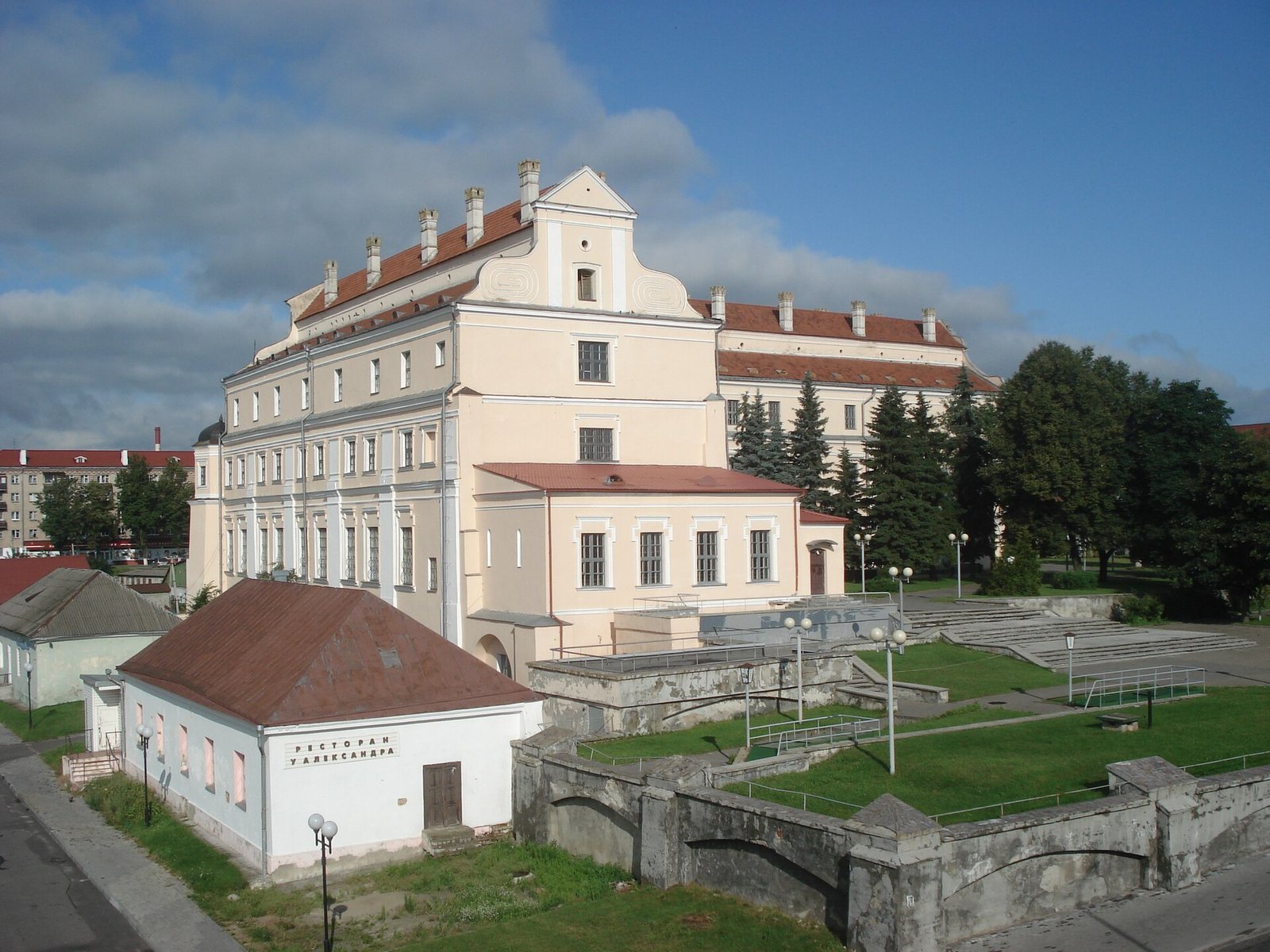
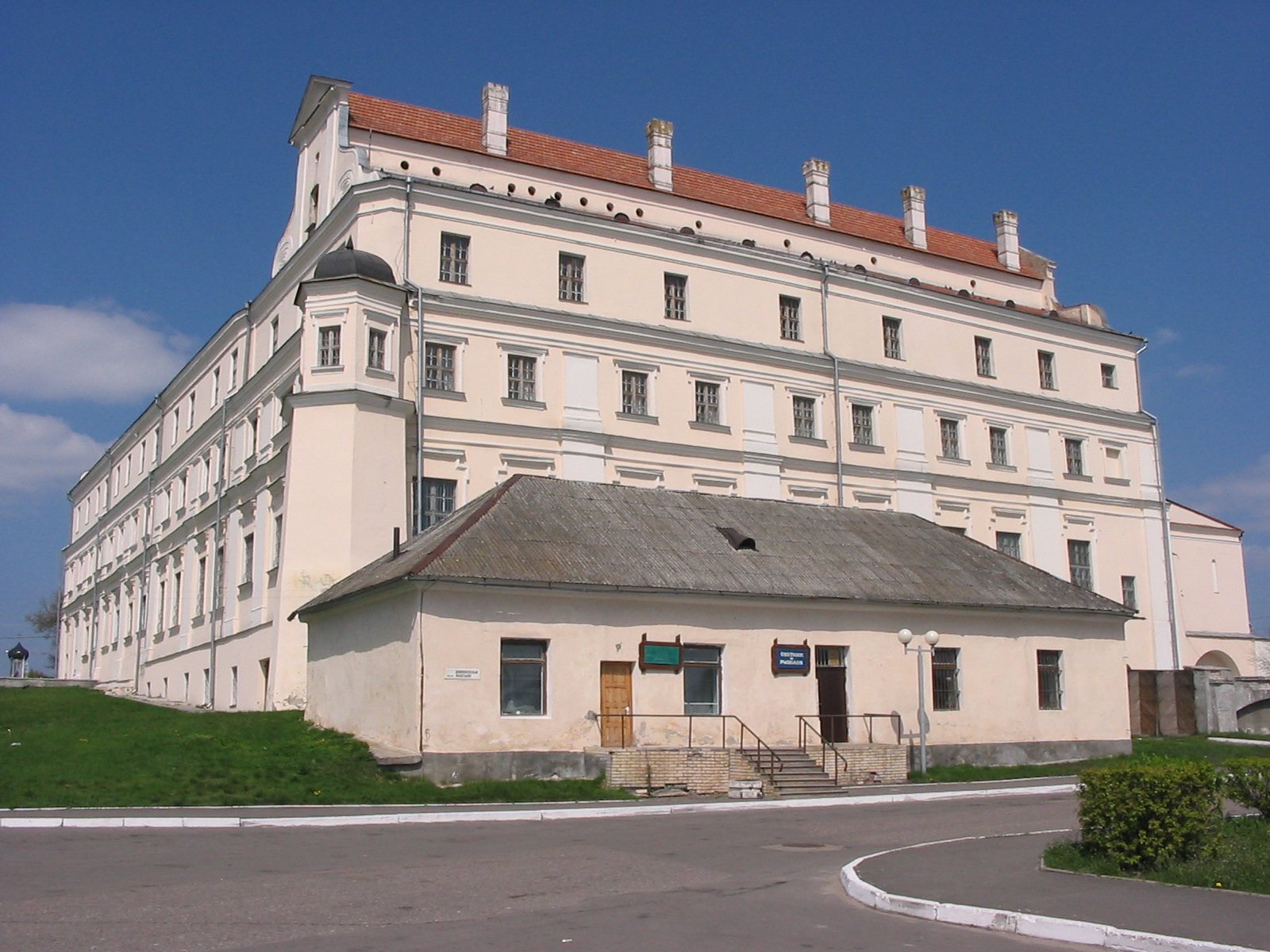
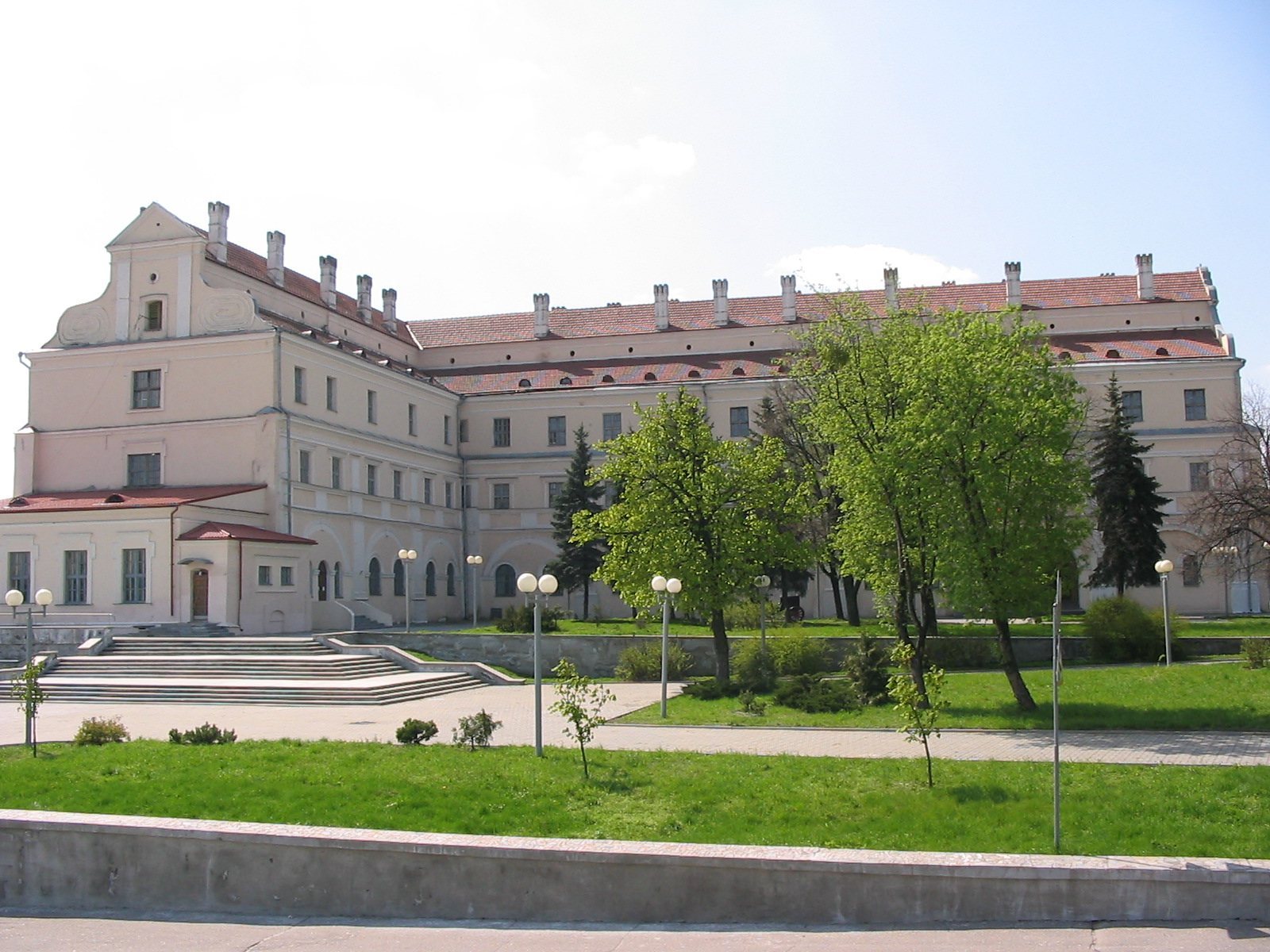
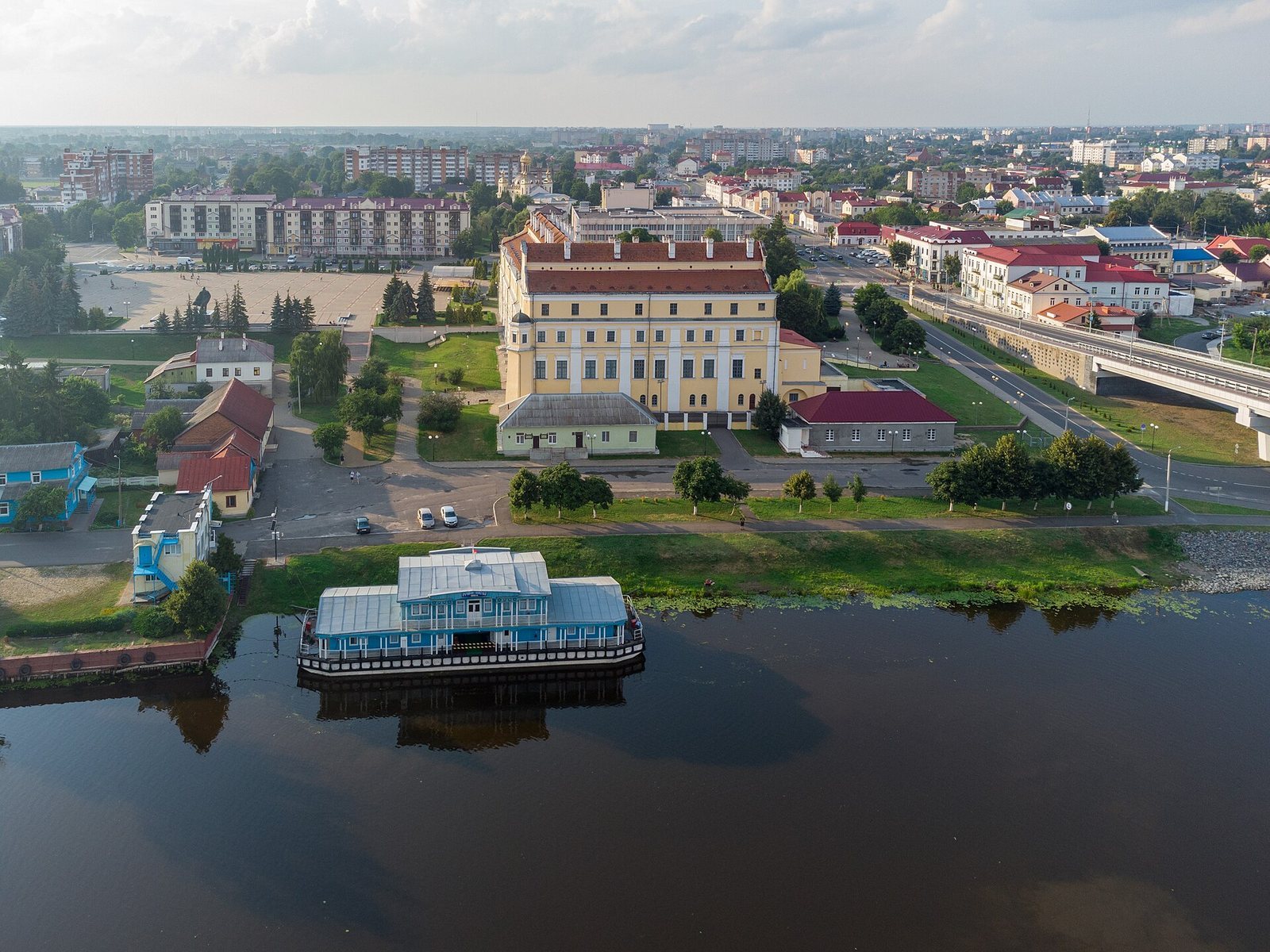
The surviving core of the former complex is a brick college building in Pinsk’s historic centre, on the site of the ancient hillfort. Its exterior combines features associated with Renaissance architecture and a building tradition linked to the Baroque. Repeated alterations have substantially changed the interior, which no longer preserves its original appearance.
Buildings and enclosure of the former complex
College building
The brick college is the principal surviving building of the Jesuit ensemble. Its long history of rebuilding and alteration has shaped its present form, while changes to the interior have obscured the original arrangement.
Defensive walls and courtyard
Walls enclosed the college, with a gate on the side facing the Pina River. The complex also had a courtyard and a porter’s lodge, associated with the entrance to the college grounds.
Church of St. Stanislaus
The former ensemble included the stone Church of St. Stanislaus the Bishop. Its richly decorated chapel was dedicated to Andrzej Bobola, and its towers were rebuilt between 1749 and 1753. The church was demolished in 1956.