Ivolginsky Deer Stone: A Carved Monument in Buryatia
Site at a Glance
- Popularity
- High
- Country
- Russia
- Primary era
- Bronze Age
- Eras represented
- Bronze Age
- Civilizations
- Unclassified
- Site type
- Burial
- Remains
- Tomb
On this page12 sections
History
The Ivolginsky deer stone is a carved stone monument found beside the Ivolga River in Buryatia, Russia. It is one of the best-known deer stones of Transbaikalia and is classed as a classic example of the Mongol-Transbaikalian type, a regional archaeological grouping associated with Mongolia and Transbaikalia. Its date remains disputed: a 1950s interpretation placed it in the Late Bronze Age, around the seventh to fifth centuries BC.
Discovery and early records
Ethnographer D. P. Davydov found the stone in 1856 at a burial ground about 22 versts south of Verkhneudinsk, now Ulan-Ude. The slab formed the central element of the site. On June 16, Davydov returned with artist Smirnov, who made a drawing while Davydov added notes and compared the carvings with those on another stone he had examined. Davydov thought the slab had been intended to stand on its narrow end, but found no nearby supports for raising it.
Davydov excavated five structures above ground, which he considered probably ritual rather than burial places. He also turned the slab over and dug beneath it. He proposed that a marker might have been planned there above a horse skeleton, but that the work had not been completed. The burial ground had disappeared by the end of the twentieth century. The slab was later taken by sled across Lake Baikal to Irkutsk; neither the date nor the identity of those who moved it is known.
Davydov published a description with Smirnov’s drawing. Finnish archaeologist A. Heikel photographed the stone in a museum courtyard in 1890 and, two years later, described figures he thought were deer, noting their unusual beak-like heads and a curved image on an edge.
Dating and interpretation
In 1912, Finnish archaeologist Appelgren-Kivalo described four stylized red deer and proposed that their form reflected influence from China’s Han dynasty, which ruled from 206 BC to AD 220. He dated the monument to about the first century AD, but later research did not support that interpretation.
In the 1950s, archaeologist A. P. Okladnikov based his Late Bronze Age dating partly on a carved handled mirror that he compared with a bronze mirror from the Pazyryk burial mound. Archaeologist V. V. Volkov considered the comparison unpersuasive: the Pazyryk mirror belonged to the second half of the fifth century BC, while comparisons with objects of the early Tagar culture, an archaeological culture of Siberia, were weak.
Okladnikov interpreted the stone as a grave marker and the carved objects as possessions of the deceased. He also suggested that the slab might resemble a saber or a stylized fish, with a circle serving as an eye and broad curved lines as gills, while allowing that the resemblance could be accidental.
Meanings proposed for the carvings
Researchers have disagreed about which deer species the figures represent. Okladnikov identified them as reindeer on the basis of their antlers. M. V. Konstantinov argued that they were red deer, known regionally as izubr, noting that the steppe and surrounding taiga suit red deer habitat, while reindeer live farther north. Konstantinov also understood the animals as expressing hopes for health and the flourishing of descendants, family, community, and people, connecting this meaning with traditional beliefs about deer antlers.
The carved circles have also received differing explanations. Some interpretations identify them as bronze mirrors representing the Sun, with the smaller circle also standing for the Moon; others see them as earrings. Circles on deer stones have also been understood more generally as solar symbols.
Remains
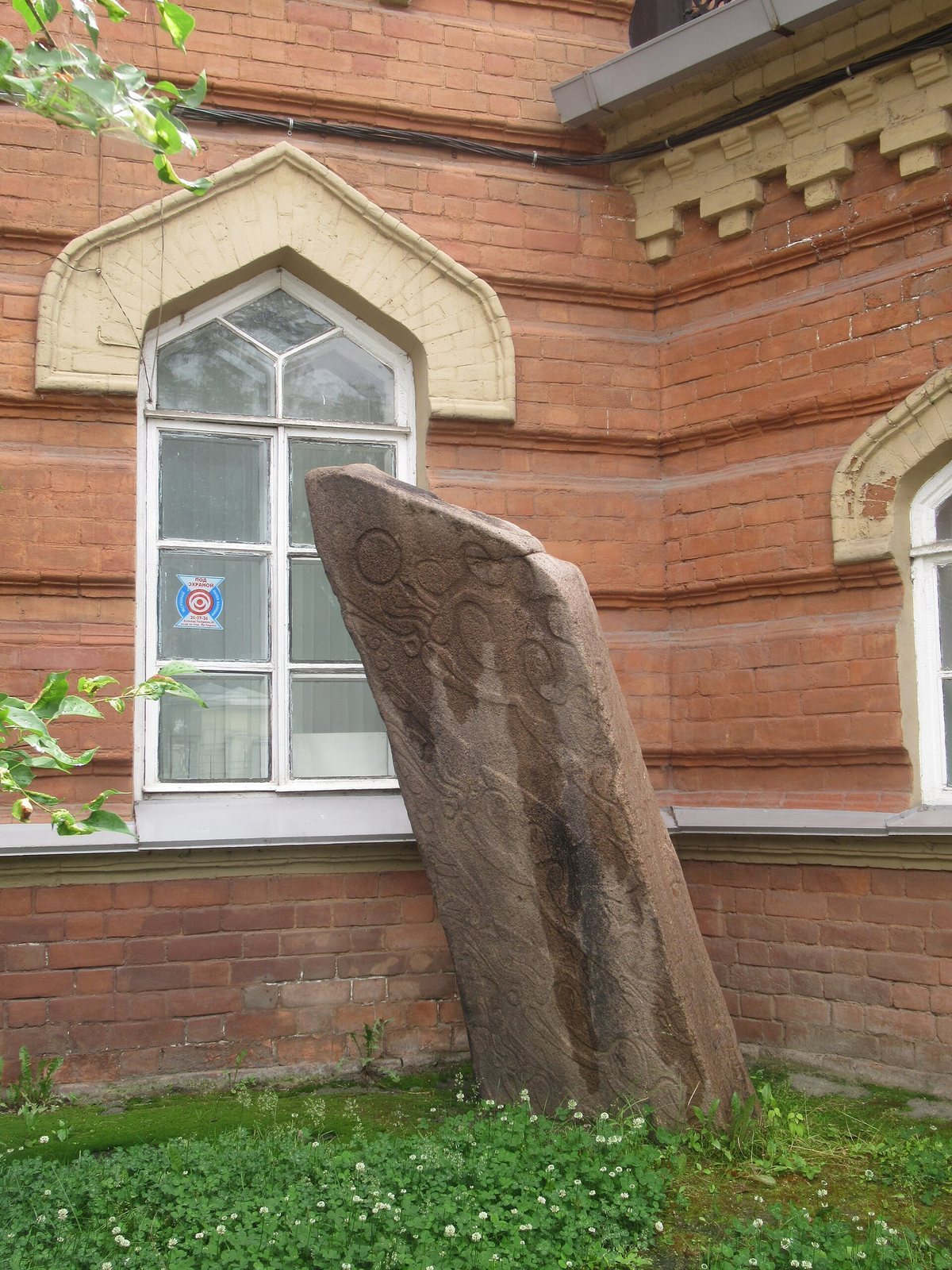
The monument is a tall, narrow granite slab decorated across both broad faces and its narrow edges. Deer figures dominate its imagery, alongside smaller animals and carved objects. Its carvings are cut into the stone rather than applied to its surface.
Slab and present position
Made from fine-grained pink Transbaikalian granite, the slab measures about 3.5 m long, 0.9 m wide, and 0.2 m thick. Its top slopes toward one edge. Davydov first thought the stone was sandstone, but Okladnikov identified the durable granite and linked its toughness with the survival of the carvings. The cuts are about 0.3 to 0.4 cm deep; Okladnikov compared their making to the removal of small flakes by pointed blows.
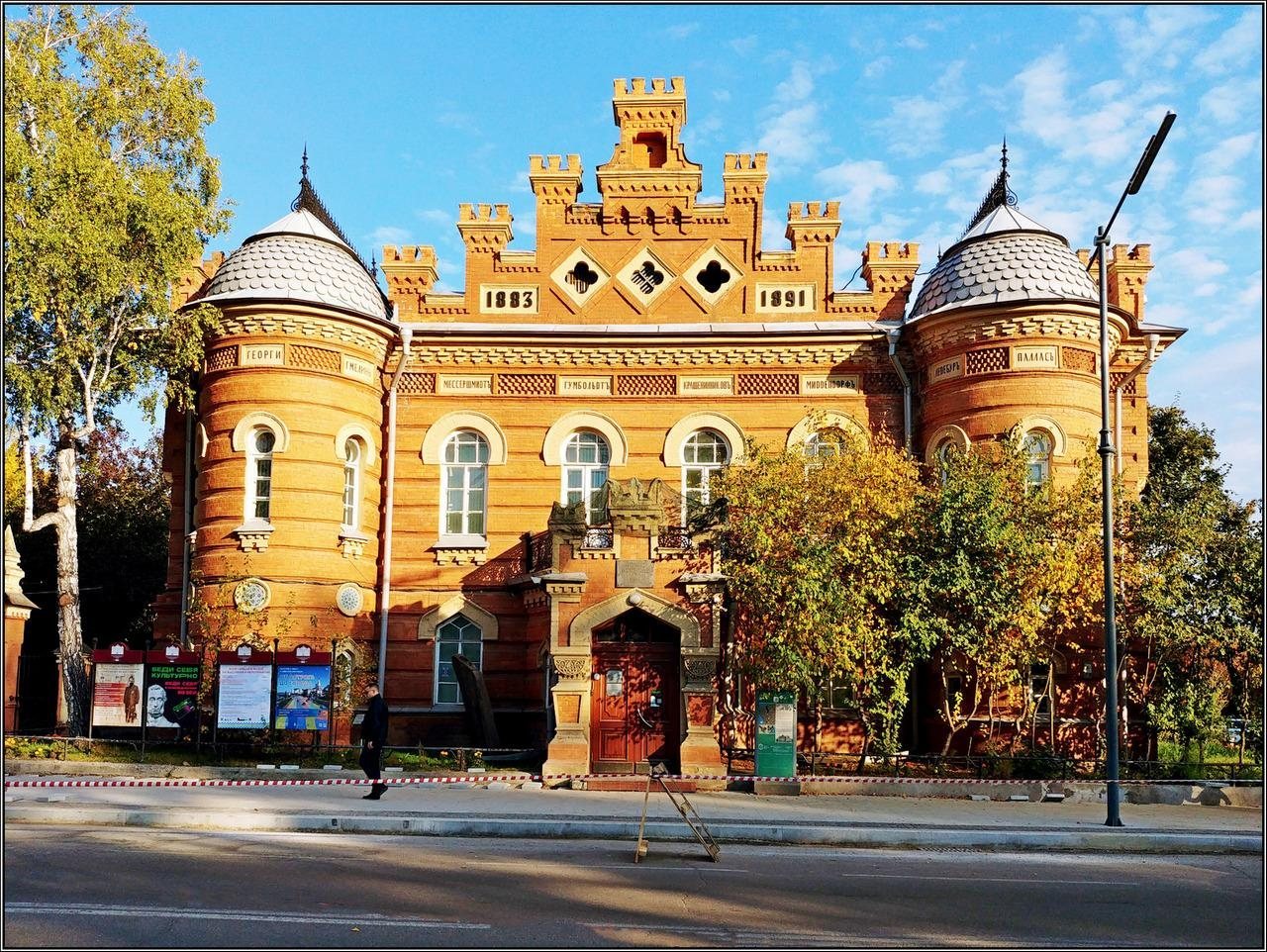
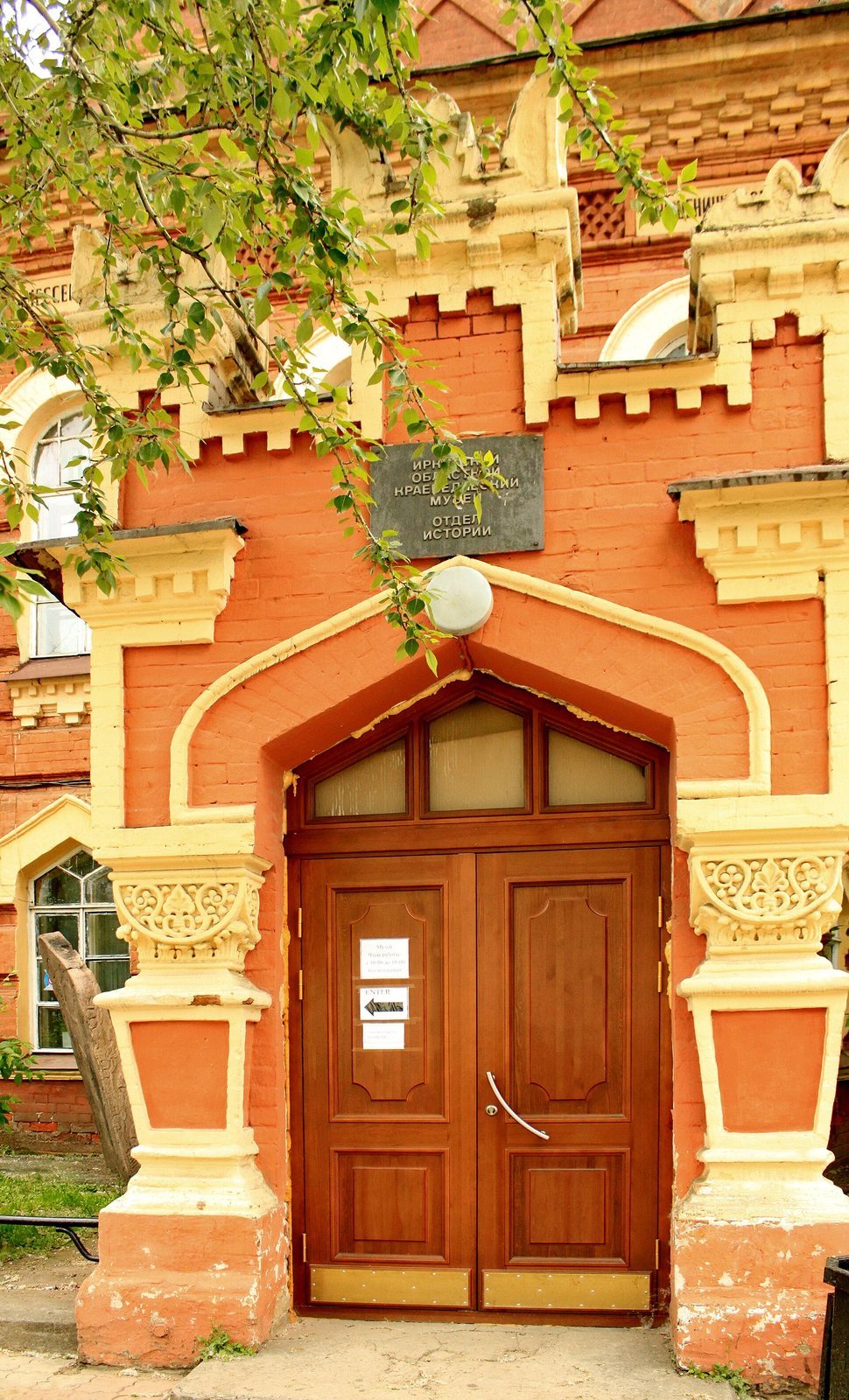
The slab now stands in a shaded area beside the entrance to the history department of the Irkutsk Regional Museum of Local Lore. It has sunk about a third of its height into the ground, covering some lower carvings. Excavation below it found a horse skeleton about 35 cm down; only several rear teeth from its skull remained. The museum decided against moving the slab indoors because extracting it from the ground could cause it to break.
Carvings on the broad faces
Front face
Six deer appear on the front broad face. Three larger animals form a vertical sequence, with three smaller figures grouped below and beside them. The large deer have long bodies, raised heads, curved necks, and branching antlers; some also have very large eyes and a triangular rise at the shoulder. Two smaller deer are only partly formed, while another is rendered as a grooved outline. Above the smaller figures are two little animals interpreted as horses, one with its head raised and the other with its head lowered.
Opposite face
Two large deer occupy much of the opposite face. The upper animal has fuller antlers, a second ear, and a more carefully shaped hind leg. Parts of the lower large figure and another deer near the slab’s right edge extend below ground. A small deer appears beside a slightly curved, handle-shaped object with a blade-like projection pointing toward the lower deer. Two circles of different sizes are carved near the top; a circle with an external stem also appears above a deer on one of the broad faces.
Carvings on the narrow edges
Edge with deer and a patterned figure
One narrow edge bears three deer arranged vertically and a five-sided figure filled with angular cross-lines. The upper deer lacks its legs and lower torso, and the middle one is missing a foreleg. Okladnikov suggested that the carver had misjudged how much space the figures would require.
Edge with weapons and other motifs
The other edge has broad bands across its lower part, with two hook-shaped projections. Above them are a dagger beside tapered vertical lines, an axe with a substantial handle and short projecting blade, a bow and arrow, a regular disk, and an unfinished deer lacking a foreleg and the tips of its antlers. Other motifs on the slab include a celt, a prehistoric axe or adze head, and a U-shaped figure.