Germanna: An Early German Colonial Settlement in Virginia
Site at a Glance
- Rating
- 4.8
- Popularity
- Very Low
- Country
- United States
- Primary era
- Early Modern
- External website
- Open
- Eras represented
- Early Modern
- Civilizations
- English, German
- Site type
- Military
- Remains
- Fort
On this page12 sections
History
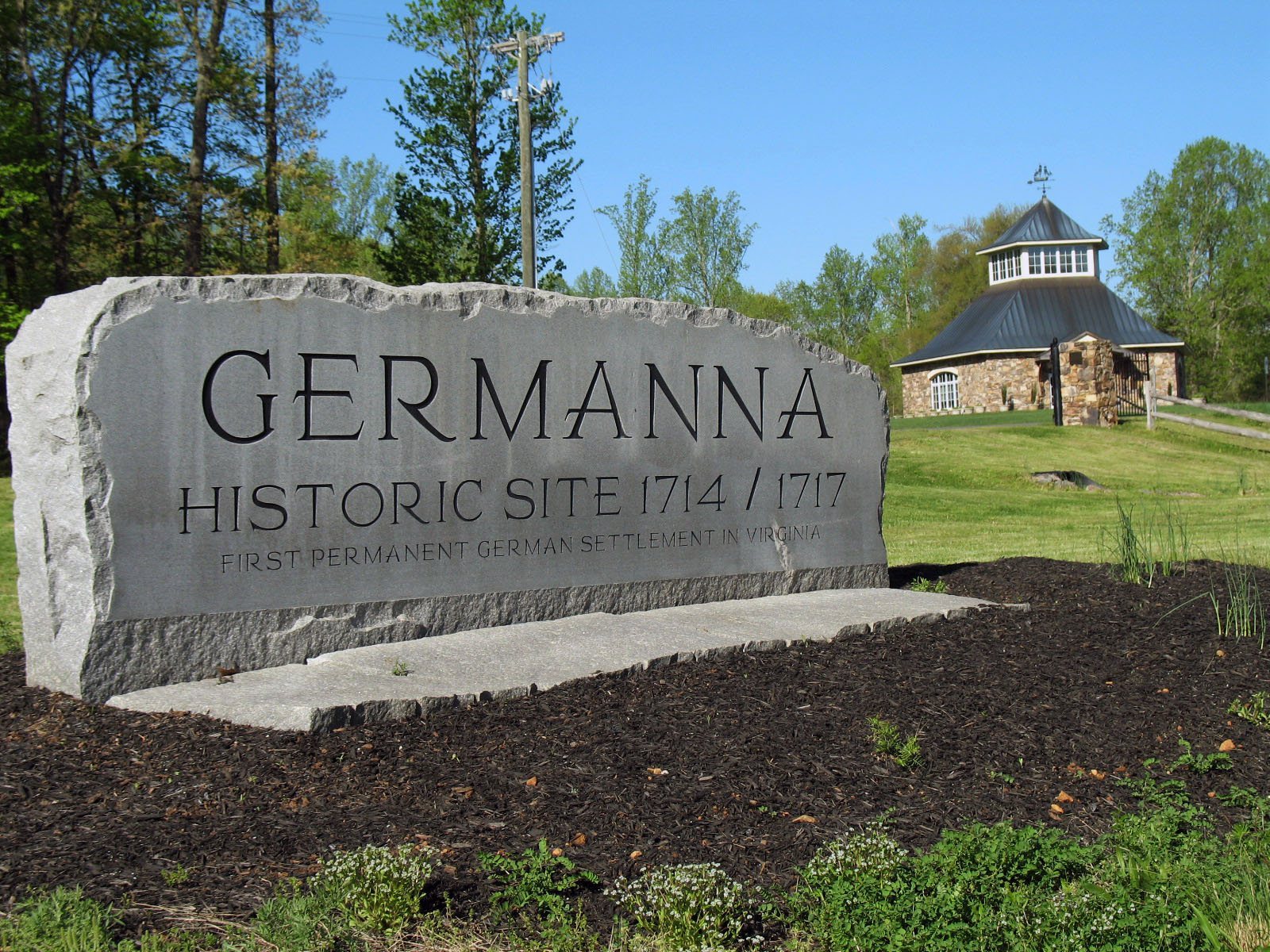
Germanna is a historic German colonial settlement in Locust Grove, Virginia, United States, established by German immigrants in 1714 during the colonial period. It was promoted by Alexander Spotswood, Virginia’s lieutenant governor from 1710 to 1722, as a frontier-defense settlement and as a source of labor for mining and ironworking. The name, selected in 1714, combined the identity of the German settlers with that of Queen Anne, although Anne died on August 1 of that year.
Foundation and the first colony
The first group reached Virginia in April 1714. It consisted of 42 people from the Siegerland area of Nassau-Siegen, and other German families joined them later. Reverend Henry Haeger organized the first German Reformed Church congregation in America at Germanna that same year. Its building also served as a defensive blockhouse, a fortified structure intended to protect its occupants, giving the settlement’s first church both religious and military purposes.
Spotswood had advertised in Germany for miners, and mining activity began at Germanna in 1716. The settlers were instructed to look for iron in early 1718, while laborers worked in mines or quarries at or near the settlement from approximately March 1715 or 1716 until December 1718. Spotswood stated that he had spent about £60 on the undertaking, but no iron furnace had been established by December 1718.
The first colony left Germanna between January 1719 and 1720. Haeger and members of his congregation moved to an area then in Stafford County and now in Fauquier County, where John Fishback, John Hoffman, and Jacob Holtzclaw secured 1,805 acres for distribution among the group.
The second colony and county administration
A second group arrived after a planned voyage to Pennsylvania was redirected to Virginia in 1717 or 1718. These settlers became indentured servants of Spotswood, meaning that they were bound by contracts to work for a specified period in return for passage, support, or another form of consideration. Some members arrived later, between 1719 and 1722. On February 1, 1728, Spotswood claimed headrights for 48 men, women, and children from the colony. A headright was a colonial land claim based on financing or sponsoring a person’s migration.
Many members of the second colony moved to the Robinson River Valley, now in Madison County, by 1725. Between 1723 and 1725, Spotswood sued many of them in disputes involving land and labor. In 1733, Johann Caspar Stöver became pastor of the second colony’s Lutheran congregation. A German Lutheran church, now Hebron Lutheran Church, was built in 1740 with funds raised in Germany.
Germanna became the seat of Spotsylvania County from 1720 to 1732. In 1720, the English Crown’s Privy Council, its central advisory and administrative body, granted Spotswood 86,000 acres in the newly created county. The grant formed part of a wider effort to create a buffer against the French, and the Germanna tract was the first section of this territory.
Mining, ironworking, and later dispersal
Germanna developed as a center of mining and metalworking during the eighteenth century and is also described as an important ironworking center during its nearly seventy years of continuous habitation. After German settlers moved to Germantown, Spotswood continued operating the Germanna ironworks with enslaved labor. He had earlier built a substantial residence at Germanna, later called the “Enchanted Castle,” while his widow subsequently lived at nearby Salubria.
The Germanna Colonies later dispersed southward and westward from the Virginia Piedmont. Many families intermarried for generations, and their descendants took part in events including the American Revolution and the westward migration to Kentucky and beyond. The first settlement, Fort Germanna, stood along the Rapidan River in what is now Orange County. Later German settlements associated with the colonies developed in areas now within Culpeper and Spotsylvania counties.
Preservation and archaeological work
The Germanna Foundation owns land associated with the original Germanna peninsula and conducts archaeological exploration at Fort Germanna, Siegen Forest, and Salubria. It also maintains a research library and memorial garden and publishes historical and genealogical works. Fort Germanna was listed on the Virginia Landmarks Register on June 21, 1977, and on the National Register of Historic Places on August 24, 1978.
Remains
The surviving Germanna-associated landscape includes the former Fort Germanna site along the banks of the Rapidan River in present-day Orange County. It consists mostly of open fields interrupted by thickets of second-growth timber. Foundation-owned land connected with the original Germanna peninsula lies on both sides of Germanna Highway near the former fort site. Archaeological work at Fort Germanna, Siegen Forest, and Salubria examines the settlement’s surviving archaeological remains and related historic properties.
Fort Germanna landscape
Church and defensive blockhouse
The first German Reformed Church building served as a blockhouse as well as a place of worship. Its combined religious and defensive function reflects the needs of the early settlement. The building formed part of Fort Germanna, the first settlement established along the Rapidan River, where archaeological exploration continues.
Spotswood’s residence
Traces of the terraces belonging to Spotswood’s mansion remain discernible at the site. The residence was later known as the “Enchanted Castle,” and its surviving terraces preserve part of the physical layout associated with Spotswood’s occupation of Germanna.
Associated historic properties
Salubria
Salubria is a nearby eighteenth-century mansion associated with Germanna. It was formerly the home of Spotswood’s widow and was donated to the Germanna Foundation by the Grayson family in October 2000 for historic preservation. The property forms part of the group of sites examined through the foundation’s archaeological and preservation work.
Siegen Forest
Siegen Forest is another property connected with the Germanna Colonies. The Germanna Foundation conducts archaeological exploration there alongside work at Fort Germanna and Salubria, using these sites to investigate the surviving physical evidence of the settlements and their associated history.