Fort Snelling: A U.S. Army Post at the Minnesota-Mississippi Confluence
Site at a Glance
- Country
- United States
- Primary era
- Modern
- Eras represented
- Modern
- Civilizations
- Unclassified
- Site type
- Military
- Remains
- Fort
On this page12 sections
History
Fort Snelling is a former U.S. Army post on bluffs above the confluence of the Minnesota and Mississippi Rivers in the United States. The Army established an outpost there in 1819 and built the fort from 1820 to 1824 as part of its effort to extend federal authority in the Northwest after the War of 1812. The Dakota name for the meeting of the rivers is Bdóte, meaning meeting of waters. The place held spiritual importance for the Dakota and other Indigenous peoples, and became a center of contested land claims.
Treaties and construction
Bdóte was important to the Dakota, Ojibwe, Ioway, Otoe, Sauk, Fox, and Cheyenne peoples. The confluence was also the setting for treaties between Indigenous nations and the United States, including the 1805 Treaty of St. Peters, the 1837 White Pine Treaty with Ojibwe bands, and the 1851 Treaty of Mendota with the Mdewakanton and Wahpekute Dakota.
In 1805, U.S. Army officer Zebulon Pike negotiated a treaty under which Dakota representatives ceded about 155,320 acres around the confluence for military posts. Seven Dakota men were present, but only Cetan Wakuwa Mani and Way Aga Enogee signed. The treaty’s authority, land description, and payment terms were disputed. Pike did not specify a payment, though he estimated the land’s value at $200,000. The Senate ratified the treaty in 1808 and approved $2,000. In 1819, Indian agent Thomas Forsyth distributed goods worth about that amount, and in 1838 agent Lawrence Taliaferro paid another $4,000 in an effort to settle the matter with a different Dakota band. Congress annulled treaties with the Dakota in 1863, and the moral legitimacy of the land title remains disputed.
After the War of 1812, Secretary of War John C. Calhoun supported a chain of military posts to curb British-Canadian trading, protect U.S. commerce, mediate Dakota-Ojibwe conflicts, and discourage unauthorized settlement on Indigenous land. He favored a small number of large garrisons that could send troops on expeditions. In 1817, Army engineer Stephen H. Long surveyed the area and recommended the land covered by Pike’s treaty. Two years later, a detachment of the 5th Infantry under Lieutenant Colonel Henry Leavenworth established Cantonment New Hope on the Minnesota River flats. Poor provisions and disease took a heavy toll: 40 men died of scurvy. Leavenworth then moved the camp to Camp Coldwater, where the Army established its outpost.
Josiah Snelling took command of the post and its construction in 1820. It was first called Fort St. Anthony, after nearby falls. Following an inspection in 1824, General Winfield Scott recommended that the post be named for Snelling. The War Department approved the name Fort Snelling in 1825.
The military post and slavery
The fort served as a U.S. military post from 1820 until its closure in 1858. Its garrison included the 1st, 5th, 6th, and 10th Infantry regiments and a company of the 1st Dragoons, mounted soldiers. A post office opened in 1827. The St. Peter’s Indian Agency, a government office responsible for relations with Native nations, operated at Mendota from 1820 to 1853 under Taliaferro. The agency also held court, and Taliaferro and the fort commandant helped missionaries Gideon and Samuel W. Pond develop a Dakota alphabet and dictionary in 1834. St. Paul sent criminals to the fort until the city opened its own jail in 1851.
Army officers and fur traders brought enslaved people to the post and forced them to perform domestic labor. This continued despite restrictions in the Northwest Ordinance, which prohibited slavery in the Northwest Territory, and the Missouri Compromise, which regulated slavery’s expansion in U.S. territories. An estimated 15 to 30 African Americans were enslaved at the fort. Nine people were held there from 1855 to 1857, and the 10th Infantry was the last slaveholding unit. Slavery ended in Minnesota when the state constitution was ratified in 1858. Zachary Taylor commanded the post in 1828; during his posting, eight enslaved adults associated with him and several minors died.
Army surgeon John Emerson brought the enslaved Dred Scott to Fort Snelling in the 1830s. Scott met and married Harriet Robinson there, with Taliaferro officiating at the ceremony in Mendota. Their children were enslaved at the post from 1836 to 1840, when Emerson’s wife took the family to St. Louis. Scott sued for his family’s freedom in 1843, and they were freed in 1850. An appeal in 1852 returned them to slavery. In 1857, the U.S. Supreme Court ruled that the family would remain enslaved. Chief Justice Roger Taney held that people of African descent could not sue under the Constitution and that the Missouri Compromise was unconstitutional. The decision drew national attention and heightened tensions between North and South.
Other freedom suits also involved people who had been enslaved at the fort. Rachel, held there by Lieutenant Thomas Stockton from 1830 to 1831 and later at Fort Crawford, won her case before the Missouri Supreme Court in 1836. Courtney and her son William were freed after her enslaver conceded her case following that ruling. Her son Godfrey remained in Minnesota when she was taken to a slave market in St. Louis. He escaped from the fort and was taken in by Dakota people; during the Dakota War, he became the first defendant on the military tribunal’s hanging docket. James Thompson, enslaved first by a military merchant and then by officer William Day, gained his freedom when Methodist missionary Alfred Brunson purchased it.
War, confinement, and military expansion
As fur trading declined and settlement and wheat farming grew, the fort’s frontier role diminished. In 1848, land east of the Mississippi was separated from the military reservation and sold, contributing to St. Paul’s growth. The Army deactivated the fort in 1857, and the government sold it and about 8,000 acres to businessman Franklin Steele in 1858 for $90,000. The government took the property back for the War Department during the Civil War. An agreement in 1873 returned the fort to the Army, cleared Steele’s debt, and gave him title to 6,395 acres of the original reservation.
During the Civil War, the fort became a recruiting and training center for more than 24,000 recruits. Minnesota regiments and other state units mustered there. Slightly more than 100 African Americans sought military service at the post; because Minnesota could not form a large enough African American unit, volunteers were sent by riverboat to states with African American regiments.
The Dakota War of 1862, an armed conflict between Dakota people and the United States, brought state and federal forces to the fort. On August 19, Governor Alexander Ramsey assessed military readiness and kept troops from being sent east. He placed Colonel Henry Hastings Sibley in command of an expedition against the uprising. The fort became a rendezvous for troops, and Major General John Pope organized the Department of the Northwest there.
In November 1862, soldiers escorted 1,658 Dakota noncombatants, mostly women, children, and older people, from the Lower Sioux Agency to an encampment on Pike Island below the fort. The group included people who had opposed Little Crow III’s faction. Settlers had attacked women and children during the journey, so soldiers built a palisade around the camp. Dakota people spent the winter of 1862–63 there amid harsh conditions, inadequate food, measles, and cholera; an estimated 102 to 300 died.
In May 1863, survivors were transported by steamboat to Crow Creek. About 300 died during the journey, and three or four people died each day for weeks after their arrival. Some Dakota were later forced to move to the Santee Sioux Reservation in Nebraska. Ho-Chunk people were also confined at the fort and transported to Crow Creek. About 500 Ho-Chunk died in transit, and another 1,300 Dakota and Ho-Chunk died of starvation there. In October 1863, E. A. C. Hatch’s battalion left the fort to capture Dakota leaders who had crossed into Canada. Little Six and Medicine Bottle were later hanged at the fort; Chief Little Leaf evaded capture.
An expanding Army installation
After the Civil War, Fort Snelling served as headquarters for the Department of the Northwest and, from 1866, the Department of Dakota. The headquarters moved to St. Paul in 1867, returned to the fort in 1879, and moved back to St. Paul in 1886. Following the Battle of Little Bighorn, Congress funded a major expansion. In 1878 it approved $100,000 for the Department of Dakota, and the 7th Infantry took up garrison duty. The 25th Infantry replaced it in 1882, followed by the 3rd Infantry in 1888. The 3rd remained until 1898, while companies of the 7th Cavalry also served there during the 1880s.
The Spanish-American and Philippine-American wars brought further expansion as the fort became a larger Army base. Some soldiers served in Cuba in 1898. During the Battle of Leech Lake that year, six members of the 3rd Infantry were killed and buried at the fort’s north end. Private Oscar Burkard received the last Medal of Honor awarded for an action in the Indian Wars for his conduct in the battle. In 1895, post commander General E. C. Mason had called for preservation of the old fort, but the proposal led to no preservation work. Congress funded development of the Upper Post from 1901 to 1905.
Minnesota’s National Guard was activated at the fort in 1916 for border security during the U.S. expedition against Pancho Villa. During World War I, the post processed recruits and trained officers; the 41st Infantry was formed there in 1917. Its hospital expanded to 1,200 beds and became General Hospital 29, serving extensively during the 1918 influenza pandemic. Between the wars, the post hosted the 14th Field Artillery, the 7th Tank Battalion, and military training programs. The Civilian Conservation Corps established a headquarters company there, while the Works Progress Administration operated a supply depot for CCC camps. One of Minnesota’s two all-African American CCC companies worked in the adjacent state park.
During World War II, an enlistment center at the fort processed 300,000 recruits. The Army established its Military Railroad Service headquarters there in 1942, along with a winter-warfare program. A Japanese-language military intelligence school moved from Camp Savage in 1944 and expanded its curriculum to include Chinese. It had 125 classrooms, 160 instructors, and 3,000 students; its last commencement at the fort took place in June 1946, before the school moved to California. A Norwegian-speaking winter-warfare battalion also trained there. The Navy opened an air station north of Wold-Chamberlain Field in 1943; it operated until 1970.
Decommissioning and preservation
The War Department decommissioned Fort Snelling on October 14, 1946. The Veterans Administration took over much of the property for a hospital and other uses, and other federal agencies received parts of the land. The Army Reserve’s 205th Infantry Brigade was headquartered at the fort from 1963 to 1994.
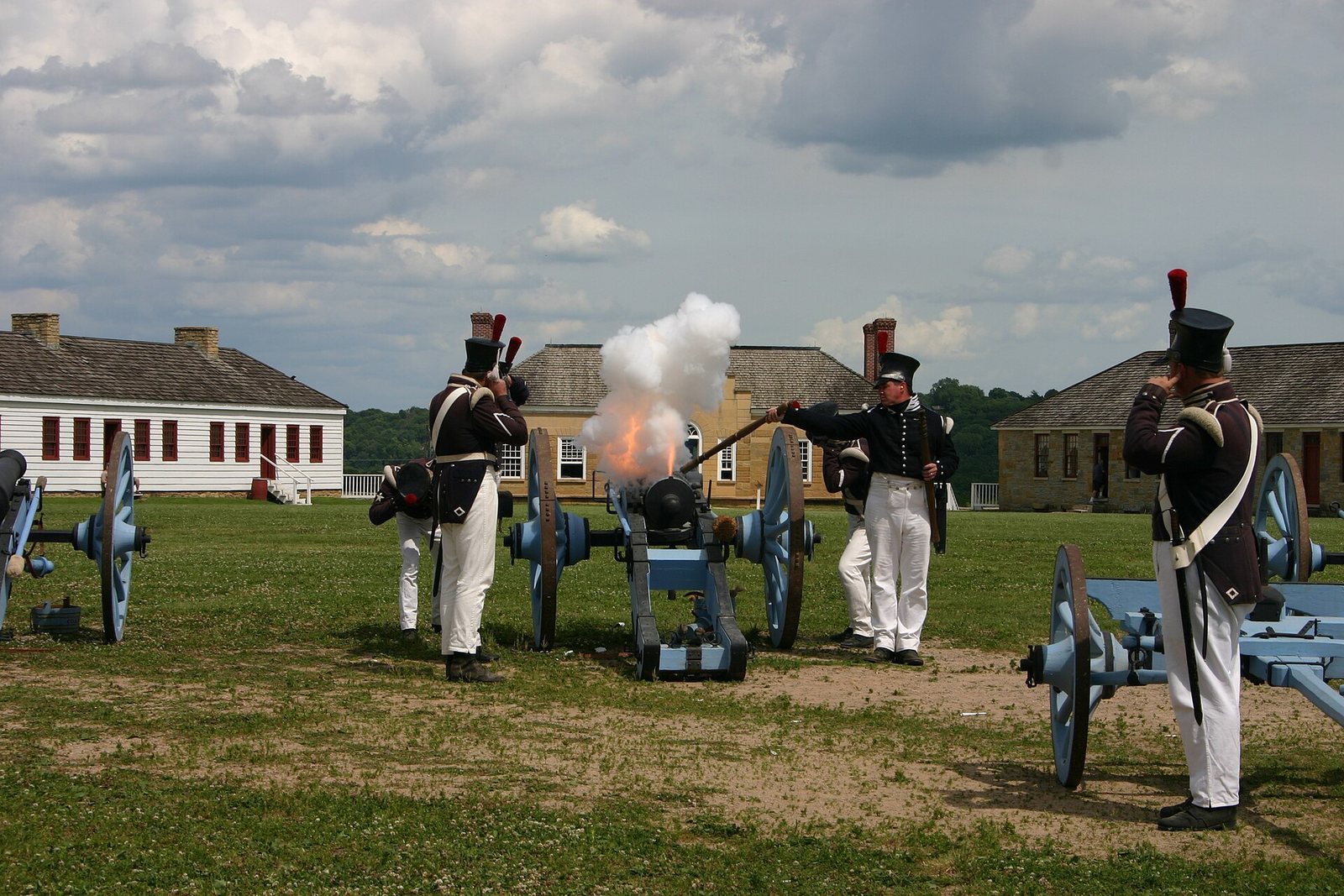
Archaeological work took place in 1957–58 and 1966–67, and reconstruction of the old fort began in the mid-20th century and continued through 1979. Fort Snelling became a National Historic Landmark in 1960 and was added to the National Register of Historic Places in 1966; the Upper Post was also designated a historic district that year. The National Trust for Historic Preservation later called the site a National Treasure and added the Upper Post to its list of America’s Most Endangered Places in 2006. A 2010 protest called for the fort to be returned to Dakota communities.
Remains
The fort’s position on the bluff was chosen so its guns could command both rivers. Local scarcity of building timber led to stone construction. The military reservation covered about 8,000 acres by 1858, extending far beyond the walled fort.
The Lower Post
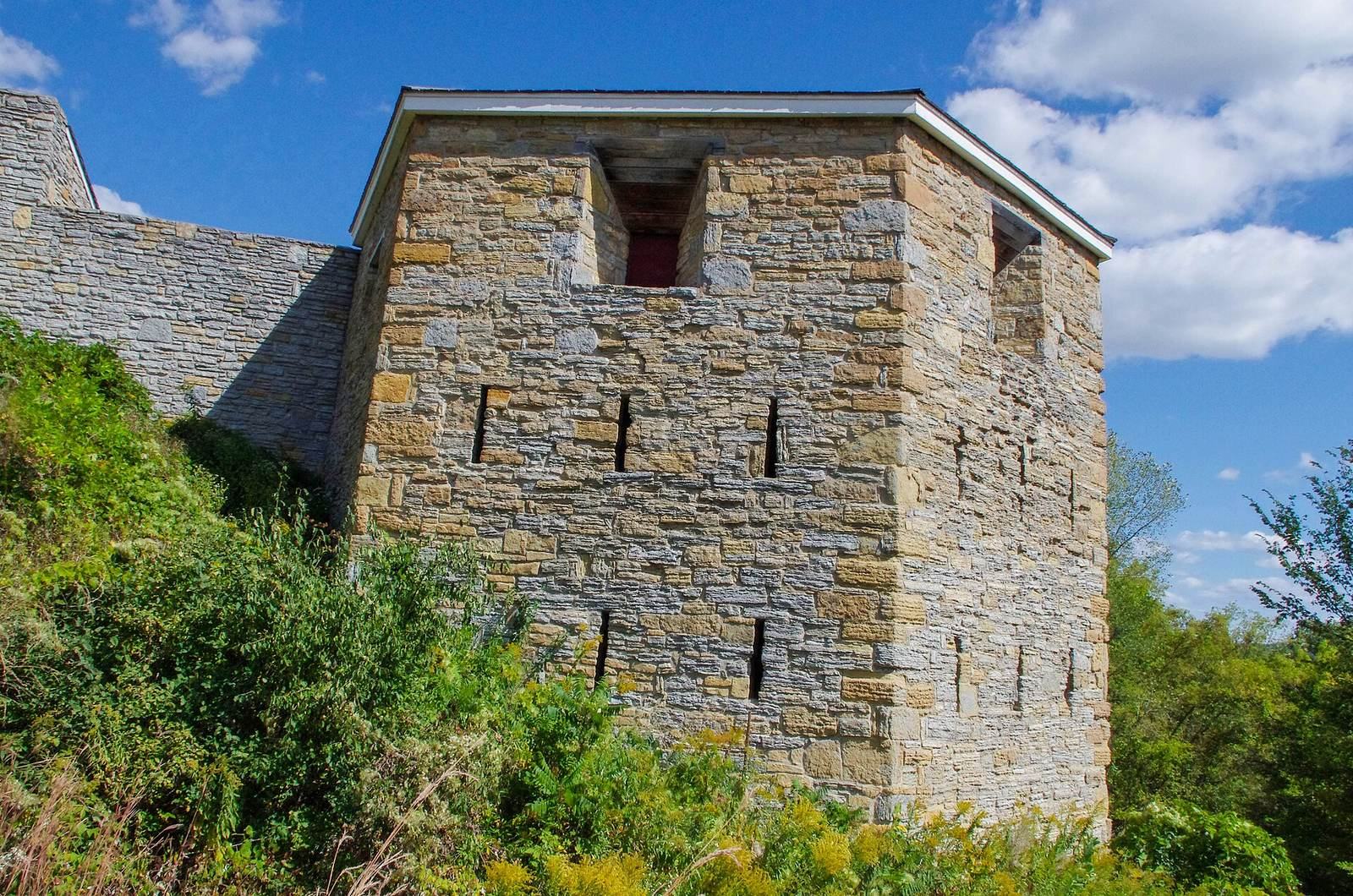
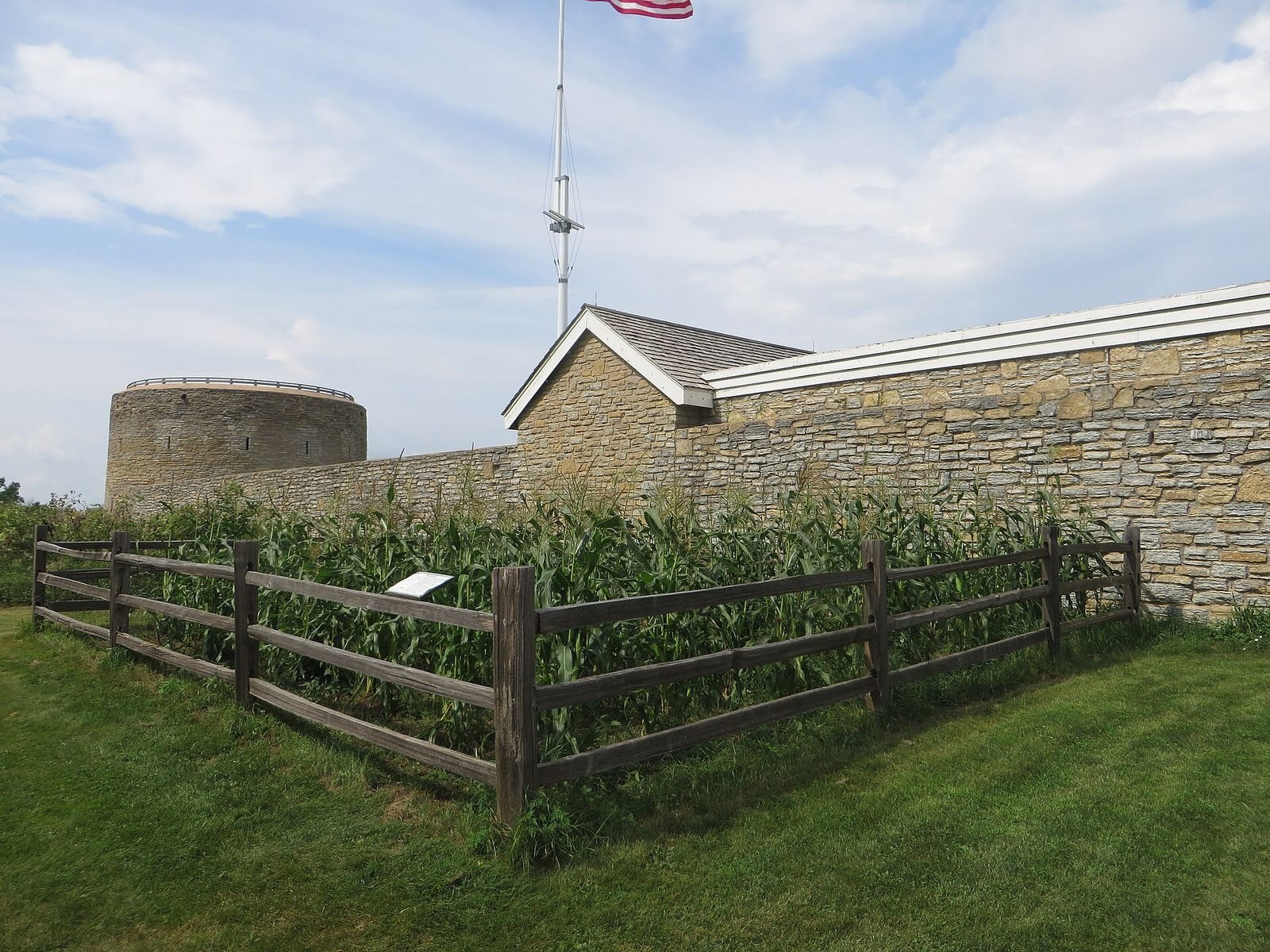
The original walled fort, also known as the Lower Post, included a round tower and a hexagonal tower. The round tower held prisoners from the Indian Agency and criminals sent from St. Paul. It later carried a flagpole, which was removed and installed at ground level. Reconstruction recreated the earlier appearance of the fort, using foundations uncovered by archaeologists to locate demolished buildings and guide the layout.
The Upper Post
The Upper Post contains later military buildings, including structures erected during the post-Civil War expansion. Many buildings from later periods were demolished, while some surviving buildings remain in disrepair.
Railway remains
A railway line completed in 1864–65 crossed the river at Mendota and passed beneath the fort. Pilings from its river crossing remain.
Camp Coldwater and Mendota
The spring at Camp Coldwater, near the fort’s original construction area, supplied its drinking water throughout the 19th century and held spiritual importance for the Dakota. Across from the fort at Mendota, the military reservation also included the St. Peter’s Indian Agency. Below the bluff, the Pike Island encampment held more than 200 tipis within a palisade built by soldiers.
The former reservation today
Fort Snelling National Cemetery, established in the 19th century and expanded after the fort closed, contains more than 160,000 burials. A memorial outside the Fort Snelling State Park visitor center honors Native Americans who died during forced removals associated with the Dakota War. The former reservation now includes the Historic Fort Snelling Interpretive Center, Fort Snelling State Park, the National Cemetery, a VA hospital, veterans’ homes, Coldwater Spring, and the airport and Joint Air Reserve Station. Roads and transportation works, including the Mendota Bridge, an Interstate 494 interchange, and airport access roads, have altered the land. Fort Snelling State Park occupies the bottom of the bluff.