Fort Ballance: A Nineteenth-Century Coastal Artillery Battery in New Zealand
Site at a Glance
- Rating
- 4.5
- Popularity
- Low
- Country
- New Zealand
- Primary era
- Modern
- External website
- Open
- Eras represented
- Modern
- Civilizations
- British
- Site type
- Military
- Remains
- Fort
On this page15 sections
History
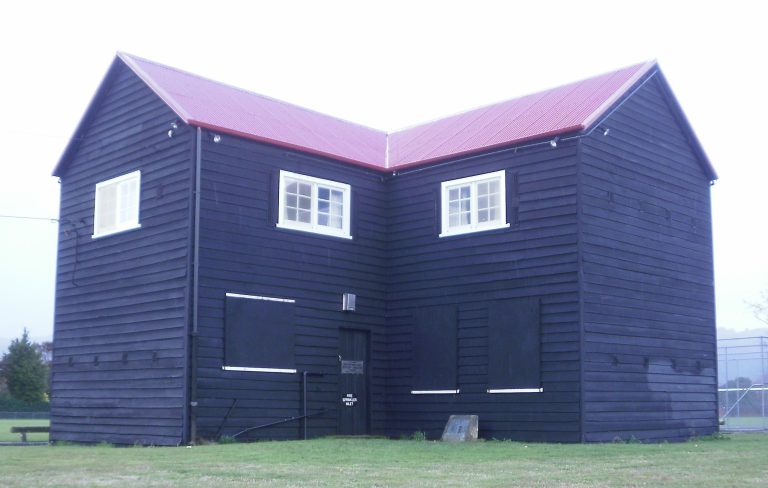
Fort Ballance is a former coastal artillery battery in Wellington, New Zealand, built in 1885 on Point Gordon to defend the harbour during fears of an impending war with Russia. It formed part of New Zealand’s late nineteenth-century coastal-defence network and is an early example of concrete military construction.
Construction and military role
In 1885, the New Zealand Government accepted that the country could not depend entirely on Britain for defence. It commissioned Major Henry Cautley, a military engineer involved in designing New Zealand’s coastal fortifications, to plan defences for the principal ports. Fort Ballance became the leading fort in the Wellington area between 1885 and 1911.
The installation was part of a wider group of positions along the spur between Mahanga Bay and Scorching Bay. Fortifications at Fort Gordon, the Spur Battery, the Low or Foreshore Battery, Kau Point, and Point Halswell supported the main fort. A further position on Mount Crawford was intended to protect the installations from attack over land. Fort Ballance and its associated positions remained in military use for approximately 60 years, from 1885 to 1945.
Accidents and later military use
Fort Ballance experienced two serious accidents during its operational history. On 7 August 1899, three permanent militia members were killed and another was injured when gun cotton exploded during an attempt to demolish the seesaw searchlight emplacement. On 2 November 1904, a breech explosion during live firing with a 12-pounder killed one gunner and injured five others.
After the guns were decommissioned in the years immediately after the war, Fort Ballance and the facilities at Mahanga Bay, Shelly Bay, Fort Gordon, and Kau Point were taken over by the Ammunition Section of the New Zealand Army Ordnance Corps. This army branch managed military equipment and ammunition. Together, the sites formed the corps’ first large-scale ammunition depot until 1929, when purpose-built facilities opened at Hopuhopu Camp in the Waikato. The ammunition infrastructure around Fort Ballance continued in use into the early years of the Second World War.
Preservation
The ruins of Fort Gordon, the Spur Battery, and the Low or Foreshore Battery were partly buried around 1960, and their tunnel entrances were filled. Fort Ballance itself retains much of its nineteenth-century arrangement. Heritage New Zealand listed it as a Category 1 Historic Place on 19 July 1990.
Remains
Fort Ballance
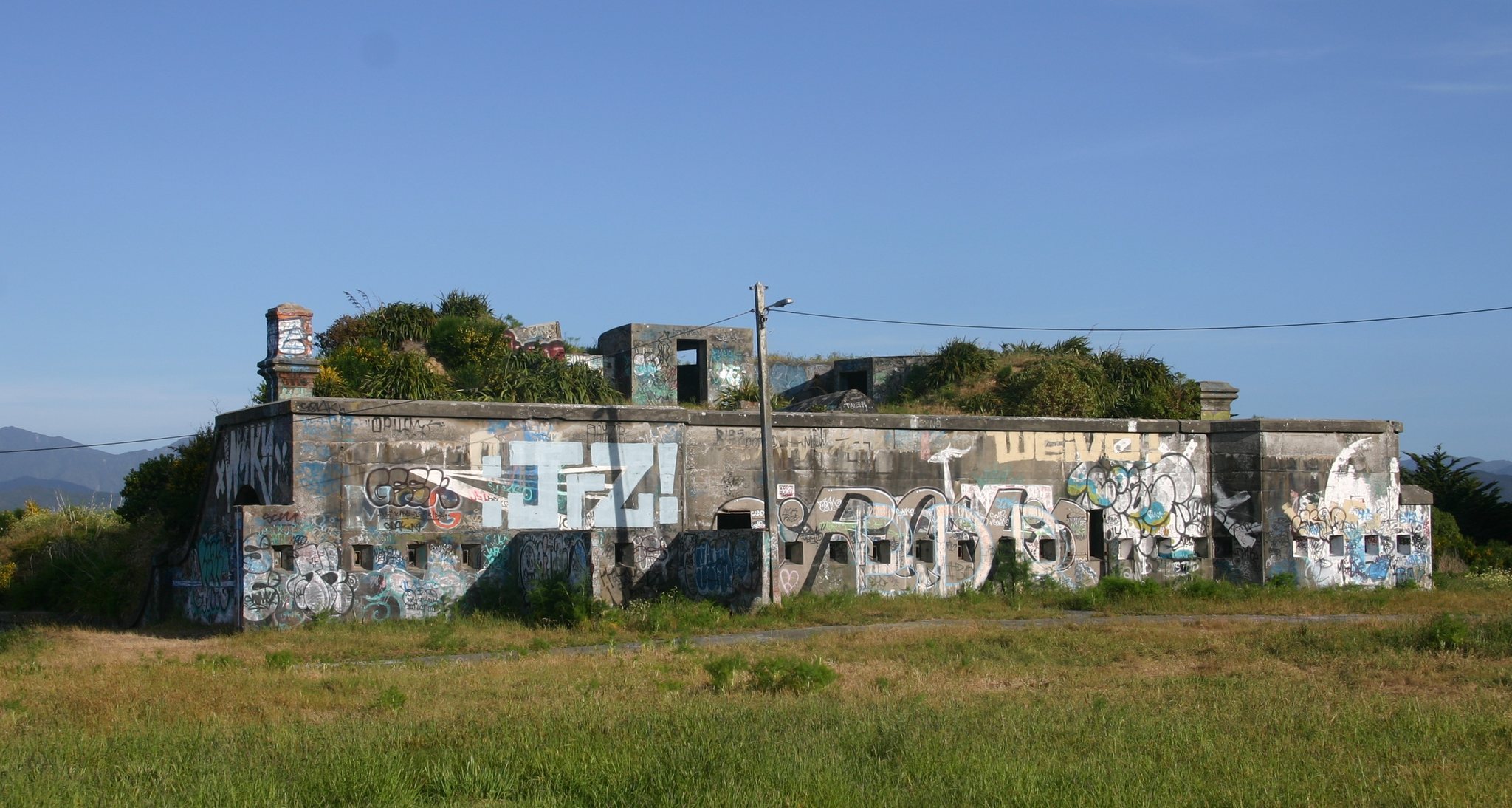
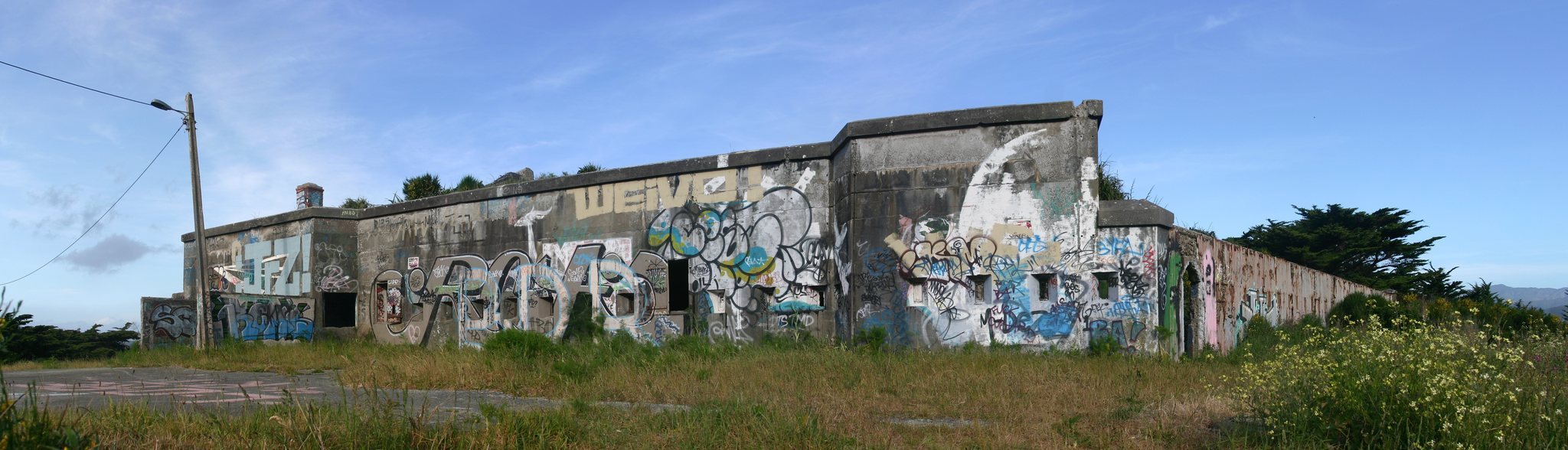
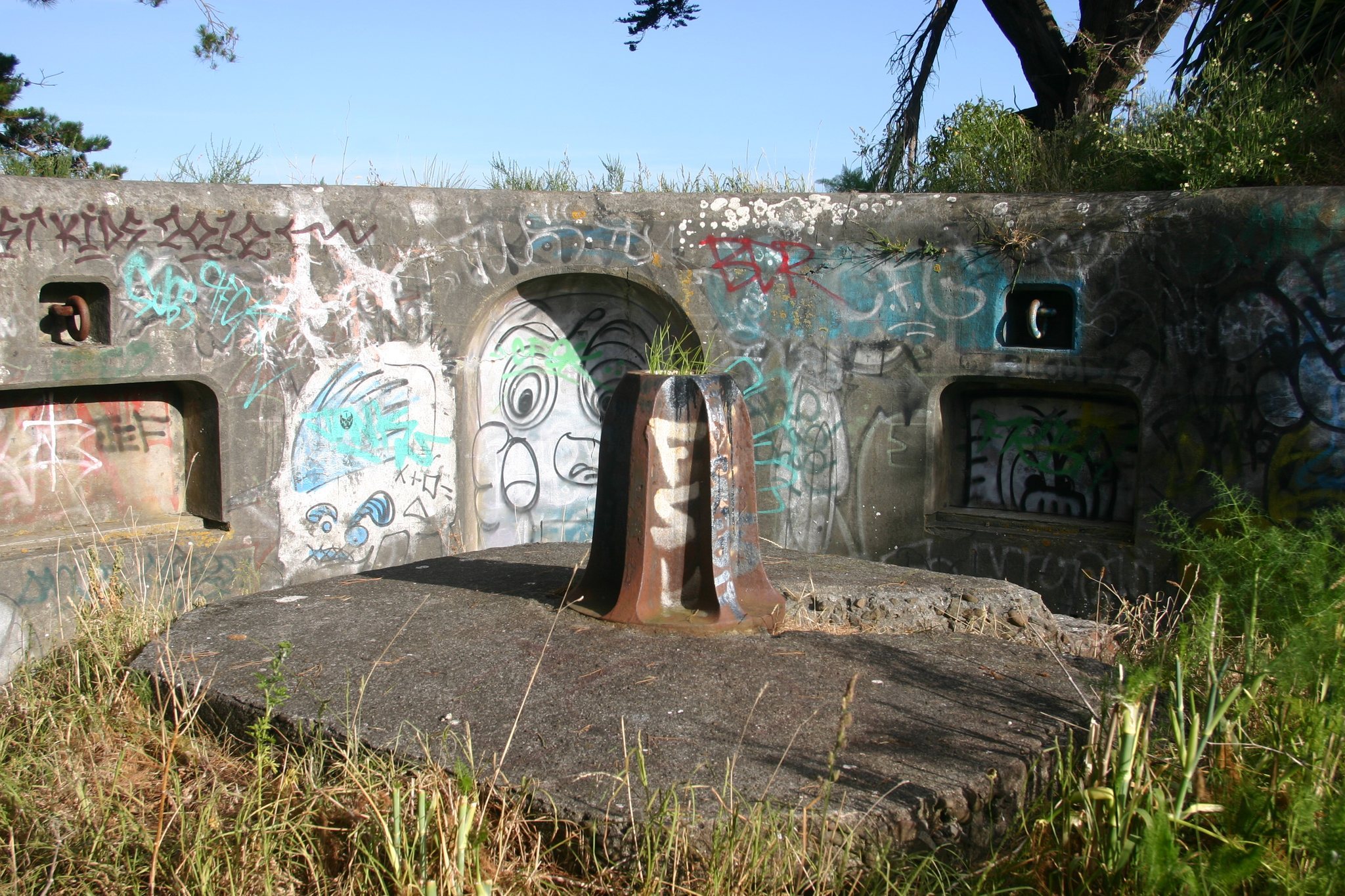
Fort Ballance is the largest installation on the spur between Mahanga Bay and Scorching Bay. Its layout follows the natural shape of the spur, with earthworks raising the centre of the position. The command post and communications centre stood in this elevated area, while further earthworks protected the barracks, ablution areas, magazines, and stores behind the gun pits. The rear of the fort, beside the accommodation casemates, was enclosed by musketry parapets and walls with firing openings. Parts of these walls have since been demolished.
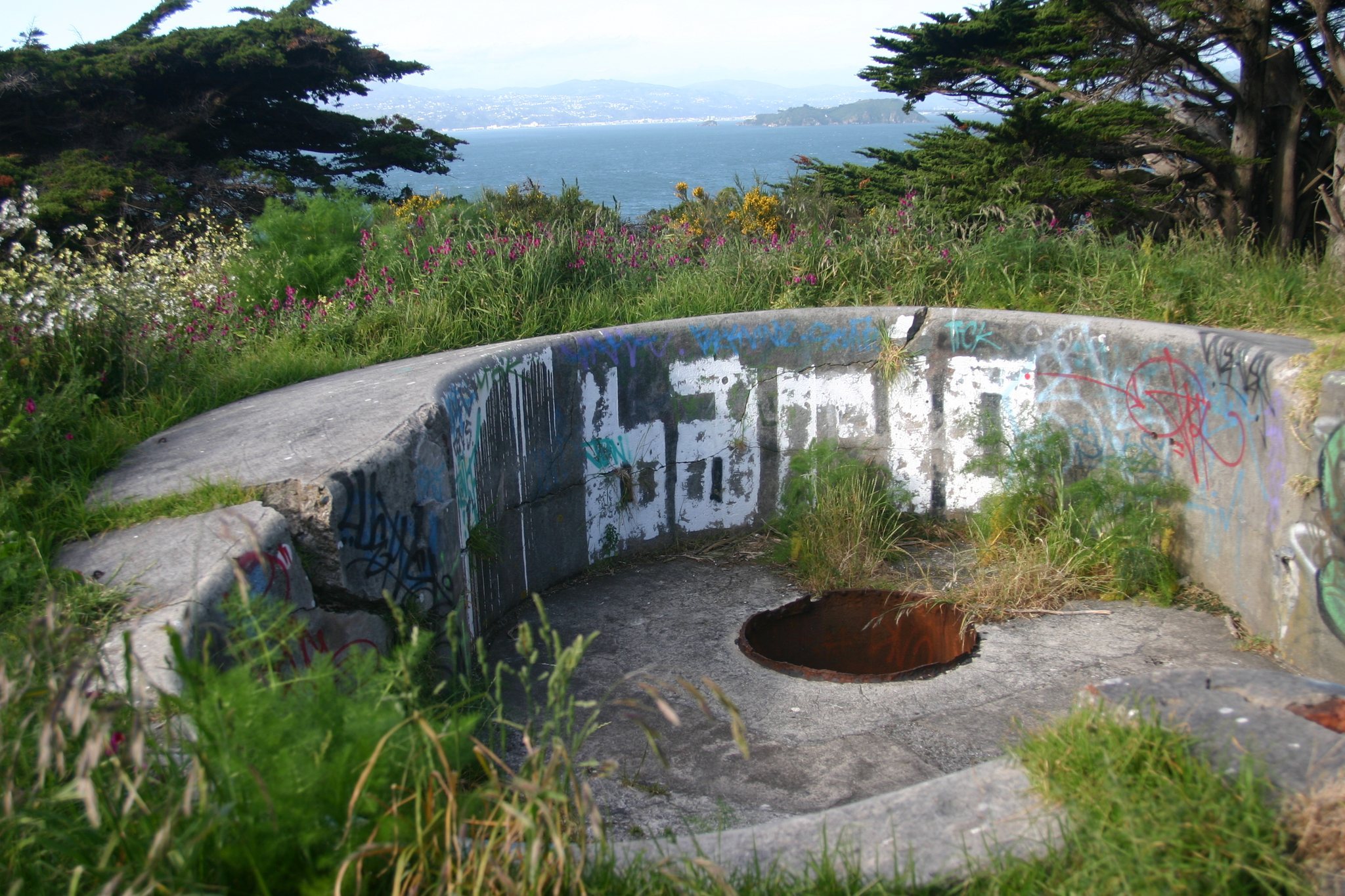
Five principal gun pits faced the channel. Their concrete emplacements are circular or semicircular, with some designed as enclosed positions and others left open. The guns have been removed, but the pits remain intact. The largely unaltered 1880s layout preserves a clear impression of the original fort and evidence of the construction methods used in New Zealand’s coastal defences during that decade.
Gun positions and armament
Fort Ballance carried two 7-inch rifled muzzle-loading guns from 1885 to 1910. A 6-inch disappearing gun, mounted so that it could be lowered behind cover after firing, served from 1886 to 1924. Between 1903 and 1924, another 6-inch disappearing gun replaced one of the 7-inch weapons. Two quick-firing Nordenfeldt 6-pounder guns stood at the flank angles from 1892 until the First World War.
Associated batteries
Fort Gordon and the Spur Battery
Fort Gordon, south of Fort Ballance, consisted of one gun pit and magazines. Its associated armament included an 8-inch disappearing gun and a quick-firing 3-pounder Hotchkiss gun at the Spur Battery, in service from 1895 to 1924.
Low or Foreshore Battery
The smaller positions lower on the spur are now almost completely buried. The Low or Foreshore Battery carried two 64-pounder rifled muzzle-loading guns from 1891 to 1897, followed by two quick-firing 6-pounder Hotchkiss guns from 1897 to 1907. The latter weapons were removed after the First World War.
Gordon Point Battery
The Gordon Point Battery had two quick-firing 12-pounder guns from 1901 to 1923. Its later armament included two BL 4-inch naval Mk VII guns from 1941 to 1959, two Ordnance quick-firing 18-pounder guns in 1942, two 75 mm M1917 guns from 1943 to 1944, and one twin quick-firing 6-pounder 10 cwt gun from 1944 to 1945.
Searchlight and ammunition facilities
Seesaw searchlight emplacement
Below and east of the fort was a seesaw searchlight emplacement established in 1891. Powered by Fort Ballance’s steam engine, it used an electric carbon lamp and a large mirror fixed to a seesaw girder to project a beam across the water. With a power of 50,000 candlepower, it could illuminate targets from the harbour heads to Ward Island. The position was abandoned in 1899, but the emplacement survives.
Magazines, store, and laboratory
The ammunition system at Fort Ballance and the surrounding positions comprised 19 magazines, one store, and a laboratory. A magazine was a fortified chamber for storing ammunition. These facilities formed part of the larger military supply complex that operated around the fort after the gun positions had been decommissioned.
Wider defensive positions
The positions at Kau Point and Point Halswell supplied additional firing support to the coastal-defence system. The Mount Crawford position had a different purpose, defending the installations against attack from land.