Eshaqvand Tombs: Rock-Cut Burial Chambers in Iran
Site at a Glance
- Popularity
- High
- Country
- Iran
- Primary era
- Classical
- Eras represented
- Iron Age, Classical
- Civilizations
- Achaemenid, Median, Parthian, Seleucid
- Site type
- Burial
- Remains
- Tomb
On this page8 sections
History
The Eshaqvand Tombs are a group of rock-cut burial chambers at Sakavand in Kermanshah province, Iran. Their date and cultural attribution are disputed, and no single period or civilization has been established as their origin.
Date and cultural attribution
Proposals connect the tombs with the Medes, an ancient Iranian people, or with the Achaemenids, the Persian dynasty that ruled the first Persian Empire. One interpretation places them in the seventh or sixth century BC and identifies them as Median; other descriptions assign them to the late Achaemenid period. Seleucid and Parthian dates have also been considered. The Seleucids were a Greek dynasty that ruled parts of western Asia after Alexander the Great, while the Parthians were a later Iranian dynasty.
Roman Ghirshman first attributed this kind of carved relief, in which figures stand out from a surrounding surface, to the Medes. He pointed to the site’s position in ancient Media and the clothing shown. Another proposed date for the reliefs is the fourth or third century BC, around the end of Achaemenid rule or the beginning of Seleucid rule; a Parthian date remains a possibility. The principal figure’s clothing has also been used to support a late Achaemenid or immediately post-Achaemenid date for the first carving.
Proposed identification and protection
Ernst Herzfeld connected a tomb at Sakavand with Gaumata, a Magian whom Darius the Great said had claimed the Persian throne. The proposed link rested on a resemblance between the name Sakavand and that of a fortress associated with Gaumata’s death. The identification is disputed because Darius’s account says that he killed Gaumata.
The tombs are registered as a national monument of Iran.
Remains
The Farhād-taš group
Rock-cut chambers
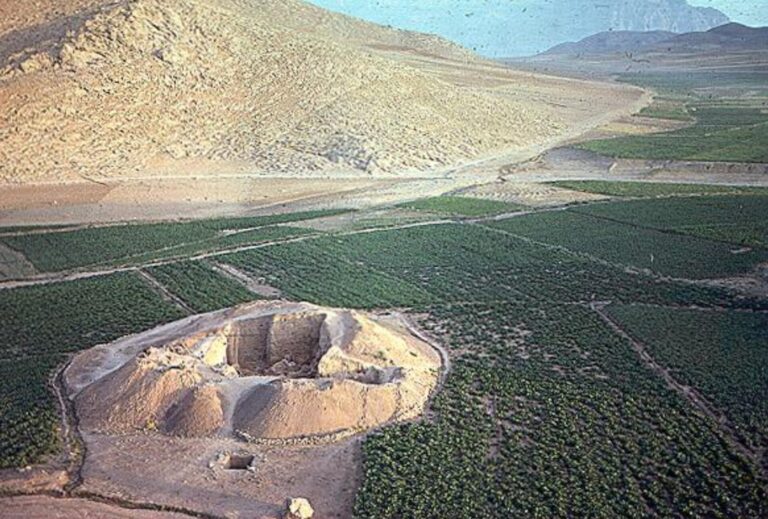
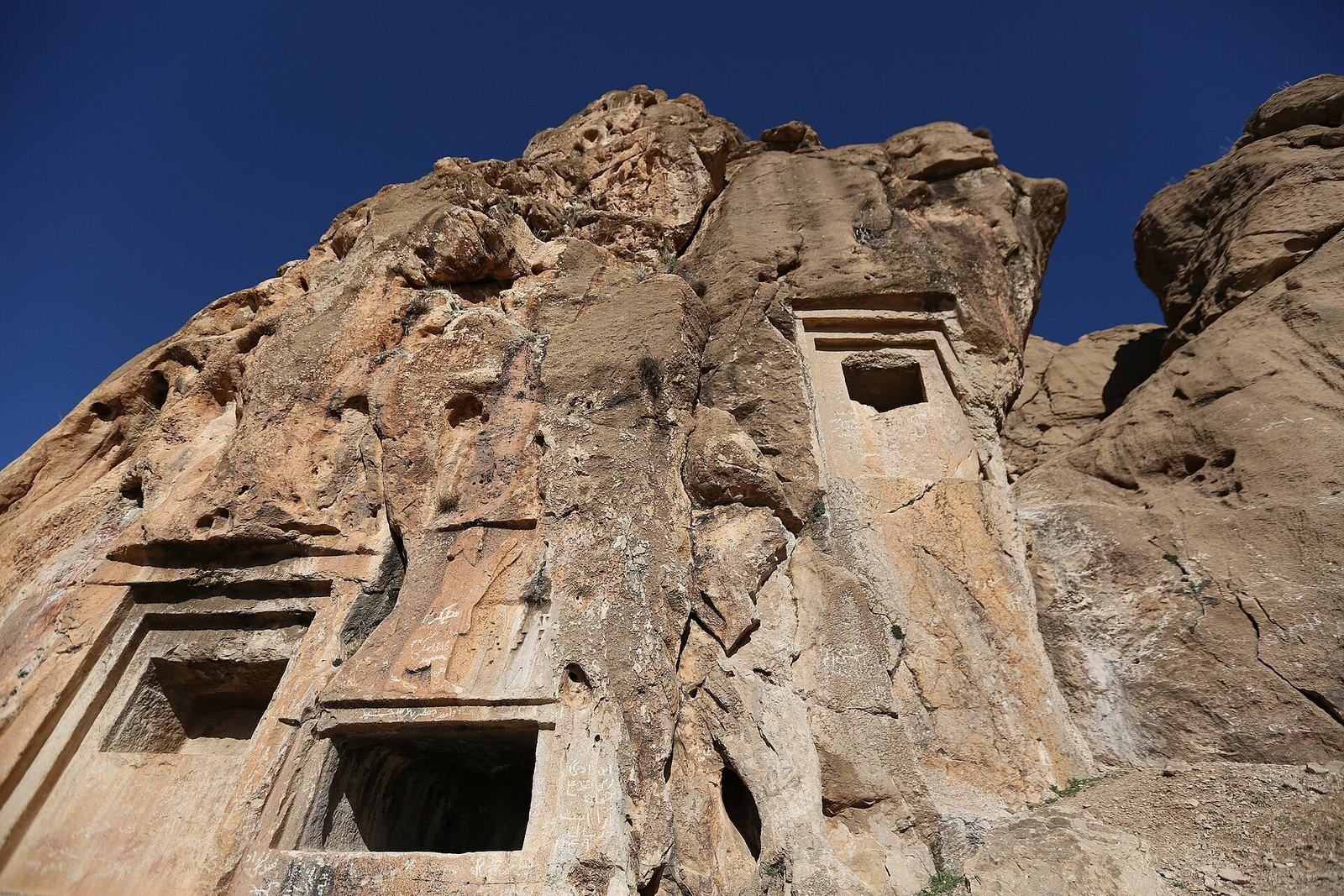
Three small tombs are cut into the slopes of an isolated rock locally called Farhād-taš, or “Farhād’s Rock.” The site lies about 25 km southwest of Harsin and 25 km south of Behistun. The chambers are often close to human size. This type of tomb, also called an ossuary, is known in Media and especially in Fars, a region in southern Iran.
Carved panel
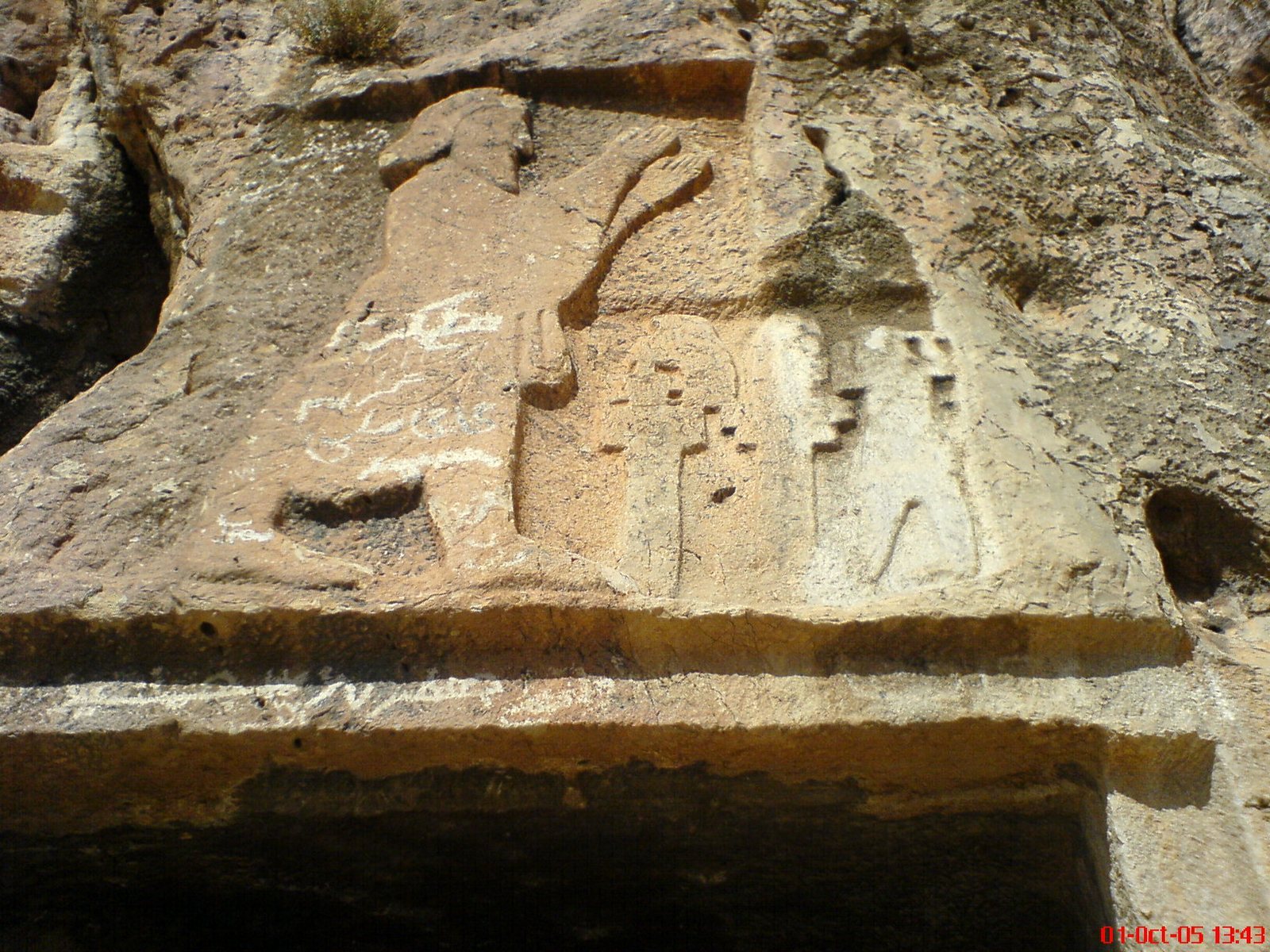
A panel above the central tomb was carved in at least two phases. The earlier carving shows a bareheaded figure, 1.87 m tall, wearing a long robe resembling clothing associated with Elam, an ancient civilization in southwestern Iran. The figure raises both arms in prayer. A smaller addition to the right depicts an incense burner, a fire altar, and another praying figure. This second figure wears a pointed cap of Achaemenid type, with ribbons trailing behind, and holds an indistinct object that may be a hook for tending the fire. The figures are uneven in proportion, and their rough carving has been compared with earlier work by the Lullubians, an ancient people of the Zagros, and the Elamites.
Oṭāq-e Farhād
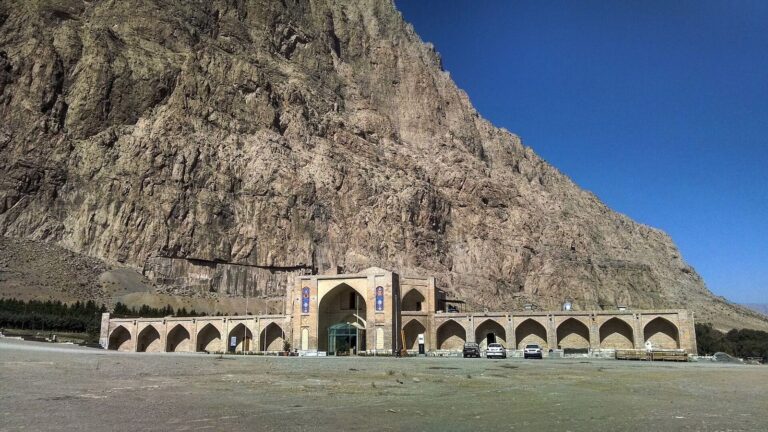
A fourth tomb lies near Sorḵa-deh at Oṭāq-e Farhād, meaning “Farhād’s Chamber.” It is cut into a cliff rising 50 m above the river’s left bank. Its form resembles the tombs at Farhād-taš, and it appears to have been left unfinished.