Delal Bridge: An Ancient Crossing of the Khabur River
Site at a Glance
- Rating
- 4.6
- Popularity
- Low
- Country
- Iraq
- Primary era
- Medieval
- Eras represented
- Medieval
- Civilizations
- Abbasid
- Site type
- Infrastructure
- Remains
- Bridge
On this page6 sections
History
Delal Bridge is an ancient stone bridge crossing the Khabur River at Zakho in northern Iraq. It is believed to have originated during the Roman period, while the surviving structure is generally attributed to the Abbasid period, the era of the caliphate that ruled much of the Islamic world from the eighth to the thirteenth century. Its precise date remains uncertain because the bridge has no inscription establishing when it was built. The names Pira Delal and Pirdí Delal use Kurdish words meaning “Delal’s Bridge” or “beautiful bridge.” Other names include Abbasid Bridge, Khabur Bridge, and Great Bridge.
Origins and historical attributions
Traditions differ about the bridge’s early history. Some attribute its original construction to the Roman commander Seleucus, while some Iraqi archaeologists connect its construction or repair with a ruler of Bahdinan, a Kurdish emirate in northern Mesopotamia. Another tradition states that Emir Hasan ordered his deputy in Zakho, Naser al-Din al-Abbasi, to build the bridge so that army supplies could be transported and communications secured. This account says that the work took approximately a year and a half.
The bridge’s name is also linked to a widespread Kurdish legend about Delal, a woman said to have been buried beneath it as a sacrifice after its central section repeatedly collapsed during construction. In the traditional story, Delal accepted the sacrifice to save the bridge and her city. The legend explains the bridge’s name and symbolic meaning rather than providing independently established evidence of a burial beneath the structure.
Conflict, destruction, and preservation
In 1833, Muhammad Rawandizi, known as Miri Kora, occupied Zakho and demolished the upper part of the bridge, apparently to obstruct the advance of Ottoman forces. After British forces occupied Zakho, they placed TNT in the central arch so that the bridge could be destroyed if Ottoman forces advanced. The explosives were removed in 1955 in the presence of Hussein Tovi, then deputy police chief of Zakho.
A severe flood destroyed the northern part of the bridge in 1969. The bridge was called Khabur Bridge by an archaeologist who visited it on 15 May 1909, while local usage continued to preserve the names Delal Bridge, Abbasid Bridge, and Great Bridge. It remains one of Zakho’s prominent historic landmarks.
Cultural traditions
Delal Bridge also holds a place in Assyrian cultural memory through its association with the traditional folk song “Dalaleh,” also known as “Dalale,” “Dalali,” or “Dalaliyeh.” Assyrian communities perform the song at weddings, festivals, and communal celebrations. Within this tradition, the bridge is associated with beauty, endurance, emotional longing, and connection to ancestral landscapes.
Remains
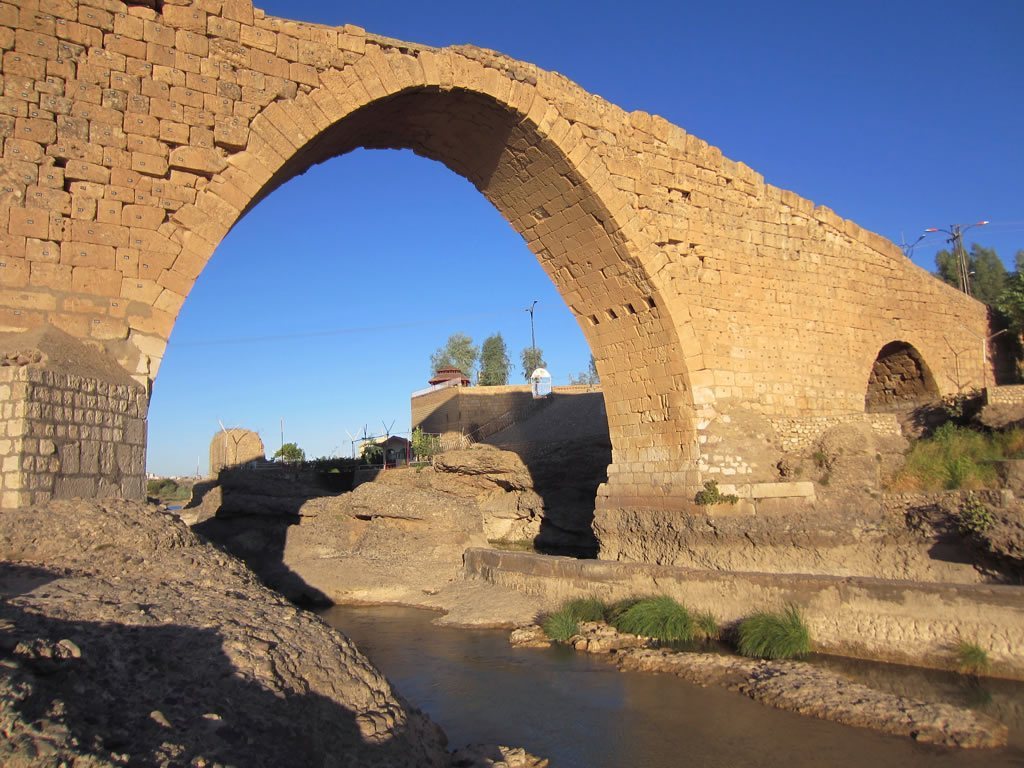
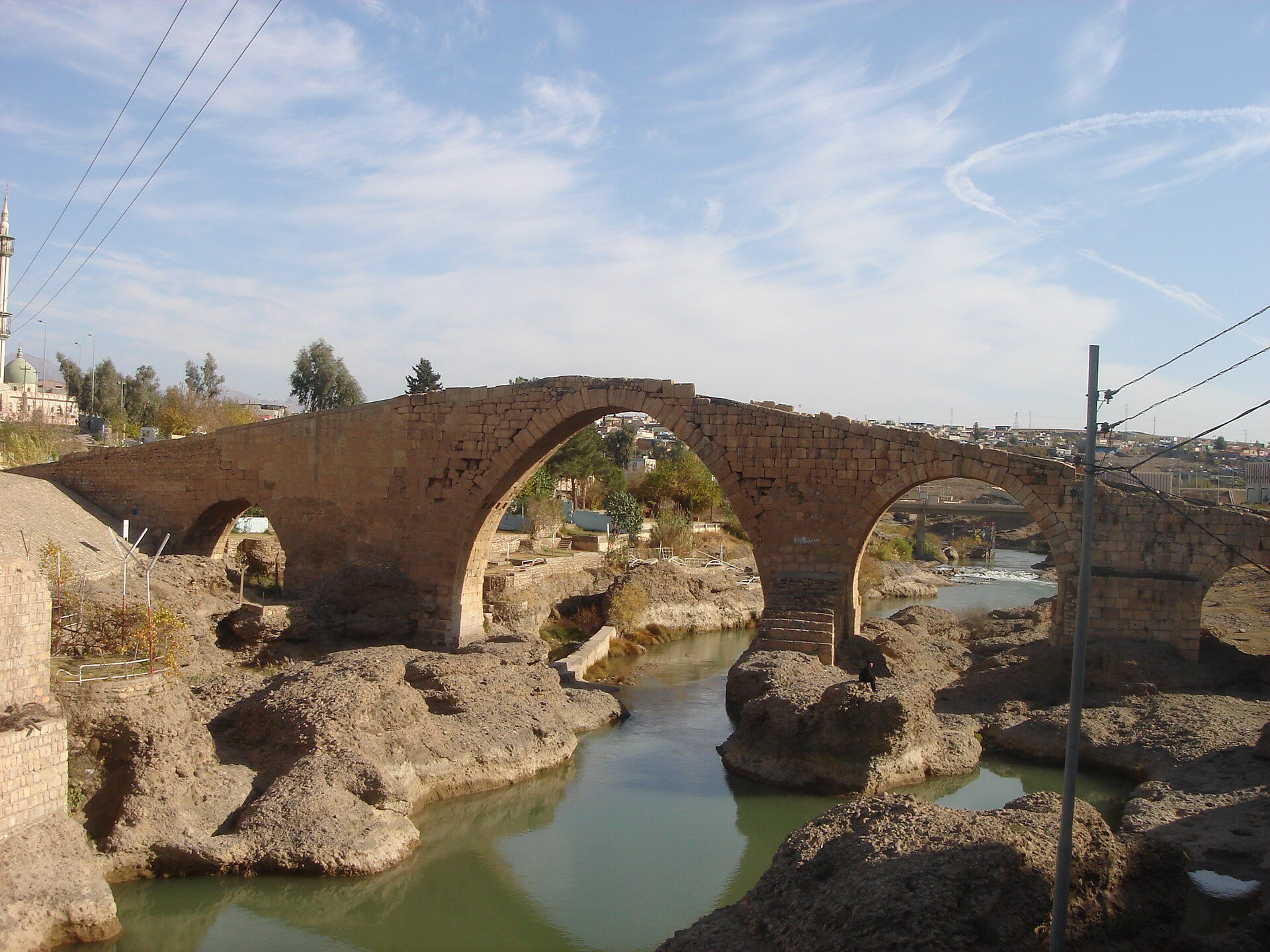
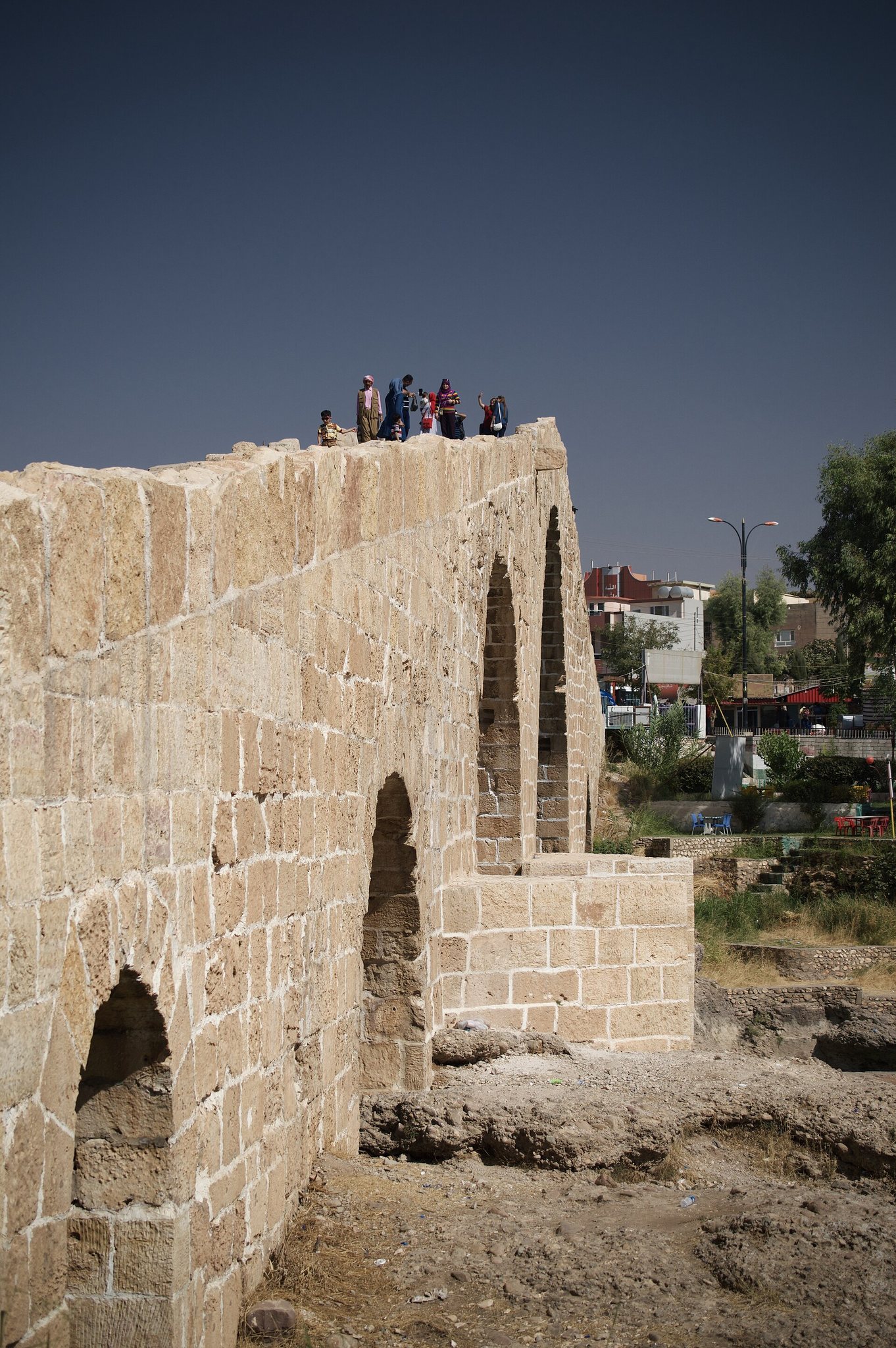
Delal Bridge is a stone structure spanning the Khabur River on the eastern side of Zakho and linking its two banks. It measures approximately 115 metres in length, about 4.70 to 5 metres in width, and roughly 15.5 to 16 metres above the river. Its walls are built from large carved and worked limestone blocks.
Arches and surviving features
The bridge is formed by six semicircular arches. A semicircular arch has a curved opening shaped as half a circle, rising symmetrically from its supports. One large central arch is flanked by five smaller arches, creating the structure’s principal rhythm across the river. The northern portion was destroyed by the 1969 flood, while the surviving stonework preserves the bridge’s principal crossing and its relationship to the riverbanks.
A gap between stones on one side of the bridge supports two long plants traditionally cultivated by local inhabitants. They regard these plants as representations of Delal’s braided hair, linking a visible feature of the masonry with the bridge’s foundation legend.