Church of John the Baptist in Sambir: A Roman Catholic Parish Church in Ukraine
Site at a Glance
- Popularity
- Low
- Country
- Ukraine
- Primary era
- Early Modern
- Eras represented
- Early Modern, Modern
- Civilizations
- Austria-Hungary, Habsburg, Kingdom of Poland, Polish–Lithuanian Commonwealth
- Site type
- Religious
- Remains
- Church
On this page8 sections
History
Medieval parish and stone church
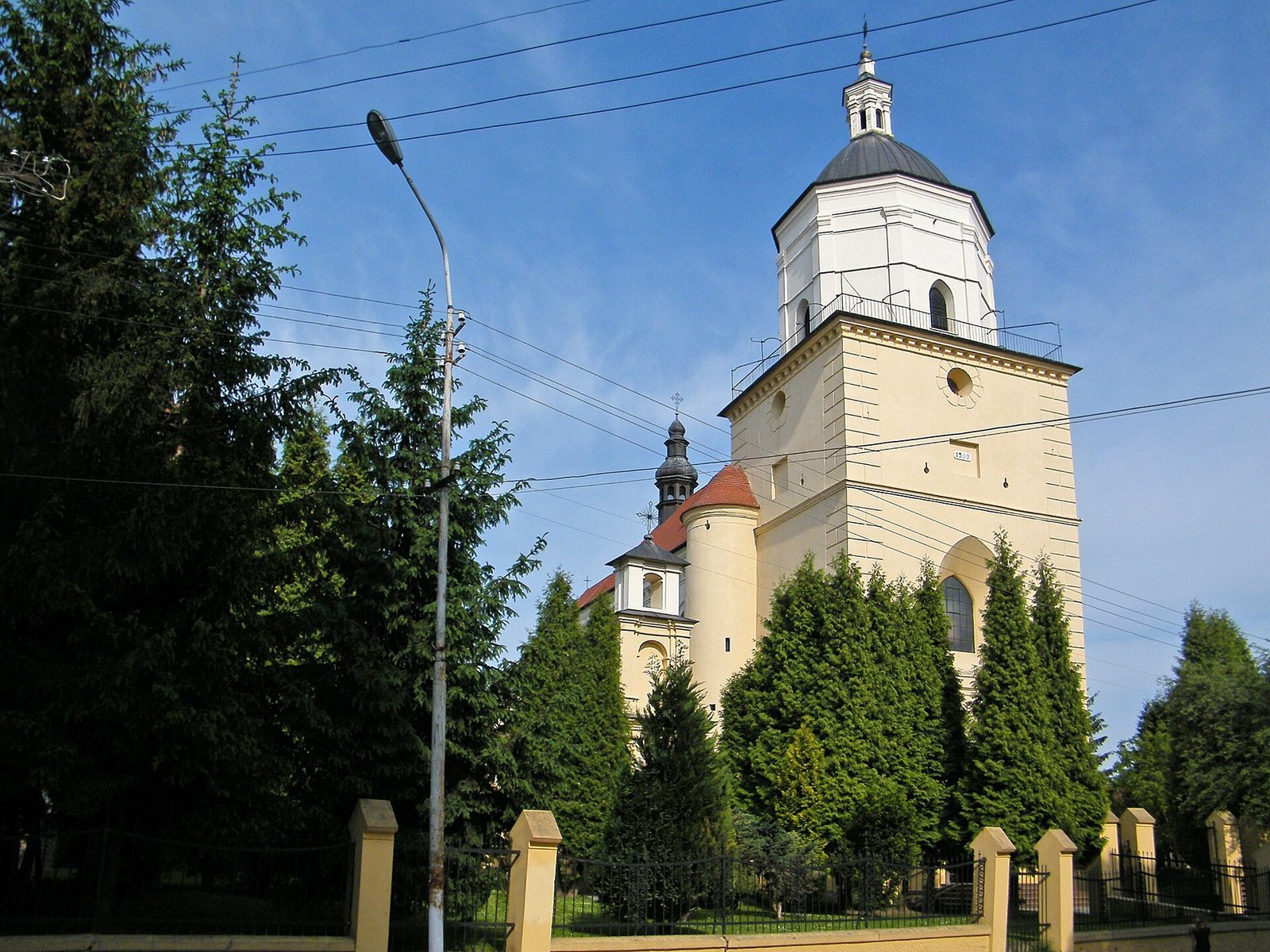
The Church of John the Baptist in Sambir is an active Roman Catholic church in Ukraine’s Lviv region. Its stone building, begun around 1530, combines Gothic and Renaissance architecture. A Roman Catholic parish and a small wooden church already stood on the site by about 1370. The wooden church burned during the 1498 Tatar attack on Podolia and Galicia.
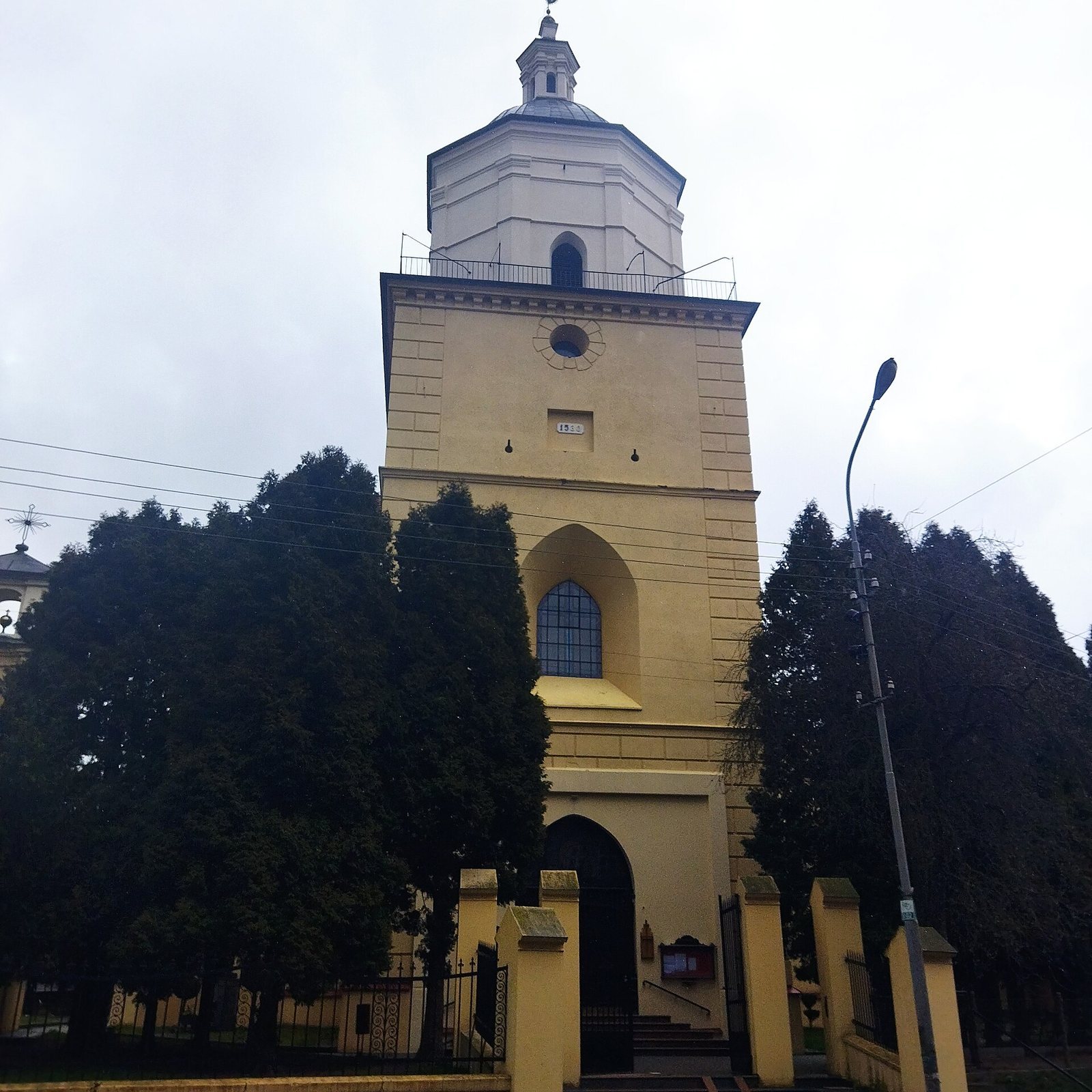
An inscription on the stone church’s façade gives the date 1530, considered the likely beginning of its construction. Work proceeded in stages: the choir and an adjoining room date from 1530–1565, while the vault was erected in 1573–1574. Archbishop J. Solikowski consecrated the church. A hospital associated with it operated until the beginning of the nineteenth century.
Fires and rebuilding
Four fires affected the church during its history. In 1637, a fire destroyed the tower and vault, while the side aisles survived. The church had been rebuilt by 1642, and Bishop S. Sarnowski consecrated it again in 1664. In 1846, another fire destroyed the roof and badly damaged the vault above the choir; the church was subsequently rebuilt.
Nineteenth century to the present
Bishop Joseph Pelczar served at the church in 1864–1865. He was later canonized as a saint by the Catholic Church. The building received further restoration and decorative work in the late nineteenth century, followed by another restoration in 2001–2002. After the Second World War, it remained active, with Father Kazymyr Monchynskyi serving there. Since 1990, its care has involved Resurrectionist priests, members of a Roman Catholic congregation, and the Franciscan Sisters of the Family of Mary, a women’s religious congregation. The church belongs to the Sambir deanery, a local grouping of Catholic parishes, within the Archdiocese of Lviv, which is headed by an archbishop. It is protected as a Ukrainian architectural monument of national significance, under protection number 398.
Remains
Plan and exterior
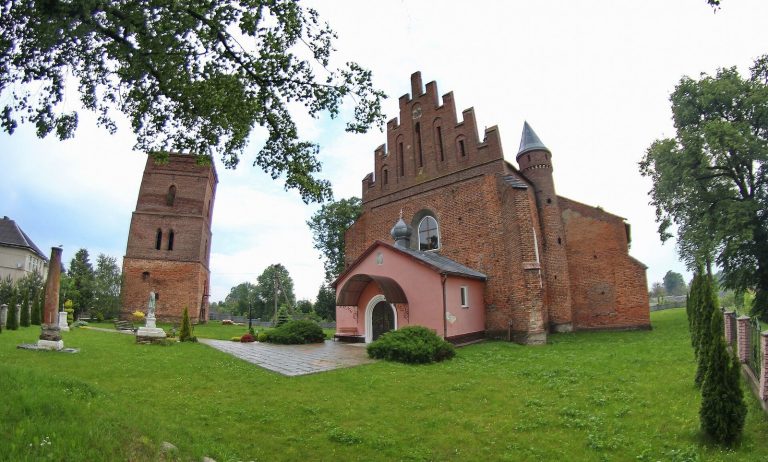
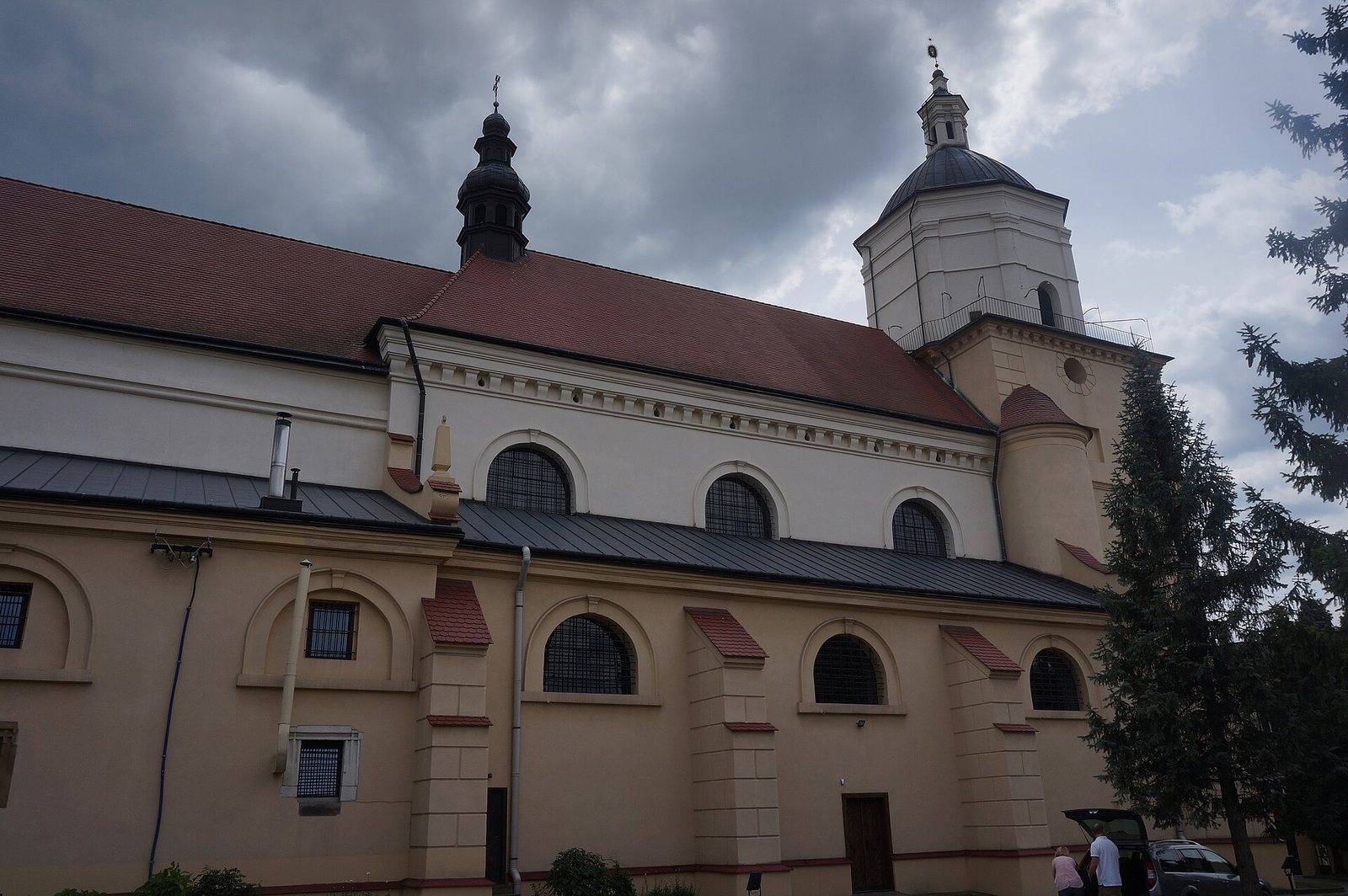
Built of brick and stone, the church has a three-aisled basilical plan, with a central nave flanked by side aisles. Its main body is square, while the elongated choir ends in a polygonal apse, the many-sided terminal part of the church. A substantial bell tower stands at the west façade. The plan is made asymmetrical by a room adjoining the choir on the north and a semicircular tower between the bell tower and north aisle. Stone stairs inside the semicircular tower lead to the choir and upper levels of the bell tower. Exterior buttresses, supports that brace the walls, strengthen the structure. The church is described as Sambir’s oldest and tallest building.
Bell tower and interior
The square bell tower has four levels. Its uppermost level is octagonal and supports a helmet-shaped dome topped by a lantern. In the choir and adjoining room, Gothic features include a star vault, whose ribs form a star-like pattern, pointed windows and arches, and a Gothic doorway into the side room. The three-aisled main body has Renaissance features: a continuous barrel-shaped ceiling with lunettes, curved spaces where a vault meets a wall, over the central nave, and intersecting cross vaults over the side aisles. Stucco decorates the central nave’s vault.
Later decoration and associated buildings
Metal grilles were added to the cornices in 1886–1887, the side aisles were restored in 1889, and the entrance vestibule in 1893. Ya. Tabinskyi painted the central nave; stained-glass windows were installed in 1923, and the choir galleries were painted in 1929. A one-storey parish house near the church once housed a Polish parish school. A masonry school building was erected on the site of an earlier school in 1715–1727 and now houses the Boykivshchyna Museum. A new parish house was built nearby between 1990 and 2000. In front of the church stands a stone statue of Pope John Paul II, placed there in 2007 and consecrated by Bishop Marian Buczek on 18 May that year.