Berel Kurgan: An Early Nomadic Burial Complex in Kazakhstan
Site at a Glance
- Popularity
- Very High
- Country
- Kazakhstan
- Primary era
- Iron Age
- Eras represented
- Iron Age
- Civilizations
- Scythian
- Site type
- Burial
- Remains
- Necropolis
On this page9 sections
History
The Berel kurgan is a burial complex in eastern Kazakhstan, about 7–8 km southwest of Berel village. Its Early Saka mounds, associated with ancient nomadic peoples of Central Asia, are generally dated to the fifth through third centuries BCE. Later graves belong to the ancient Turkic period, the era of early Turkic peoples and polities, in the seventh and eighth centuries CE. The cemetery served as a burial place for leaders and elites of Pazyryk society, an Iron Age nomadic culture associated with the Altai region.
Early Saka and Pazyryk burials
The earliest mounds are dated to the fourth and third centuries BCE. Finds connect the cemetery with the middle and late phases of Pazyryk culture, dated respectively to the fifth century BCE and the fifth to fourth centuries BCE. Material from the fifth to fourth centuries BCE is also associated with the Berel stage, an archaeological designation for a phase of early nomadic culture in eastern Kazakhstan.
Excavation and modern study
Vasily Radlov excavated the Great Berel mound in 1865, after it had been looted in antiquity. Finds passed to the Archaeological Commission, the imperial Russian body responsible for archaeological excavations and antiquities, and then to the Moscow Public Museum. They are now held by the State Historical Museum in Moscow. Some objects Radlov listed in his diary and records never reached a museum and are presumed lost. In 1959, Sergei Sorokin led another investigation of the mound in an expedition organized by the Leningrad branch of the USSR Academy of Sciences’ Institute of Archaeology, at the initiative of Sergei Rudenko.
Systematic work associated with Zainolla Samashev began in 1997; 20 monuments were investigated from that year onward. A Kazakh-French expedition led by Samashev examined several mounds in 1998 and 1999, including mound 11. In 2003, an expedition led by Abdesh Toleubaev found a mound dated to the eighth and seventh centuries BCE, called the “Golden Mound of the Kings.” Its ornaments later provided the basis for reconstructing Kazakhstan’s third “Golden Man,” a reconstruction of a richly adorned ancient burial. The king’s clothing was thought to have been embroidered entirely with gold and worn continuously.
Research using environmental, animal, human, and other scientific methods yielded information about the region’s ancient environment and animals, and enabled DNA study of early nomads. Genetic analysis placed a man from Berel close to Kazakhs, Uzbeks, Turkmens, and people of northern China. The Berel State Historical and Cultural Museum-Reserve was established by government decree on 4 July 2008 to protect and study the monuments, conserve them and their surroundings, and support scientifically grounded restoration. Berel is listed as a monument of national significance in Kazakhstan and is included in the country’s national sacred-sites list.
Remains
Cemetery layout and construction
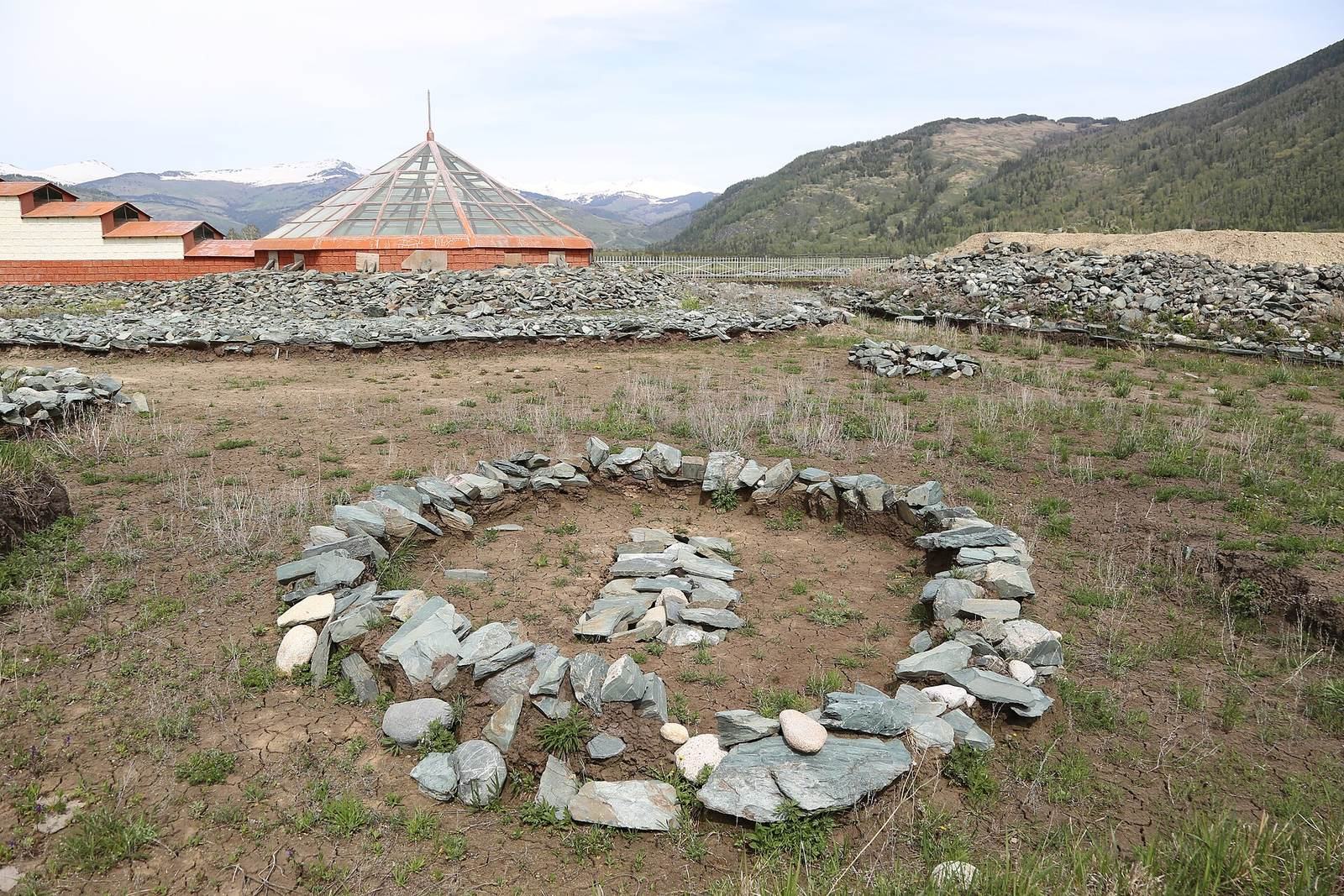
The cemetery covers an area about 4,000 by 1,000 metres on the right bank of the Bukhtarma River, at roughly 1,120 metres elevation on a terrace above the floodplain. The Bukhtarma and Berel rivers meet to the north, the Kansu River lies to the south, and mountains bound the site to the east and west. More than 100 mounds of different sizes, along with ritual monuments, are arranged in chains and separate groups, with the chains running northwest to southeast. The main groups include six mounds near the middle of a mountain escarpment, a chain of 12 to its west, and nine to its east. The Great Berel mound is the largest in the eastern group, and it and adjacent smaller mounds form a distinct cluster. Mounds were built from small river cobbles mixed with broken mountain stone. Their varying sizes are interpreted as reflecting social divisions among those buried there.
Burial chambers and offerings
Great Berel mound
Excavated graves lay about 2–3 metres below the mound surface and included timber chambers and coffins hollowed from thick tree trunks. A coffin from the Great Berel mound was carved from a single larch trunk and covered with birch bark. Bronze figures of mythical birds with horse-like eyes and outstretched wings decorated its corners; the figures were cast in different moulds. The grave also included a wooden sarcophagus and an outer wooden chamber holding the ritual remains of 17 sacrificed horses, together with horse gear.
Mound 11
Mound 11 contained the burials of a man aged about 35–40 and an elderly woman, accompanied by 16 horses. Grass remains were found in the horses’ stomachs. Some hollowed coffins elsewhere in the cemetery were made from pine.
Frozen graves and preserved objects
Excavations of mounds 4, 9, 10, and 11 revealed graves preserved in frozen ground. In some burials, the combination of freezing conditions, mound materials, and grave construction preserved horse remains, including horse mummies, as well as human remains and a human mummy. Organic objects that would usually decay also survived, including clothing, horse gear, saddles, wooden objects and vessels, leather goods, felt, and textiles. Finds include finely worked gold ornaments and gilded wooden decorations in the Scytho-Siberian animal style, an artistic tradition characterized by animal imagery.