Arzhan: Early Saka Burial Sites in Tuva, Russia
Site at a Glance
- Popularity
- High
- Country
- Russia
- Primary era
- Iron Age
- Eras represented
- Iron Age
- Civilizations
- Scythian
- Site type
- Burial
- Remains
- Necropolis
On this page17 sections
History
Arzhan is the collective name for Uyuk-culture burial sites in Tuva, Russia, including the early Saka burial mounds of Arzhan 1 and Arzhan 2. The Saka were eastern peoples related to groups called Scythians elsewhere across the Eurasian steppe. Arzhan’s traditions are placed broadly in the ninth and eighth centuries BC, within the initial Scythian period, usually dated to the eighth and seventh centuries BC.
Early Saka and Scythian origins
Arzhan has helped shape interpretations of where Scythian culture first developed. Eastern burial mounds are older than western examples, while animal-style art, with its stylized depictions of animals, was present in the Yenisei region and what is now China by the tenth century BC. This evidence has supported the view that Scythian culture emerged among eastern groups and spread west across the steppe. The westward appearance of animal designs during the ninth to seventh centuries BC may have accompanied human migration.
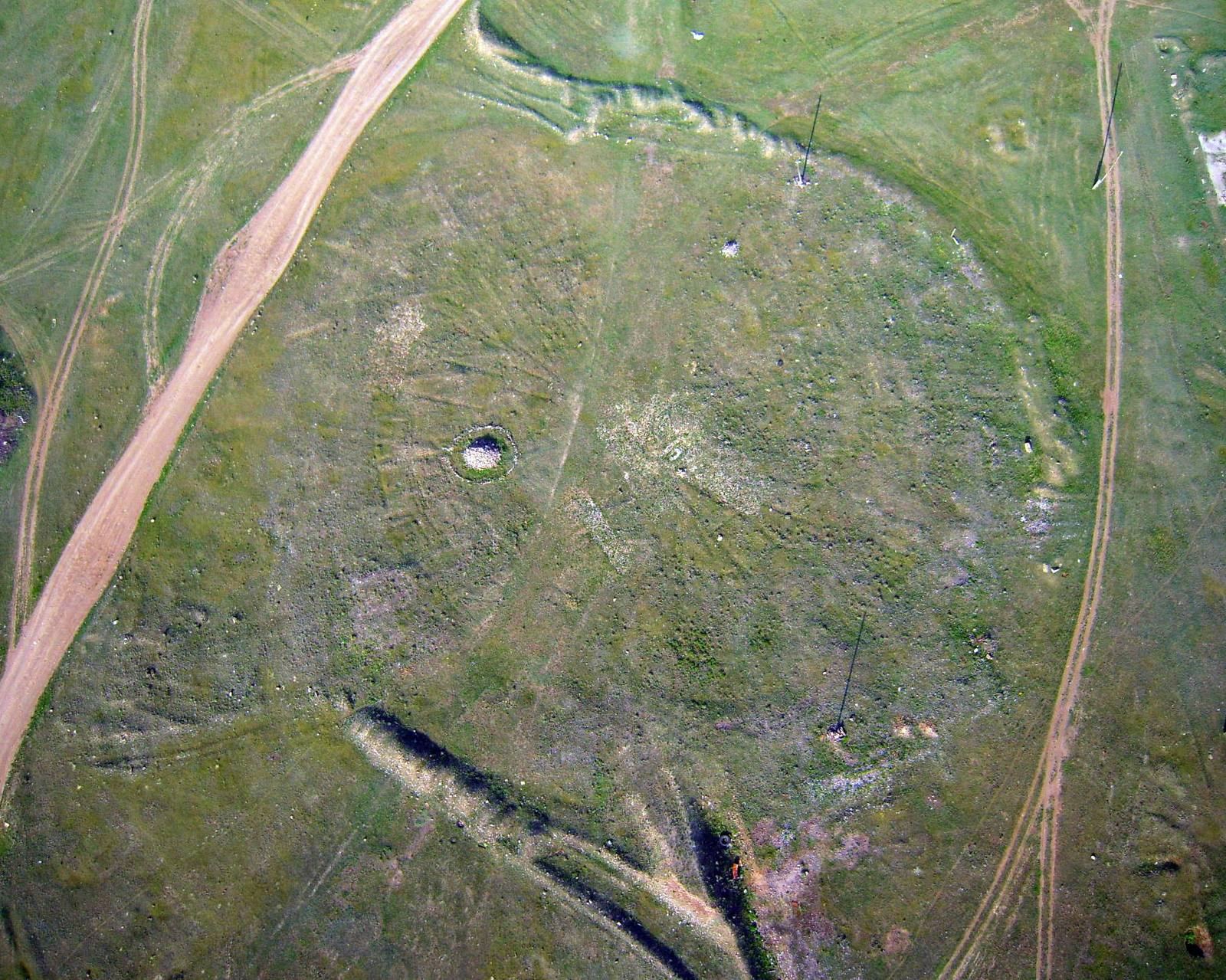
The royal mound Tunnug 1, also known as Arzhan 0, dates to the ninth century BC and is contemporary with, or perhaps slightly earlier than, Arzhan 1. A Russian-Swiss expedition investigated the site in 2017, and radiocarbon analysis of timber associated with the burial placed it in the ninth century BC. The early Saka mound itself has not been excavated. A separate Kokel-culture burial, dated to the second through fourth centuries AD, was excavated just beyond its southern edge. The Kokel burial belongs to a period after the Xiongnu, a powerful confederation of nomadic peoples in Inner Asia.
Arzhan 1
M. P. Gryaznov excavated Arzhan 1 in the 1970s. Radiocarbon dating places the burial at about 800 BC, and later investigations took place in 1997 and from 1998 to 2003 as work on Arzhan 2 proceeded. The finds helped establish the early development of Scythian culture in the region. Arzhan 1 is regarded as the earliest known example of the Scythian triad, the combination of horse equipment, weapons, and animal-style art.
Bronze weapons from the mound resemble those associated with the late Karasuk culture and point to connections with several other archaeological traditions, including the Novocherkassk culture north of the Black Sea, the Bainov phase of the Tagar culture, and the early Majemir culture of the Altai. Animal designs from Arzhan, including images of deer, boars, and panthers, later appeared farther west and influenced artistic traditions in European Scythia.
Arzhan 2
Arzhan 2 dates to about 650–600 BC. It was first investigated in 1997, followed by a joint German-Russian expedition that worked at the site from 2000 to 2004, with excavation reported for 2001–2003. The largely undisturbed burial contained a couple identified as royal, sixteen attendants who had been killed, and around 9,300 objects. About 5,700 of the objects were gold, weighing approximately 20 kilograms in total, a record quantity for Siberia. The mound is broadly contemporary with early Saka burial mounds at Shilikti in eastern Kazakhstan.
The woman’s burial beside the man has been interpreted as evidence that she was killed to accompany him in the afterlife, while his identification as a king remains an interpretation rather than a certainty. Genetic analysis of the pair found a broadly balanced mix of western-steppe ancestry, including ancestry related to the Sintashta, Srubnaya, and Andronovo traditions, and eastern Eurasian ancestry of the Khövsgöl Late Bronze Age type from northern Mongolia. A smaller component was linked to the Bactria-Margiana Archaeological Complex, a Bronze Age tradition of Central Asia.
Analysis of remains from 26 Siberian Scythians at Arzhan found eastern Eurasian maternal lineages in about half and western Eurasian ones in the remainder; C4 was the most common maternal lineage. Comparisons with Scythians from the Pontic-Caspian steppe, north of the Black and Caspian seas, found substantial differences in paternal ancestry and little paternal gene flow between the groups. They also indicated shared maternal ancestry and the movement of women from eastern to western Eurasia.
Other burials in the Uyuk basin
Chinge-Tey I, about 20 kilometres from Arzhan 2, is an elite burial of the Arzhan Aldy-Bel culture, dated to the seventh or sixth century BC. A genome analyzed in 2025 showed close relationships with people associated with the Tasmola culture of eastern and central Kazakhstan and the earlier Okunevo culture. The man buried there, estimated to have been about 20 to 25 years old, carried Y-chromosome haplogroup Q1b1 (Q-L476) and mitochondrial haplogroup G2a. A haplogroup is a genetic lineage used to trace descent along a particular line.
Arzhan 5 is a funerary and commemorative complex in the Turano-Uyuk basin, dated to the ninth and eighth centuries BC. It has federal-level cultural-heritage status in Russia.
Remains
Burial landscape
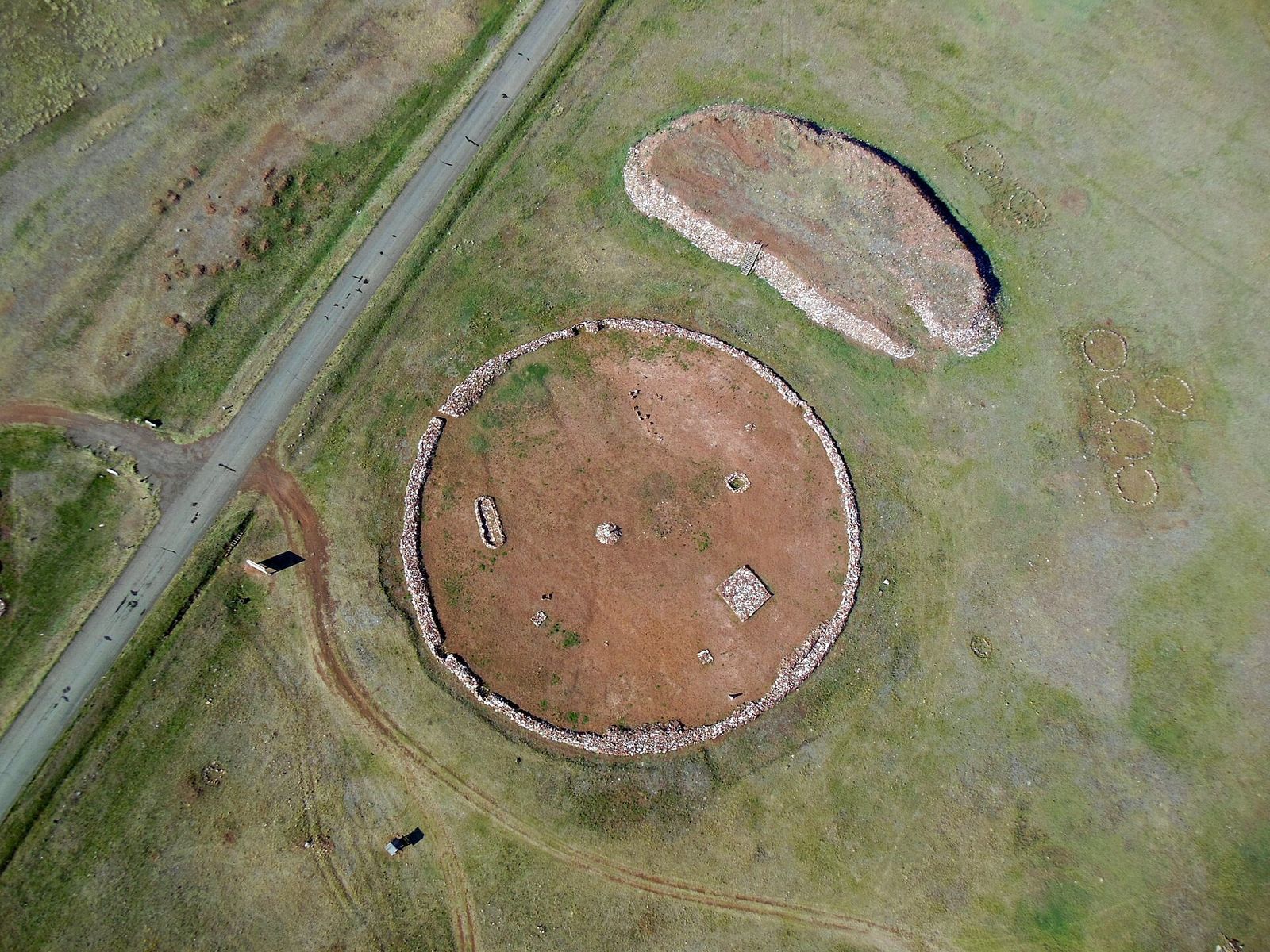
The Arzhan burial landscape occupies a high plateau crossed by the Uyuk River, a tributary of the Yenisei, in the foothills of the Western Sayan mountains. It lies about 60 kilometres northwest of Kyzyl and 20 kilometres southwest of Turan. Several hundred burial mounds are spread across the area.
Arzhan 1
Mound and burial layout
Arzhan 1 lies between the settlements of Arzhaan and Tarlyk. Its main chamber was built in a cube-like form from pine logs 30 to 85 centimetres in diameter and surrounded by a pine fence. Around a triangular central area, about 70 graves were arranged in a radial pattern. The mound had been looted in antiquity. Medical examination of skeletal remains identified an elderly person among those buried there.
Objects and animal imagery
Excavations recovered clothing remains, weapons, horse equipment, jewelry, bones from sacrificed animals, and rock art. Among the objects were a bronze horse bit shaped like a horseshoe, a decorative fitting for a pole, and daggers, including one resembling types from the Tagar culture. A curled feline figure from the burial, dated to about 800 BC, is the earliest known example of a widely used animal-art motif. A geometrically decorated textile is associated with a burial designated Grave 1 of the “King and Queen.”
Deer stones
Decorated upright stones known as deer stones are associated with Arzhan 1 and Arzhan 2. These human-shaped monuments, bearing stylized animal and other imagery, are broadly dated to 1300–700 BC. A deer stone from Arzhan 1, dated to the eighth century BC, is held by the State Hermitage Museum in St Petersburg. The curled-feline design found at Arzhan 1 also appears on some deer stones.
Arzhan 2
Mound and central burial
The mound is about 80 metres across and 2 metres high. Two pits at its center served as decoys, while the main burial lay approximately 20 metres from the mound’s center.
Grave goods
The couple’s grave goods included thousands of beads, among them more than 400 made from Baltic amber and others of etched carnelian. The carnelian was worked using a technique developed in India in the third millennium BC; the beads were probably made in Iran or Central Asia and point to connections with southern regions. The man’s belongings included a gold neck ring, a jacket decorated with 2,500 gold panther figures, a dagger covered in gold, trousers sewn with gold beads, and boots with gold cuffs. The woman’s included a red cloak bearing another 2,500 gold panther figures, an iron dagger with a gold handle, a gold comb, and a wooden ladle with a gold handle.
A battle axe and arrowheads were decorated with gold inlay on iron or bronze. Eurasian nomads adopted this technique in the seventh century BC, and it remained in use in other regions into the fourth century AD. Other finds include an animal-style deer, a chest ornament, and short princely daggers. Most objects from the mound are held by the Republic of Tuva Museum in Kyzyl, with some in the State Hermitage.
Petroglyphs
Several rock carvings occur on the eastern side of the mound. They show armed people, horse-drawn chariots, deer, and shields, with imagery comparable to that on the deer stones.
Chinge-Tey I
Burial and surrounding graves
Eight warrior graves were found around the principal burial. The buried man wore an unusually long robe and was accompanied by gold jewelry, weapons, horse equipment, and burial clothing. His grave also contained a distinctive glass bowl, probably of Assyrian origin. Some decorative imagery, especially the animal designs, is related to the artistic tradition of the Okunevo culture.