Almonacid de la Cuba Dam: A Roman Irrigation Dam in Spain



Site at a Glance
- Rating
- 4.6
- Popularity
- Low
- Country
- Spain
- Primary era
- Classical
- External website
- Open
- Eras represented
- Classical
- Civilizations
- Roman
- Site type
- Infrastructure
- Remains
- Dam
On this page7 sections
History
Almonacid de la Cuba Dam is a Roman dam in Almonacid de la Cuba, Spain, built during the reign of Emperor Augustus in the first century AD. It was designed to regulate the Aguasvivas River, a tributary of the Ebro, chiefly for agriculture. Its possible role in supplying the settlement of Pueyo de Belchite remains uncertain.
Construction and Roman repairs
The first structure at the site was a dam with three arches. Flooding breached it at an early stage, possibly before construction had been completed. It was subsequently rebuilt as a gravity dam, a structure that resists water pressure through its own weight, with parts of the earlier work incorporated into the new construction.
Repairs were carried out under the emperors Claudius and Trajan. During Trajan’s intervention, the dam was heightened, probably in response to the accumulation of silt. The structure was abandoned during the second half of the first century, although its water-control role formed part of a continuing history of adaptation.
Later reuse and preservation
Under Muslim rule, the dam was abandoned again in the thirteenth century before being reused. As the reservoir became heavily filled with silt, the structure’s function changed. It was eventually used as a diversion weir, a barrier that raises or redirects river water into canals rather than storing a large reservoir. This irrigation role continues through an ancient Roman canal of approximately 8 kilometres, which carries water toward the lands around Belchite.
The dam has undergone repeated repairs and remains functional. A refurbishment was completed in 2019. In 2024, it helped protect Almonacid de la Cuba from flooding that devastated other nearby towns. Spain declared it an Asset of Cultural Interest in 2001, a formal heritage designation for places with recognized historical, architectural, archaeological, or cultural value.
Remains
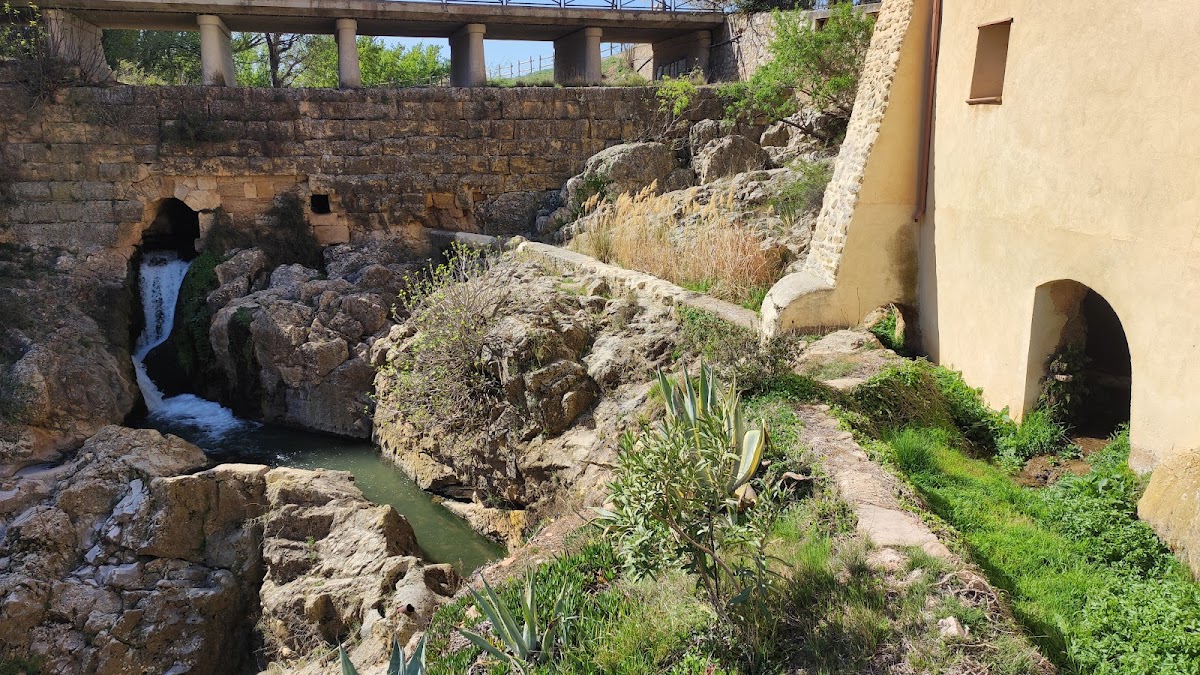
The surviving structure is a large gravity dam with a Roman masonry facing. It measures approximately 34 metres in height and 120 metres in length. Its thickness is given as 27 metres, while its base width is approximately 38 metres. With its height of 34 metres, it is described as the highest surviving Roman dam in the world and was the highest dam in Spain until 1590.
Dam structure and water system
Roman masonry and concrete
The dam was built with Roman concrete, a hydraulic material made from binding mortar and aggregate such as stone, and faced with stone blocks. Its substantial mass gives the structure the weight needed to withstand retained water. The remains of the earlier three-arched dam survive within the present structure, preserving evidence of the site’s first construction phase and its destruction by flooding.
Reservoir and irrigation canal
The reservoir was designed to hold approximately 6 million cubic metres of water, a capacity considered sufficient for the needs of about 90,000 people. It is linked to the surrounding irrigation system by an approximately 8-kilometre Roman canal. Heavy silting later changed the physical operation of the site, so the dam now works as a diversion weir for irrigation rather than primarily as a reservoir dam.
The dam and its reservoir belong to the water system of the Aguasvivas River and the wider Ebro basin. The structure is described as being in an excellent state of preservation and continues in use as part of the irrigation network.