Abat-Baitak: An Islamic Funerary and Religious Complex in Kazakhstan
Site at a Glance
- Popularity
- Medium
- Country
- Kazakhstan
- Primary era
- Early Modern
- Eras represented
- Early Modern, Modern
- Civilizations
- Unclassified
- Site type
- Religious
- Remains
- Tomb
On this page11 sections
History
Legends and use
Abat-Baitak is an Islamic funerary and religious complex in Aktobe Region, western Kazakhstan, about 12 km south of Taldysai. Its burial ground was in use from the 14th century to the early 20th century, and the site remains a place of pilgrimage.
The most widely repeated origin story says that Abat, son of the poet and philosopher Asan Kaigy, was a warrior who defended local lands from Kalmyk raids. Kalmyks are a Mongolic people. In the legend, Abat defeated a Kalmyk ruler and recovered some captured territory. After his death, the community supposedly built a mausoleum where he died in just three days. This story explains “Baitak” as meaning “shared by the people.” A different legend, written down in the 19th century, connects the mausoleum with a Mongol commander named Baitak.
Early records and study
The earliest recorded reference associated with Abat-Baitak dates to 1750. In Topography of Orenburg, historian Pyotr Rychkov recounted that engineer Alexander Rigelman had found and sketched pyramid-like stone structures near the meeting point of the Karasu and Big Khobda rivers. Local people described them as burial places of notable figures, including one called Baytan, and said that a city had once stood there.
In the late 19th century, Derbisali Berkimbaev and Ya. Ya. Polferov, a member of the Orenburg Scientific Archival Commission, wrote brief descriptions of the monument. Joseph-Antoine Castagné published the first graphic record of the mausoleum in the early 20th century.
Investigations and protection
Engineer G. Gerasimov may have taken the first measurements in 1947, when the mausoleum was already partly ruined. An expedition led by archaeologist Serik Adzhigaliyev carried out the most comprehensive historical and architectural study to that point in 1979–1980. In 1982, the burial ground received state protection as a monument of history and culture of republican significance.
In 2004, Erbol Smagulov led the first comprehensive investigation of both the mausoleum and its surroundings. By then, graves had been looted and valuable objects were probably taken. The mausoleum was restored after the investigations, with craftspeople making 32,000 bricks to complete its brickwork.
Remains
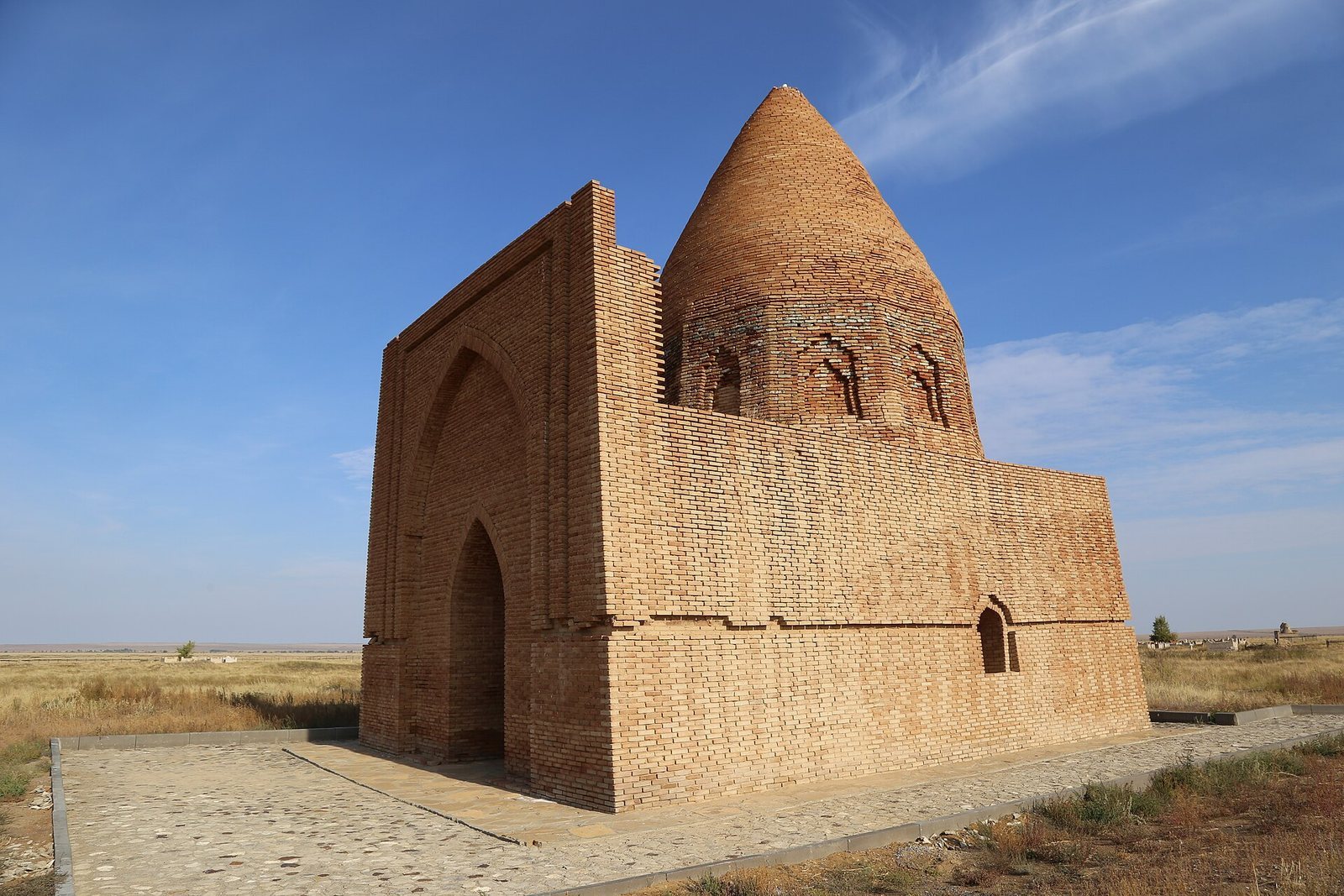
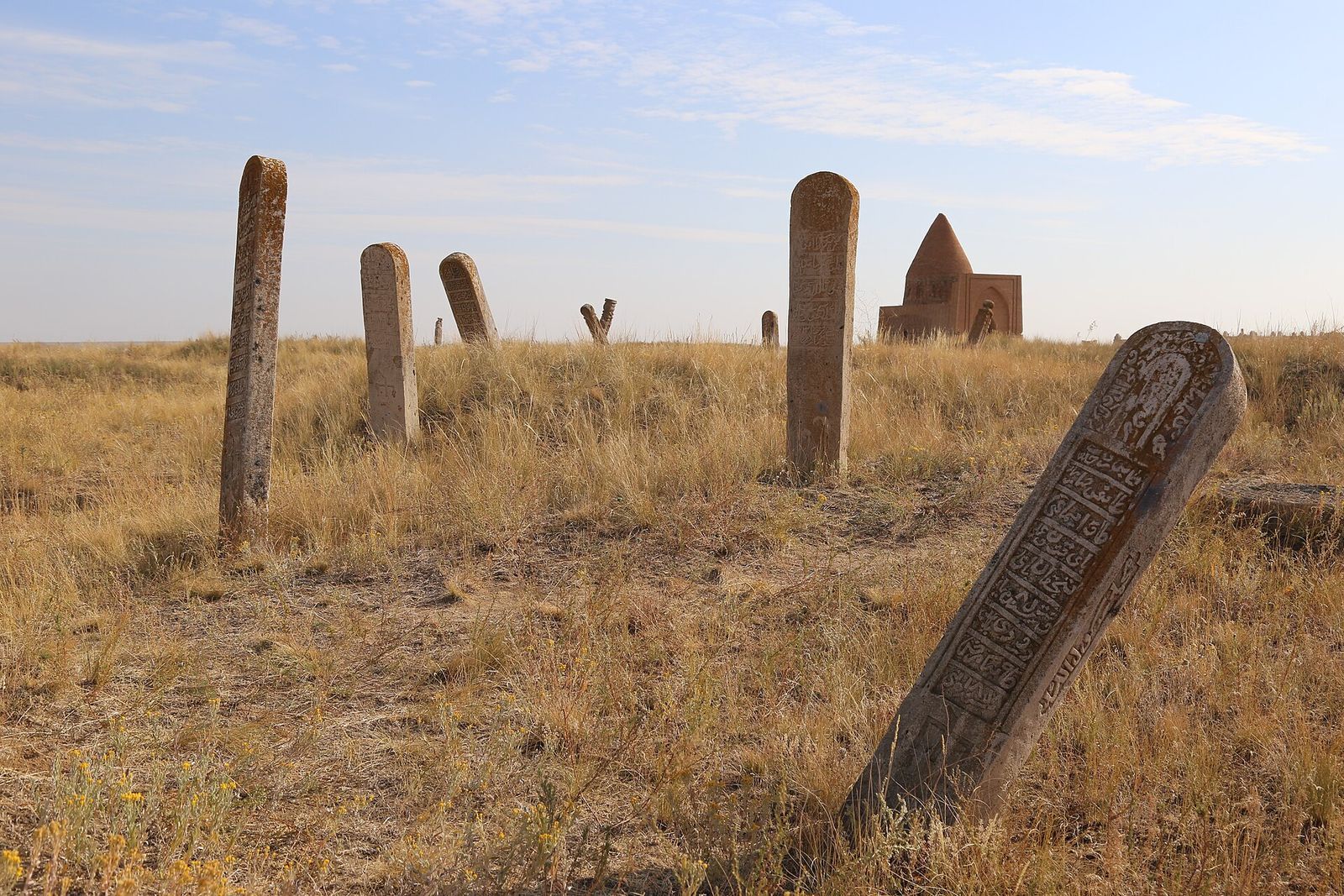
The burial ground includes a central brick mausoleum, a second memorial building nearby, and more than 200 carved stone grave markers to the west. Its memorial structures have varied plans and decoration, and use both fired and unfired brick.
Memorial buildings
Central mausoleum
The central mausoleum measures 9.52 by 9.8 metres. Its square body supports an 11-sided drum, the polygonal wall beneath a dome, and a conical roof. Most of its construction uses square fired bricks measuring 24 by 24 by 6 cm. Rectangular fired bricks, 24 by 12 by 6 cm, appear in some parts, including the arched vaults. Inner layers of the main body include unfired bricks of similar dimensions.
Evidence for an original entrance portal includes a thinner south wall, traces of portal supports, and remnants of arched pendentives, curved supports that bridge a square space to a dome, in the gable end. Excavation exposed support masonry extending 2.98 metres beyond the wall line, confirming the portal’s projecting form.
Maiden’s Tomb
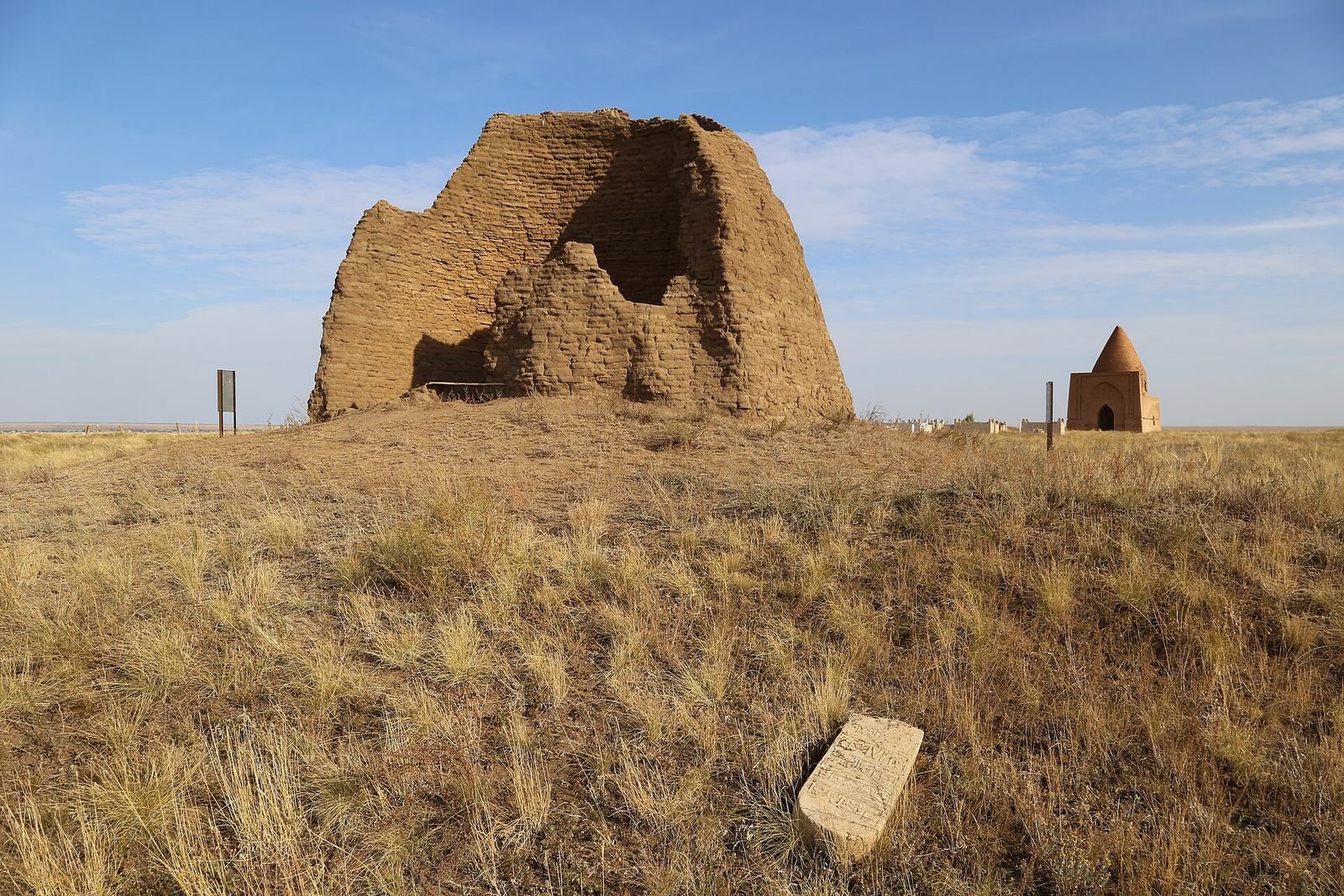
A second mausoleum nearby was built in the late 18th century from unfired earth brick and modeled on the central mausoleum. It is popularly known as the “Maiden’s Tomb” or “Holy Maiden.”
Grave markers and burials
Carved grave markers
The more than 200 grave stelae, upright carved stone markers, date from the 18th to the 20th centuries and vary in form and ornament. Their Kazakh-language inscriptions use Arabic script, alongside carved clan marks. These identify burials associated with several clans of the Junior Zhuz, one of the three traditional Kazakh tribal confederations, including the Tabyn, Kete, Alshyn, and Baybakty. A marker dated 1848 is noted for its fine carving, and some three-dimensional details draw on woodcarving traditions. A rarer gravestone from 1893 was carved from a block of limestone-rich sandstone.
Burials within the central mausoleum
The 2004 investigation found five burials inside the mausoleum: those of a middle-aged man, a woman, an adolescent, and two children. The finds included wooden coffin remains and clothing, as well as a metal mace that may have served as the staff of a Sufi missionary, a religious figure associated with devotional and mystical traditions within Islam.