Kieselstein Castle: A Medieval Fortress in Kranj, Slovenia


Site at a Glance
- Rating
- 4.6
- Popularity
- Low
- Country
- Slovenia
- Primary era
- Medieval
- External website
- Open
- Eras represented
- Medieval, Early Modern, Modern
- Civilizations
- Habsburg, Holy Roman Empire
- Site type
- Military
- Remains
- Castle
On this page9 sections
History
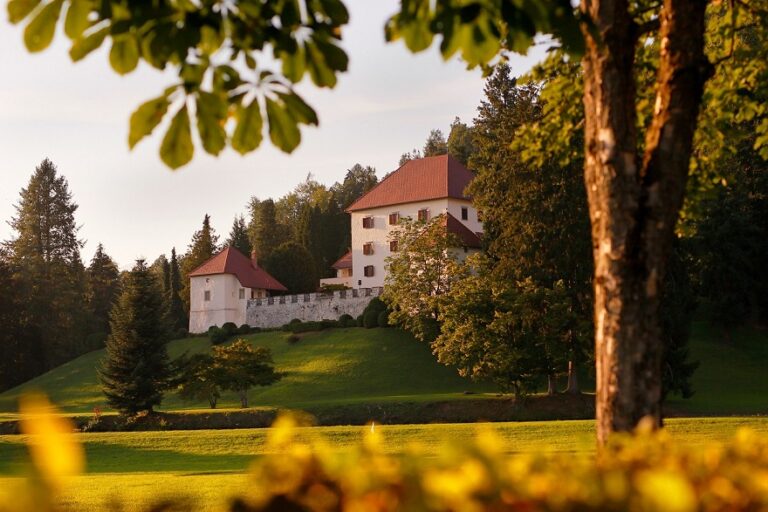
Kieselstein Castle, also known as Khislstein, is a medieval castle in Kranj, Slovenia, built in 1256 by the Counts of Ortenburg. It stands in the historical region of Upper Carniola and occupies a defensible position overlooking the city pier and a crossing of the Sava River. The name Kieselstein comes from the German word for gravel or flinty rock, while the later name Khislstein reflects the ownership of the Khiessl family.
Early Defences and the Ortenburg Castle
A round keep stood on the site in the 11th century, before the present castle was established. The Counts of Ortenburg built the castle in 1256 through an arrangement with Ulrich III, Duke of Carinthia and lord of Kranj. Until 1420, its administration was entrusted to the knights von Chreinburch, ministeriales who served as the Ortenburgs’ administrative and military vassals.
Celje, Habsburg, and Noble Ownership
In 1420, the property passed to Count Hermann II of Celje. When the Counts of Celje, a powerful late-medieval noble family based in the region of present-day Slovenia, died out in 1456, the castle was inherited by the Habsburgs, a major European ruling dynasty.
The Habsburgs sold the castle in the mid-16th century to Baron Hans Khiessl. He obtained permission from Emperor Ferdinand I, Holy Roman Emperor from 1558 to 1564, to rename the property after his family. During this period, the earlier tower was expanded into an L-shaped castle. The Khiessl family later sold it to Franz von Moscon. Subsequent owners included the Ravbar, Apfaltrer, Auersperg, and Natalis Pagliaruzzi noble families.
Defensive and Modern Transformations
During the Ottoman incursions into Europe, a period when the expanding Ottoman Empire conducted military campaigns in southeastern and central Europe, the tower was incorporated into Kranj’s city walls. This connected the castle’s earlier defensive role with the wider fortifications of the town.
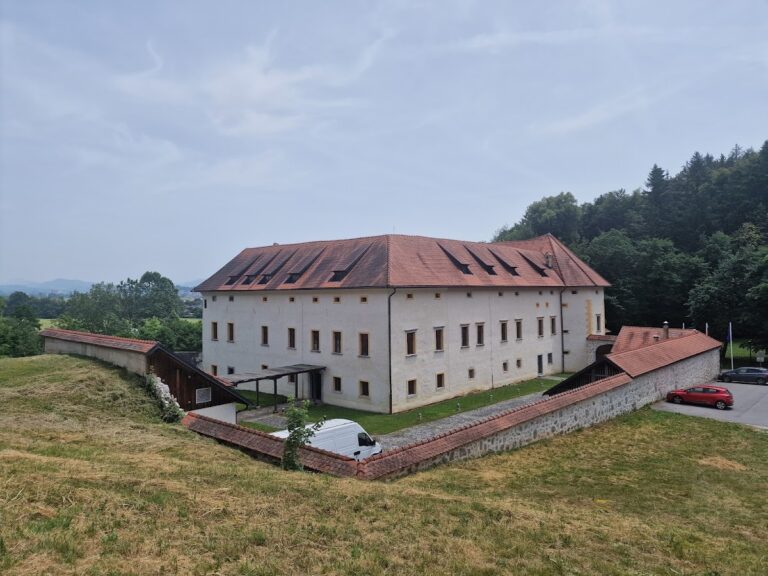
The state purchased Kieselstein Castle in 1913. Between the two World Wars, it housed government offices, and it was nationalized after the Second World War. In 1952, it was renovated according to plans by Jože Plečnik, the Slovenian architect whose work shaped many buildings and public spaces in Slovenia and Central Europe. The building now houses the Kranj Municipal Agency for the Protection of Natural and Cultural Heritage and a department of the Upper Carniola Museum.
Remains
Kieselstein Castle stands in Kranj’s old city center on part of the upper town, above the Sava crossing. The upper-town area had defensive use from antiquity through the early Middle Ages. The surviving complex combines the remains of an earlier defensive tower with a later castle whose form developed through alterations from the 16th to the 19th centuries and the renovation of 1952.
Defensive Origins
11th-Century Keep
The earliest known defensive feature is a round keep dating from the 11th century. It formed the first major installation on the site and preceded the castle built by the Counts of Ortenburg. During the Ottoman incursions, the tower became part of Kranj’s city walls, linking the castle site with the town’s defensive perimeter.
Later Castle Form
L-Shaped Castle
The later complex developed from the tower constructed in 1256. In the 16th century, the structure was enlarged into an L-shaped castle, and further changes between the 16th and 19th centuries shaped its appearance. The building seen today is a renovated structure that incorporates these successive alterations together with Plečnik’s 1952 intervention.