Fortezza Albornoz: Orvieto’s Papal Fortress


Site at a Glance
- Rating
- 4.4
- Popularity
- Low
- Country
- Italy
- Primary era
- Medieval
- External website
- Open
- Eras represented
- Medieval, Early Modern, Modern
- Civilizations
- Italian, Papal States
- Site type
- Military
- Remains
- Fort
On this page10 sections
History
Fortezza Albornoz is a medieval fortress in Orvieto, Italy, built in 1364 on the city’s eastern cliff edge as part of Cardinal Egidio Albornoz’s campaign to restore papal authority in central Italy. Albornoz, a fourteenth-century cardinal and papal representative, used fortress construction both to control strategic positions and to display the authority of the Papal States, the territories governed by the pope as a temporal ruler.
Foundation and medieval conflicts
The fortress belonged to the eighth and final phase of Orvieto’s medieval urban development. By this period, many of the city’s public buildings had been abandoned, and Fortezza Albornoz became, together with the slowly rising cathedral, one of Orvieto’s two principal urban centers. Construction began on the ruins of the San Martino popular quarter, much of which had been demolished for military-security reasons. The municipality formally presented the project after Orvieto’s “free annexation” to the Papal States.
The first fortress was a quadrilateral enclosure protected by a broad moat and drawbridges. In 1389, during a struggle between the rival Monaldeschi della Cervara and Monaldeschi del Cane factions, Luca I Monaldeschi della Cervara caused the fortress’s first destruction while fighting his opponents. The Monaldeschi were a powerful noble family of medieval Orvieto, divided into competing branches.
Francesco I Orsini strengthened the defenses in 1413, but they failed to withstand attacks by Ladislaus I of Naples in 1414. Ladislaus was the king of Naples, and his assault left the fortress in poor condition. After Orvieto’s definitive subjection to the Papal States, the structure was rebuilt along its former perimeter by Antonio da Carpi. The work added a circular tower, or ravelin, an external fortification placed before a gate to reinforce its defense. Reconstruction was completed in 1450 under the supervision of Bernardo Rossellino.
Papal rebuilding and later changes
In 1527, Pope Clement VII sought refuge in Orvieto after the Sack of Rome, the violent capture and looting of the papal city by imperial troops. Antonio da Sangallo the Younger, who was already responsible for the fortress’s fortifications, received a commission to build a well near it. The well supplied water for the building works and for the city. It was first known as the Well of the Fortress and later as the Well of Saint Patrick.
The fortress was completed in 1620 under the pontificates of Paul II and Urban VIII. Pope Alexander VII later ordered further restoration. His arms and an inscription over the entrance refer to repairs carried out under the papal governor Odoardo Cybo in 1658.
During the nineteenth century, Fortezza Albornoz lost its original defensive role and became a public space for recreation and events. In 1841, Francesco Ricchi received a thirty-year emphyteutic lease, a long-term arrangement allowing him to use and improve the property while ownership remained with another party. He laid out an Italian-style garden and built an amphitheater with boxes and tiered seating around an arena for horse races and public events. When the lease ended, the municipality took control of the amphitheater in 1871 and continued its public use.
On 19 June 1882, the fortress hosted a funeral ceremony for Giuseppe Garibaldi, the military leader who played a central part in the movement that unified Italy. A statue of Garibaldi by Adolfo Cozza stood at the center of the arena during the ceremony. The statue later disappeared, although old photographs preserve its appearance. The amphitheater was demolished decades ago because of its poor condition. From 1888, the moats were filled during construction of the water-powered funicular, a cable railway moved by water-powered counterbalancing, which connected Orvieto with the transport station below the city. The former fortress area continues to serve as municipal public gardens.
Remains
Fortezza Albornoz survives in part on the eastern edge of Orvieto’s cliff. Its remains preserve the outline of a fortified enclosure, the entrance defenses, and portions of the perimeter walls. The position gives the surviving walls a direct relationship with the valley of the Paglia River below.
Fortifications and entrance defenses
Porta Soliana tower
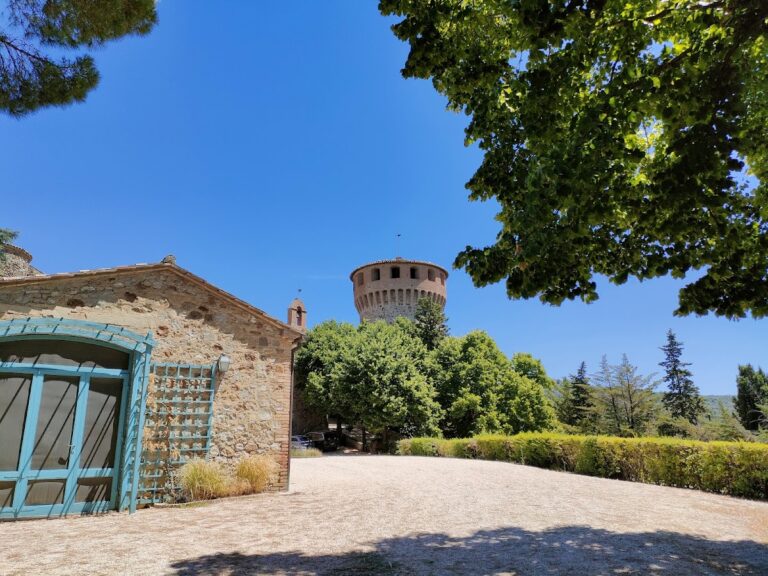
The most prominent surviving feature is the tower above Porta Soliana, also known as Porta Postierla and later as Porta Rocca. It belongs to the fortress’s defensive entrance area, whose later form followed the earlier perimeter and included a circular ravelin to protect the gate. The tower and adjoining masonry remain as the clearest visible elements of the medieval stronghold.
Perimeter walls and former moat
Part of the perimeter walls also survives. The original enclosure was quadrilateral, with a broad moat and drawbridges forming its outer defense. The rebuilt fortress retained the earlier boundary, while the moat area was physically altered when it was filled in 1888 for the water-powered funicular. These surviving and transformed elements indicate the fortress’s earlier arrangement around a defended enclosure.
Gardens and former public spaces
Municipal gardens
The former interior of the fortress now contains Orvieto’s principal public gardens. Several bronze works by the American sculptor Jack Zajac stand within the area, which also contains the birthplace of the journalist Luigi Barzini. The gardens occupy the space once enclosed by the fortress and later adapted for public use.
Former amphitheater
The nineteenth-century amphitheater was arranged around an arena with boxes and tiered seating. It accommodated horse races, public events, and the 1882 funeral ceremony for Garibaldi. Its physical structure no longer survives, but the arena’s former place within the fortress preserves the memory of the site’s transformation from a defensive complex into a civic events space.