Niya: An Ancient Oasis Settlement on China’s Silk Road
Site at a Glance
- Popularity
- High
- Country
- China
- Primary era
- Classical
- Eras represented
- Classical
- Civilizations
- Chinese
- Site type
- Settlement
- Remains
- Town
On this page8 sections
History
Jingjue on the southern Silk Road
Niya was an oasis settlement in Xinjiang, China, and an important trading center on the southern branch of the Silk Road. Camel caravans carried goods from China to Central Asia across the southern Taklamakan. The settlement’s local name was Caḍ́ota, and Han-period Chinese records knew it as Jingjue.
The Hanshu, a history of the Han dynasty, describes Jingjue, generally identified with Niya, as an independent oasis state. It places the ruler’s seat there, about 3,667 km from Chang’an, the ancient Chinese capital. The account lists 480 households and 3,350 people, including 500 able to bear arms, as well as officials such as a commandant, leaders of the left and right, and a chief interpreter.
Under the kingdom of Shanshan
In 77 BCE, the Han dynasty renamed the oasis kingdom of Loulan as Shanshan. By the third century, Niya had become part of that kingdom. Shanshan maintained diplomatic relations with Cao Wei in the third century, the Jin dynasty in the fourth, and Northern Wei in the fifth.
Toward the end of the fourth century, Niya came under Chinese suzerainty, a relationship in which a polity acknowledged a superior power while retaining some degree of its own authority. Tibet later conquered the settlement. Niya was abandoned sometime in the fourth or fifth century.
Archaeological investigations
In 1900, the Hungarian-born British archaeologist and explorer Aurel Stein excavated several groups of dwellings at Niya during an expedition in western China and the Taklamakan. He returned to the site four times between 1901 and 1931.
Official approval for joint Chinese-Japanese excavations was granted in 1994. The investigations examined settlement remains and human remains, which prompted discussion about the population’s origins.
In 2007, researchers examining a text-bearing wrapper compared its writing with early Sogdian letters found near Dunhuang and fragments from Loulan. Local archaeologists identified the script as early Sogdian, an Iranian language with its own script.
Remains
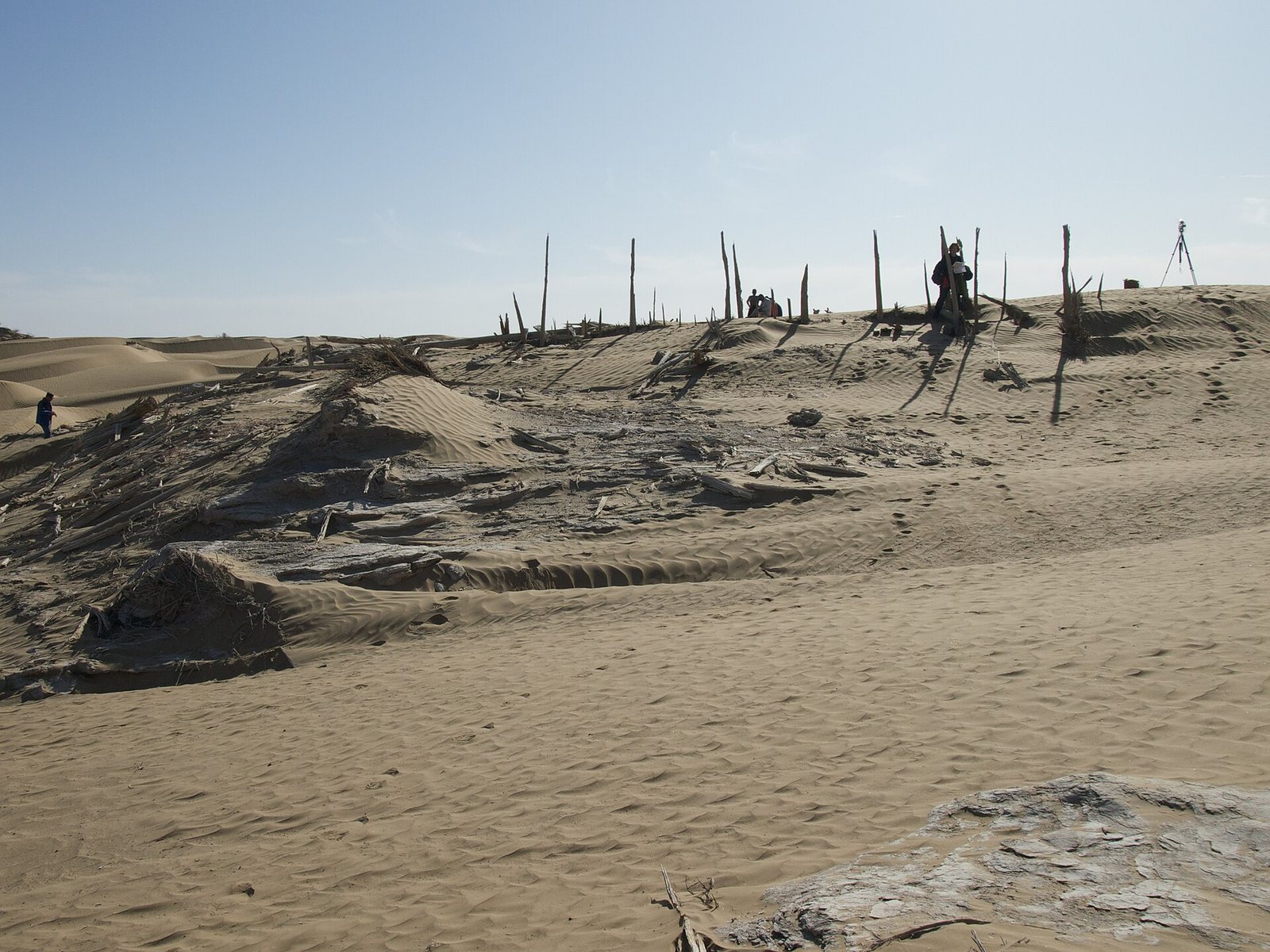
The ruins lie on the southern edge of the Tarim Basin, about 115 km north of modern Niya Town. Excavations have revealed a settlement with residential, burial, animal-keeping, and cultivated areas.
Settlement and cultivated areas
Investigations identified approximately 100 dwellings, along with burial areas and animal sheds. Orchards, gardens, and agricultural fields formed part of the settlement. The finds from the dwellings include well-preserved iron axes and sickles, wooden clubs, and pottery urns and jars containing preserved crops.
Documents and written material
Stein recovered about 100 wooden tablets dated to 105 CE. Their clay seals accompanied official orders and letters written in Kharoshthi, an ancient script used in parts of South and Central Asia. Texts from Niya also refer to regional rulers. The tablets’ writing has been linked either to the Kushan Empire, a Central Asian empire, or to migrants from Gandhara, a historic region of South Asia, influenced by Kushan and Indian bureaucratic traditions.
A text-bearing sheet described as parchment had been tied around powder made from plants, perhaps a spice or medicine. When unwrapped, it revealed clear writing in black ink.
Seals, household objects, and textiles
Clay seals recovered by Stein carry impressions of Athena Alkidemos, an epithet of the Greek goddess Athena, as well as Eros, a Greek god, and Heracles, a Greek hero. Other finds include Han-dynasty and Roman coins, documents, a mousetrap, a walking stick, part of a guitar, a functional bow, a carved stool, wooden furniture, pottery, Chinese basketry, and lacquerware. The finds also include a carefully designed rug and other textile fragments; one textile is described as combining Eastern and Western influences.
Some objects from Niya are held at the Tokyo National Museum. Other finds belong to the Aurel Stein collections at the British Museum, the British Library, and the National Museum in New Delhi.