Fugoppe Cave: A Zoku-Jōmon Archaeological Site in Japan
Site at a Glance
- Rating
- 3.9
- Popularity
- Medium
- Country
- Japan
- Primary era
- Classical
- Eras represented
- Classical, Modern
- Civilizations
- Japanese
- Site type
- Civic
- Remains
- Rock Art
On this page9 sections
History
Fugoppe Cave is a rock-shelter archaeological site from the Zoku-Jōmon period, also called Epi-Jōmon, a prehistoric period associated especially with Hokkaido. It lies in Yoichi, Japan, and dates to about AD 100–400. Its carvings make it one of only two cave sites among more than 700 in the Japanese archipelago where rock carvings are known to survive; the other is Temiya Cave in Otaru.
The earlier Maruyama discovery
A railway worker uncovered a separate site during railway construction across Maruyama, generally dated to 1927. The work exposed wall paintings that resembled ancient writing and an object like a stone figurine. Although this site was on the reverse side of the wall of the present cave, a connection is possible, and the two are treated as distinct. A 1925 discovery date appears to be an error.
The paintings prompted competing interpretations. A professor at Otaru Higher Commercial School, a commerce-focused institution, identified them as Ainu. Ainu writer Hokuto Iboshi rejected that attribution and suggested they could be modern fakes. Kindaichi Kyosuke, a scholar of Ainu language and culture, also judged them to be fake. He told Emperor Shōwa that an Ainu acquaintance had drawn them as a boy.
Discovery and archaeological investigations
Fugoppe Cave came to archaeological attention in 1950, when a 15-year-old student from Sapporo found it while visiting the area. His older brother, a member of a high-school local-history club, had heard about an alleged “ancient writing” site on Maruyama and inspected the cave after the discovery. The brothers alerted the club’s adviser, and students began excavating, finding pottery before the end of the year. The cave may also have been exposed when a farmer removed soil from the slope for agricultural use. A separate team later found the wall carvings, and the way the excavation had begun drew criticism.
Formal investigations followed in 1951 and 1953 under a Hokkaido University assistant professor, with archaeologists, anthropologists, and geologists among the participants. The cave became a National Historic Site of Japan on November 14, 1953. A possible relationship between its carvings and archaeological traditions associated with the Amur River region of Russia’s Far East has been proposed, but remains uncertain.
Protection
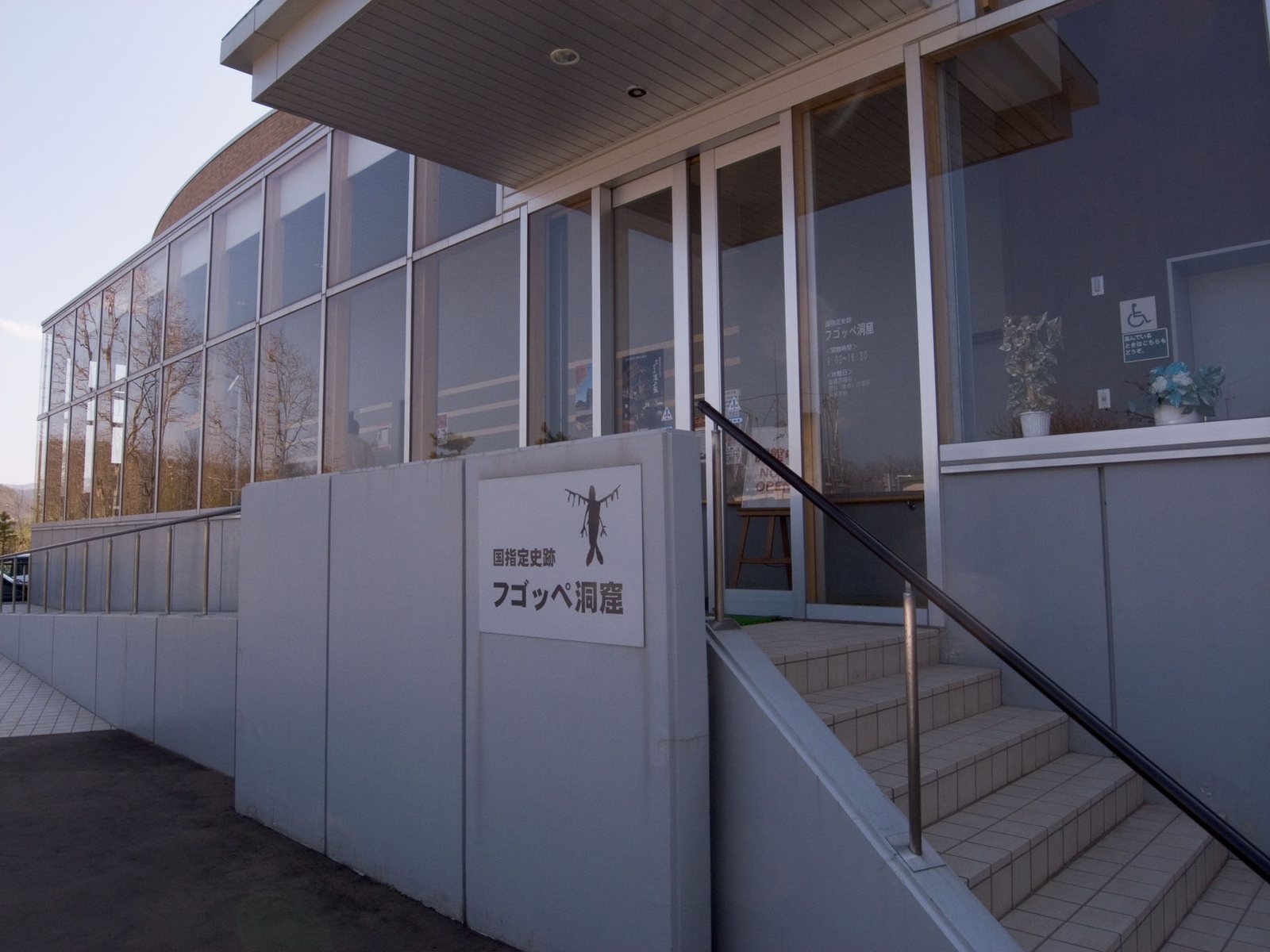
Since 1972, a capsule-style facility has protected the carvings while displaying them.
Remains
The site is a natural rock shelter on the east-facing side of a small sandstone hill, about 200–250 metres south of the Sea of Japan coast. Its soft rock is hyaloclastite, fragmental volcanic rock formed when lava or magma cools rapidly, commonly underwater. A capsule-shaped protective structure encloses the carved area.
The shelter and carved walls
The shelter
A rock shelter is a naturally sheltered space beneath an overhang or within a rock face. The publicly accessible cave area is approximately 5 metres wide, 6 metres deep, and 7 metres high. The entrance is separately described as about 4 metres wide and 5 metres high, with a depth of about 5 metres.
Wall carvings
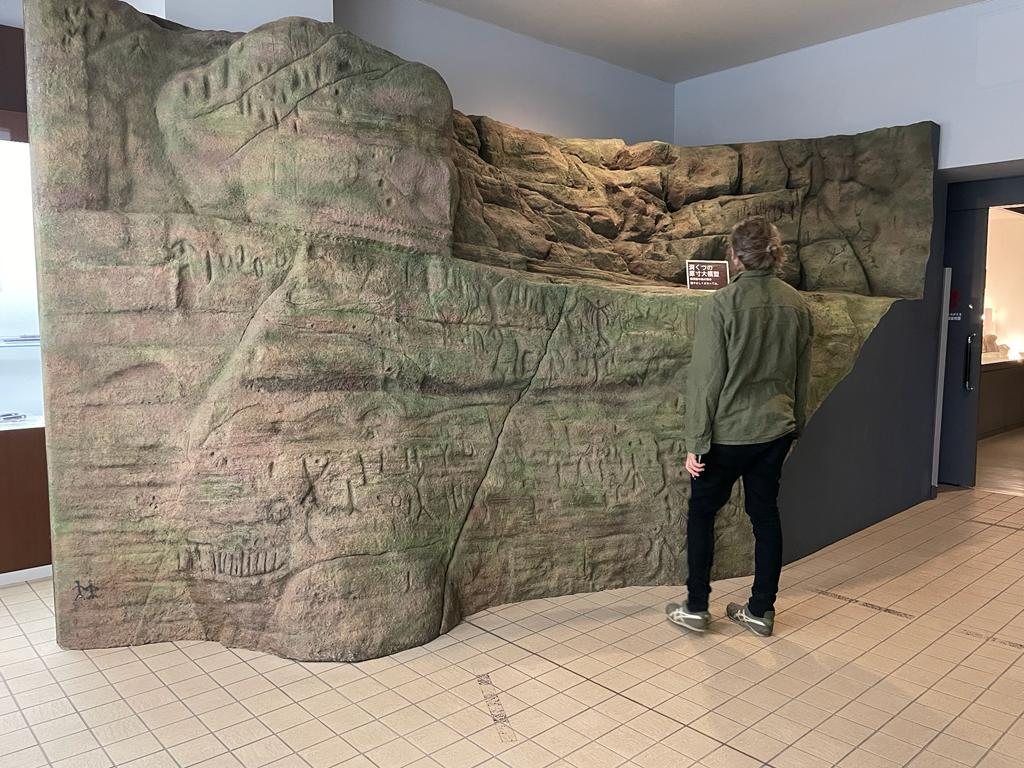
About 800 carvings cover the west, north, and south walls. Early counts identified roughly 200, while later examination recognized nearly 800. The figures include human-like forms, boats, fish and other sea creatures, four-legged animals, and shapes with horn- or wing-like features; dotted markings also appear. The soft stone could be worked by abrasion and then polished to form the images. Some motifs, including the dotted marks, are thought to have had a magical or ritual purpose.
Archaeological deposits and finds
An artifact-bearing deposit about 7 metres thick contains thin-walled pottery from the Zoku-Jōmon period, stone tools, bone and antler tools, shells, and animal bones. Some of the bones are thought to have been used for divination. The animal species represented appear to be ones that still live around the site.