Belcher Mound Site: A Caddoan Mississippian Ceremonial Center
Site at a Glance
- Rating
- 3
- Popularity
- Very Low
- Country
- United States
- Primary era
- Medieval
- Eras represented
- Medieval, Early Modern
- Civilizations
- Unclassified
- Site type
- Settlement
- Remains
- Village
On this page10 sections
History
The Belcher Mound Site, in Louisiana, United States, is a Caddoan Mississippian ceremonial center whose platform mound was built in 1400 CE. Its village area was inhabited from about 900 to 1700 CE. The Caddoan Mississippian culture was an archaeological tradition associated with ancestral Caddo communities and mound-building societies in the region.
The Belcher Phase and regional communities
The site gave its name to the Belcher Phase, an archaeological period that radiocarbon dating places at about 1400 to 1600 CE. Belcher communities may initially have overlapped and coexisted with Bossier culture. The Texarkana Phase was centered northwest of Texarkana, Texas, along the Red River, while the McCurtain Phase lay farther upstream. Belcher Phase sites extended from Fulton, Arkansas, to just south of Shreveport.
Communities in the Belcher and Texarkana areas ranged from substantial, permanent settlements with mounds and cemeteries to scattered hamlets and farmsteads. People cultivated maize, and complex societies were led by high-status individuals who lived at mound centers.
Excavation and repatriation
Archaeologist Clarence H. Webb excavated the site from 1959 to 1969. Between 1936 and 1954, Webb removed the remains of 46 people and their funerary objects. The remains and objects were donated to the Louisiana State University Museum of Natural Science in 1974.
The human remains were later identified as belonging to ancestors of the Caddo Nation of Oklahoma and returned to the Nation under NAGPRA, the Native American Graves Protection and Repatriation Act. This United States law provides for the return of Native American human remains and certain cultural items to affiliated tribes and descendants.
Remains
Set in the Red River Valley, about 20 miles north of Shreveport and half a mile east of Belcher, the site includes a platform mound, cemetery, and village area. The mound was raised in successive layers. Each layer held a building that was eventually burned or abandoned, then covered by another layer for a later structure.
Mound buildings
Rectangular buildings
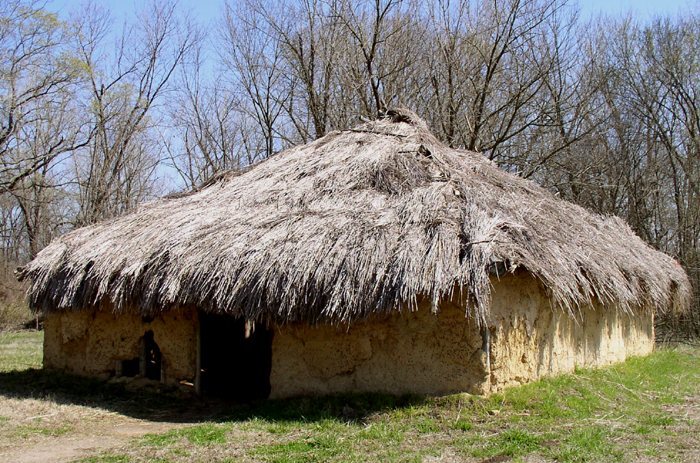
The earliest buildings on the mound were rectangular, with wall posts set in trenches and walls made of woven branches coated with clay or earth. Their roofs were gabled and thatched with grass.
Circular buildings
Later mound buildings were circular, with internal roof supports and a central hearth. They used the same basic materials as the earlier structures and were divided into compartments for separate living and cooking arrangements. These buildings may have served as ceremonial lodges or as residences for chiefs.
Burials and village evidence
Burials and grave objects
People were buried in pits beneath house floors. Funerary objects recovered from the site included earthenware pottery, a ceramic spindle whorl used to weight fibers during spinning, a hair ornament, a polished stone celt used like an axe, and shell artifacts.
Food and tools
Plant remains include maize and beans, as well as gathered hickory nuts, persimmon seeds, and pecans. People took mussels, gar, catfish, buffalo fish, sheepshead, bowfin, and turtles from local waterways, and hunted whitetail deer, rabbits, squirrels, foxes, mink, and birds in nearby woodlands. Tools included stone celts, arrow points, flint scrapers and gravers, sandstone hones, bone awls, needles and chisels, and farming hoes made from mussel shells.