Rillaton Barrow: An Early Bronze Age Burial Mound in Cornwall
Site at a Glance
- Rating
- 4.7
- Popularity
- Low
- Country
- United Kingdom
- Primary era
- Bronze Age
- Eras represented
- Bronze Age
- Civilizations
- Unclassified
- Site type
- Burial
- Remains
- Burial Mound
On this page4 sections
History
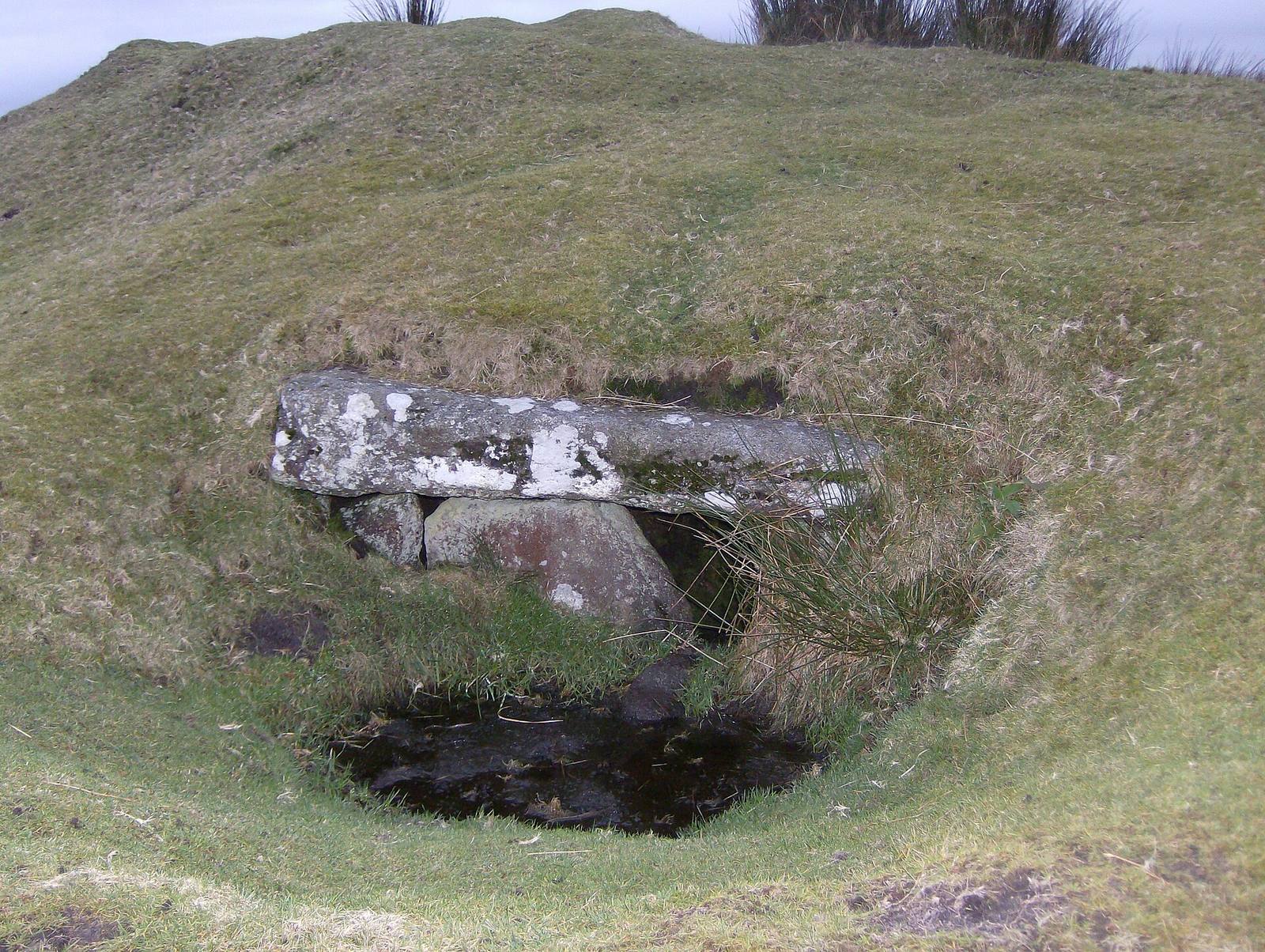
Rillaton Barrow is an Early Bronze Age burial mound on the eastern flank of Bodmin Moor near Minions, in Cornwall, United Kingdom. The Early Bronze Age was an archaeological period associated with the use of bronze, although its dates vary by region; the mound is broadly dated to about 1700–1500 BC. Its later historical importance is closely associated with a gold vessel recovered from a burial there in 1837.
That year, miners searching for stone uncovered a granite burial chamber containing a human burial and grave goods, including the Rillaton Gold Cup. The finds were transferred to King William IV as treasure trove, a historical legal category for valuable concealed objects that were discovered. The transfer was made through the Duchy of Cornwall, a historic royal estate associated with the county, and the objects remained in the royal household. After King George V’s death in 1936, the cup and an associated dagger were recognized for their importance and loaned to the British Museum. The cup is displayed there but belongs to the Royal Collection, the British monarch’s collection rather than the museum’s.
Folklore linked to the barrow tells of the ghost of a druid, a religious specialist in ancient Celtic societies, who offered a traveller a drink from an inexhaustible cup. After the traveller threw the drink at the ghost, he was later found dead in a ravine. This is a legend, not evidence that the events occurred. The barrow has been protected as a Scheduled Monument in England since 1958.
Remains
Mound and burial chamber
The round mound, built from stone rubble and earth, stands about 2.7 metres high and measures approximately 30–34 metres across. It lies near Minions and the Hurlers stone circles. Beneath the mound, a granite cist, or stone-built burial chamber, measures roughly 2–2.4 metres long and 1–1.1 metres wide. The burial goods included the gold cup and a metal dagger, as well as beads, pottery, glass and other objects.
The Rillaton Gold Cup
The cup is a gold vessel about 8–9 centimetres high. Its shape is broad around the middle and narrows toward each end, with horizontal ridges around the body. A handle, attached with rivets, has two groups of grooves and is secured to the vessel with diamond-shaped discs. Its rounded, uneven base was later flattened. A sketch possibly made around 1818 depicts the cup with its original rounded base. A replica is held at the Royal Cornwall Museum in Truro.
The cup’s form resembles a late Neolithic ceramic beaker dated to about 2300 BC, but that resemblance is not its accepted date. It was long dated to about 1650–1400 BC; a study published in 2006 instead proposed a date around 1700 BC, while allowing that it may have been buried long after it was made. Comparisons with objects from Mycenae, a major Bronze Age centre in Greece, led to descriptions of the cup as Aegean in style and suggestions of contact with the eastern Mediterranean. Other proposed parallels include the gold cup from Eschenz, the Unetice culture, Montecchio Emilia and the Ringlemere Cup, found in 2001, whose similar corded decoration is on a vessel that remains crushed nearly flat. The 2006 study placed the Rillaton cup among north-west European precious-metal cups with rounded bases that cannot stand upright, finding no need to seek distant parallels. The cup and the separate Pelynt Dagger have both been cited as evidence of contact with the Mycenaean world, although the dagger itself may be Mycenaean. The cup may have been imported from the continent or made locally as an imitation.