Casa Malpaís: An Ancestral Puebloan Settlement in Arizona
Site at a Glance
- Rating
- 4.7
- Popularity
- Low
- Country
- United States
- Primary era
- Medieval
- Eras represented
- Medieval
- Civilizations
- Ancestral Puebloan
- Site type
- Settlement
- Remains
- Village
On this page9 sections
History
Casa Malpaís is a settlement of Ancestral Puebloans, Indigenous peoples of the American Southwest, near Springerville, Arizona, in the United States. It was built around the mid-13th century and remained occupied at least into the 14th century, possibly into the early 15th. Its occupation spans Pueblo III and Pueblo IV, successive periods in the region’s archaeological chronology. The site belongs to the Mogollon, an archaeological cultural tradition of the Southwest, and is among the latest dated sites of that tradition.
The Spanish name Casa Malpaís means ‘House of the Badlands.’ Basque settlers are said to have named the place for ground largely covered with volcanic rock. Hopi and Zuni peoples continue to regard it as a sacred place of their ancestors.
In 1883, American anthropologist Frank Cushing, then living among the Zuni, made the earliest known professional visit to the ruins and sketched their masonry. Casa Malpaís became a National Historic Landmark, a U.S. designation for nationally significant sites, in 1964. It was added to the federal National Register of Historic Places in 1966.
Remains
The 60-room settlement occupies terraces about 7,000 feet above sea level, in front of basalt cliffs created by ancient lava flows. Its builders used stonework laid without mortar to bridge fissures. The surrounding Springerville volcanic field contains more than 400 volcanoes within about 50 miles and is the third-largest volcanic field in the continental United States.
Cliff access and ceremonial architecture
Basalt staircase
A steep staircase of basalt is set into a crevice in the high cliff and leads to the top of the mesa.
Great Kiva
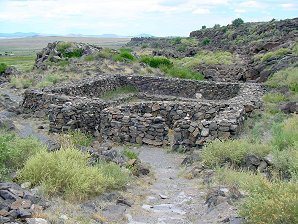
The site’s central Great Kiva, a large ceremonial structure associated with Pueblo communities, was built from volcanic rock.
Solar enclosure and petroglyph
Circular stone enclosure
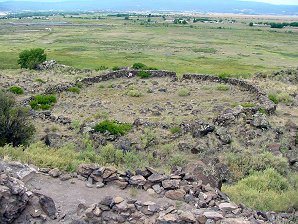
The circular enclosure measures about 26 meters across and has five gates in a low stone wall. A partly restacked section suggests the wall may originally have stood about 1.2 meters high. The northern opening appears aligned with true north, on a line that corresponds with a stone in the foundation at the center of the south wall.
An offset opening on the enclosure’s southwest side directs a rectangular shaft of sunlight onto the wall at sunset on the summer solstice. At the winter solstice, sunlight enters through a gate and reaches about the enclosure’s midpoint. During the equinoxes, sunlight again forms a distinctive rectangular shaft.
Bear-claw petroglyph
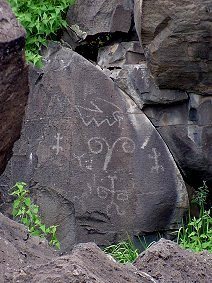
Outside the enclosure, a bear-claw image is carved into stone. At sunset on the spring equinox, it aligns with a shaft of light produced by a natural grouping of rocks. Hopi or Zuni bear clans or societies may have made the image.
Archaeological collection
The collection includes 156 boxes of pottery fragments and other artifacts, along with a separately noted butterfly collection. Most artifacts found in the 1990s are displayed at the Casa Malpaís Museum in Springerville, which is operated by the city.