Roman Circular Ditch Enclosure on Sparrenberger Egge: An Unfinished Watchtower Project
Site at a Glance
- Rating
- 3.5
- Popularity
- Very Low
- Country
- Germany
- Primary era
- Classical
- Eras represented
- Classical
- Civilizations
- Roman
- Site type
- Military
- Remains
- Tower
On this page6 sections
History
The Roman Circular Ditch Enclosure on Sparrenberger Egge is an unfinished Roman watch-and-signal-tower project in Germany, generally associated with campaigns in Germania between 12 BCE and AD 16.
Roman campaigns in Germania
The project belongs to the period of Rome’s major offensives in Germania and the later reprisal campaigns commanded by Germanicus, a Roman general. Germania Magna was Rome’s name for territories it sought to incorporate as a province. Construction may instead have begun during the campaigns of Drusus, another Roman commander, between 12 and 8 BCE. Work stopped before the tower was finished, for reasons that remain unknown.
Discovery and interpretation
A Roman coin was found about 150 m from the earthwork in 1939, followed by two more in 1988. The faint ditch and bank were identified in 1989. Archaeologist Johann-Sebastian Kühlborn proposed that the coin-findspot may have been a camp for the construction crew. Whether the site was connected to the Roman marching camp at Bielefeld-Sennestadt, about 8 km to the southeast in a straight line, remains unresolved. A marching camp was a temporary fortified encampment used by troops on campaign.
The earthwork is listed in Bielefeld’s register of archaeological monuments and protected under North Rhine-Westphalia’s monument-protection law.
Remains
Enclosure and setting
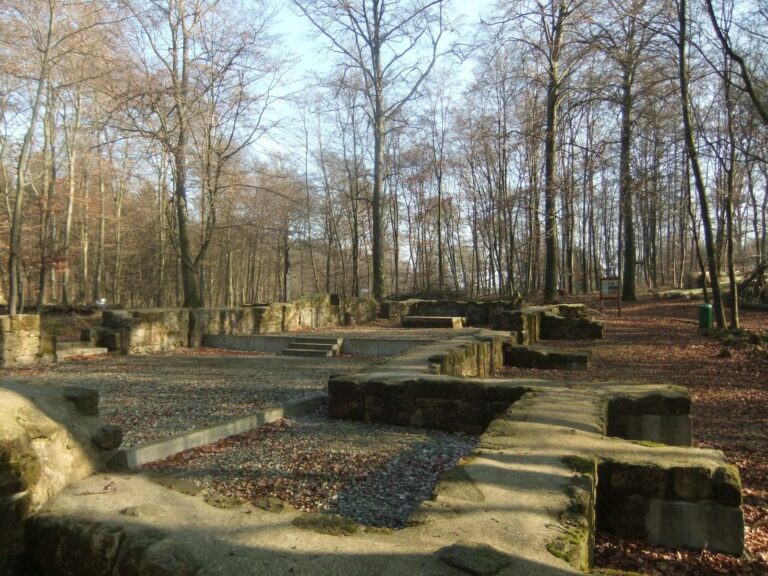
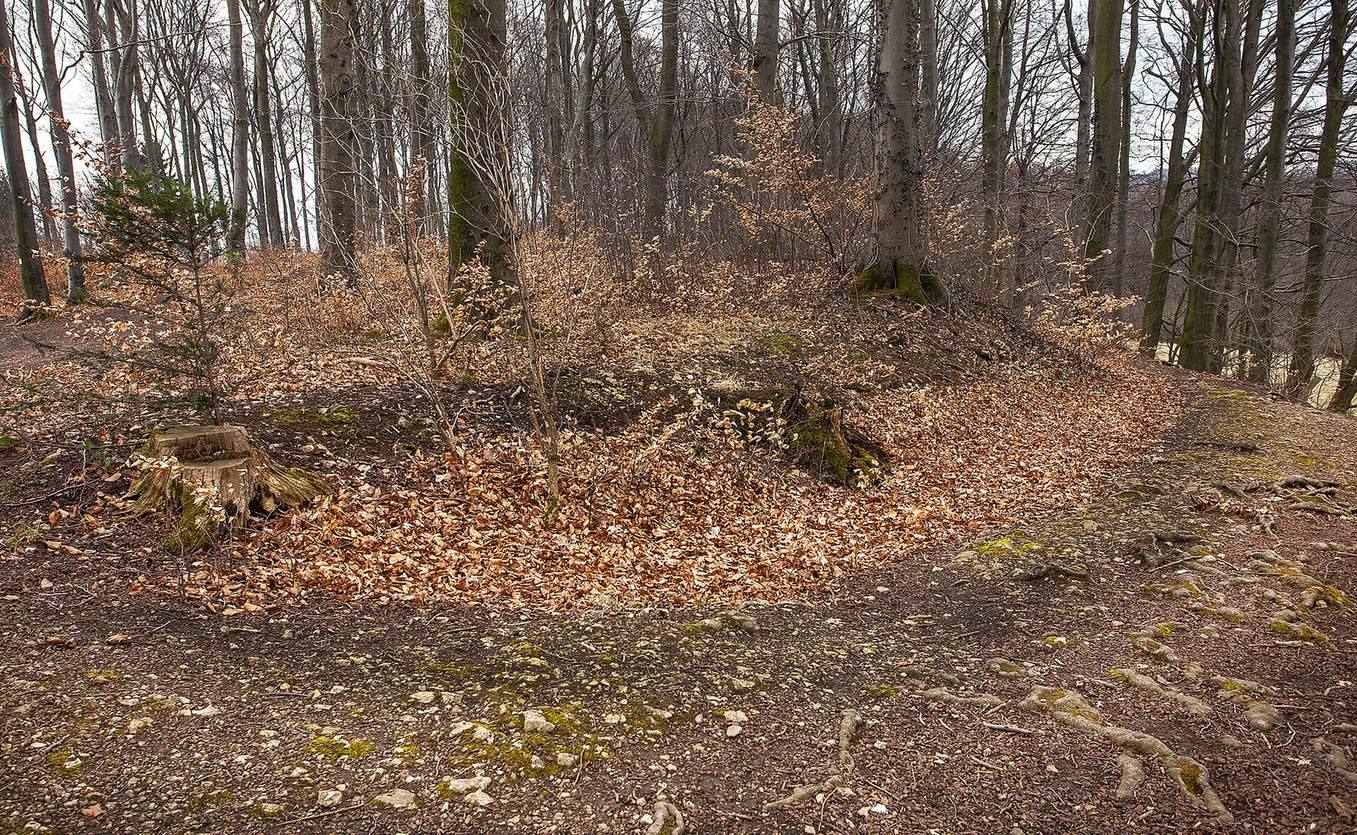
The planned watchtower was to stand within a semicircular perimeter formed by a ditch and an earth bank. The straight side measures 32 m, and the enclosure’s internal diameter is about 24 m. Both features are faint in the terrain, with the bank less distinct than the ditch. Excavations found that the ditch reached up to 2 m in width and about 0.5 m in depth; precise levelling was needed to determine the bank’s outline.
The site lies at an elevation of 203–204 m above NHN, Germany’s national height datum, and affords extensive views to the north and east. The northern view reaches the Wiehengebirge, 26 km away.
Excavated finds
Excavations inside the enclosure recovered 23 Roman nails used as studs in the tread pattern of caligae, the studded boots worn by Roman soldiers. Six Roman coins are associated with the site. One, a denarius of Marcus Antonius, came from the ditch; the other five were found about 150 m away.