Inscription of Yanran: An Eastern Han Victory Inscription in Mongolia

Site at a Glance
- Popularity
- High
- Country
- Mongolia
- Primary era
- Classical
- Eras represented
- Classical
- Civilizations
- Han
- Site type
- Civic
- Remains
- Monument
On this page5 sections
History
The Inscription of Yanran is a cliff-carved Eastern Han victory inscription in Mongolia, commissioned in 89 CE after Han forces defeated the Northern Xiongnu. The Eastern Han was the later period of Han rule in China, from 25 to 220 CE. The Xiongnu were a confederation of steppe peoples, divided into Northern and Southern political groupings. The inscription commemorated Dou Xian’s campaign and later became a celebrated expression for exceptional military achievement.
Campaign and commemoration
In 88 CE, famine and internal disorder weakened the Northern Xiongnu, and many groups surrendered to the Han. The ruler of the Southern Xiongnu, whose title was chanyu, also asked the Han to campaign against them. Dou Xian, a courtier and commander, had fallen into disgrace after arranging the assassination of an official favored by Empress Dowager Dou. Seeking to avoid punishment, he requested command of the expedition. In June 89, he was appointed General of Chariots and Cavalry, with Geng Bing as his deputy. Each commanded 4,000 cavalry, alongside allied Southern Xiongnu, Wuhuan, and Qiang forces. The initial allied force numbered more than 30,000.
Dou sent more than 10,000 cavalry against the Northern Xiongnu at Jiluo Mountain, where their chanyu was forced to flee. Dou and Geng Bing pursued for more than 3,000 li, over 1,500 kilometres, crossing the Hanhai desert and passing Jilu Pass. Southern Xiongnu troops advanced from Manyi Valley, while Deng Hong, the General Who Crosses the Liao, set out from Chouyang Pass. Their forces met at Mount Zhuoxie and defeated the Northern Xiongnu. Near Uvs Nuur, more than 13,000 people were killed, many were captured, and over a million livestock were seized. Eighty-one groups, comprising more than 200,000 people, surrendered to the Han.
After advancing more than 3,000 li beyond the frontier, Dou’s army climbed Yanran Mountain. Dou held a ceremony for Tian, or Heaven in Chinese religious and political thought, and ordered a victory text carved into the cliff. Ban Gu, a historian on his staff, composed it. The inscription gives the army’s strength as 100,000 cavalry and presents the expedition as vengeance for earlier grievances, a service to the ancestors and Han successors, an extension of Han territory, and a display of imperial authority. It casts a temporary campaign as bringing lasting peace. The text also recounts the army crossing Mount Zhuoxie and Mount Anhou, entering settlements associated with the early Xiongnu ruler Modun, and burning Laoshang’s Dragon Court, the Xiongnu royal encampment. It ends with five lines of poetry in the Chu Ci (Songs of Chu) tradition.
Aftermath and legacy
The victory restored Dou Xian’s standing: he was cleared of his offense and promoted to Grand General. In 91, he sent another expedition under Geng Kui, Ren Shang, and Zhao Bo. Han forces surrounded the Northern Xiongnu chanyu at Jinwei Mountain, defeated his main force, captured his mother, and killed more than 5,000 people, including prominent leaders. The ruler escaped, and the Han army returned after advancing more than 5,000 li beyond the frontier. About 30 years after the Yanran campaign, the last Northern Xiongnu chanyu, Fenghou, was defeated and surrendered, ending Northern Xiongnu influence in China. The defeats also drove Northern Xiongnu groups westward.
The inscription’s text was preserved in the Book of the Later Han, an official history compiled in the fifth century, in chapter 23, the biography of Dou Rong, Dou Xian’s great-grandfather. The phrase “carving a stone on Yanran” became a literary reference to exceptional military achievement, appearing in poems by the Tang poet Li Qiao and the Northern Song writer Fan Zhongyan.
Rediscovery
Mongolian journalist and writer Badamsambuu G found the inscribed cliff on 27 June 2001, but its text was initially undeciphered. In June 2016, a team led by Battulga of the National University of Mongolia identified the inscription. Mongolian-Chinese surveys followed in 2017 and 2019, examining the site and confirming the identification.
Remains
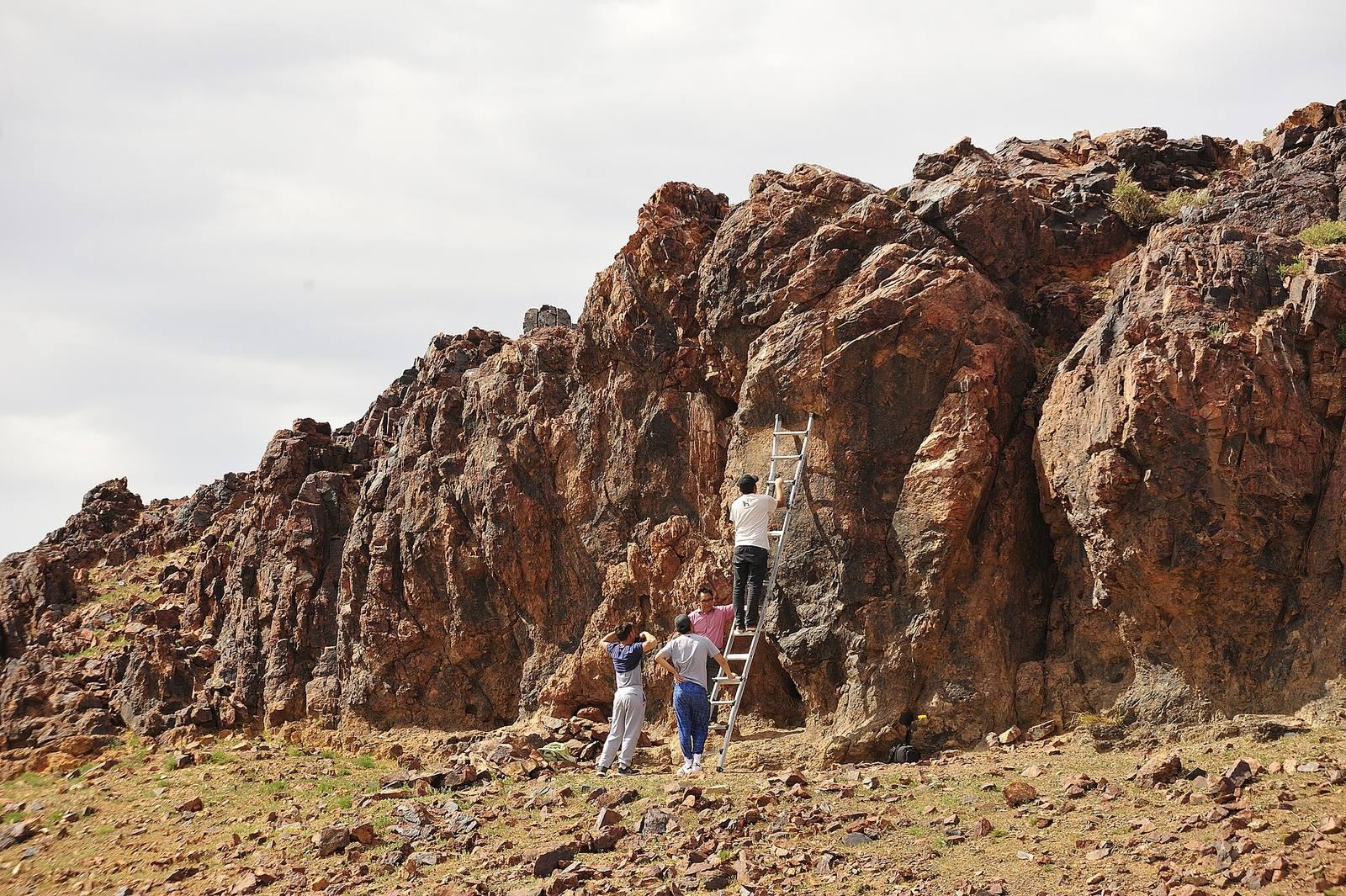
The inscription is cut into a rock outcrop projecting southwest from a spur of the Khangai range, among the Baruun Ilgen hills south of Mount Inil Hairhan. The site lies in Delgerkhangai District, Dundgovi Province, Mongolia. Mount Inil Hairhan rises 1,488 metres. The carved surface measures about 1.3 metres wide and 0.94 metres high.
The text is arranged in 20 lines and contains approximately 260 Chinese characters, written in Han clerical script, a historical Chinese writing style used during the Han period. More than 220 characters were identified during the 2017 survey, and 244 were read in 2019 using imaging and scanning. Other cliff inscriptions in the Baruun Ilgen hills are also associated with recording military successes. The Yanran text corresponds to the version preserved in the Book of the Later Han.