Shirik-Rabat: An Ancient Fortified Settlement in Kazakhstan
Site at a Glance
- Popularity
- Medium
- Country
- Kazakhstan
- Primary era
- Iron Age
- Eras represented
- Iron Age, Classical, Medieval
- Civilizations
- Scythian
- Site type
- Settlement
- Remains
- Town
On this page17 sections
History
Shirik-Rabat is an ancient fortified settlement in Karmakshy District of Kazakhstan’s Kyzylorda Region. It was probably established in the fifth century BCE, perhaps as early as the late sixth century, and is associated with Massagetae groups and Saka communities of the Syr Darya region, ancient peoples of Central Asia. Its main early settlement and fortification phase belongs to the fourth through second centuries BCE.
Early settlement and regional connections
Pastoralism formed an important part of life at Shirik-Rabat. Its inhabitants also made pottery, worked metal by smithing and casting, and took part in trade. The settlement served as a trading center on the ancient Silk Road and had a library. Its cultural and economic development was connected with Khorezm, an ancient Central Asian region, and more broadly with lands ruled by the Achaemenids, the dynasty that governed the ancient Persian Empire.
Professor A. Aidosov proposed that the person known as the Issyk Golden Man came from former inhabitants of Shirik-Rabat among the Saka of the Syr Darya. This is an interpretation, not an established identification.
Changes in occupation and water supply
Settlement activity ended in the second century BCE as water in the Zhanadarya channel dwindled. The fortifications were remodeled around the beginning of the Common Era according to defensive designs associated with Khorezm. Occupation later resumed as the river’s flow increased, with a medieval phase dating from the ninth to thirteenth centuries CE.
During the medieval period, Shirik-Rabat became a capital of the Oghuz state, the political organization of a Turkic confederation. The settlement was rebuilt in the twelfth century and abandoned in the fourteenth century as the Zhanadarya and other channels dried.
Archaeological investigation and status
The Khorezm Archaeological-Ethnographic Expedition, led by Soviet archaeologist S. P. Tolstov, discovered Shirik-Rabat in 1946 and investigated it again in 1948–49. Excavations led by Yu. A. Rapoport and S. A. Trudnovskaya in 1957–58 helped establish the site’s chronology and character. Research continued from 2004 through Kazakhstan’s state Cultural Heritage program, with an expedition led by Zh. Kurmankulov. Shirik-Rabat is included in Kazakhstan’s state list of historical and cultural monuments of republican significance.
Remains
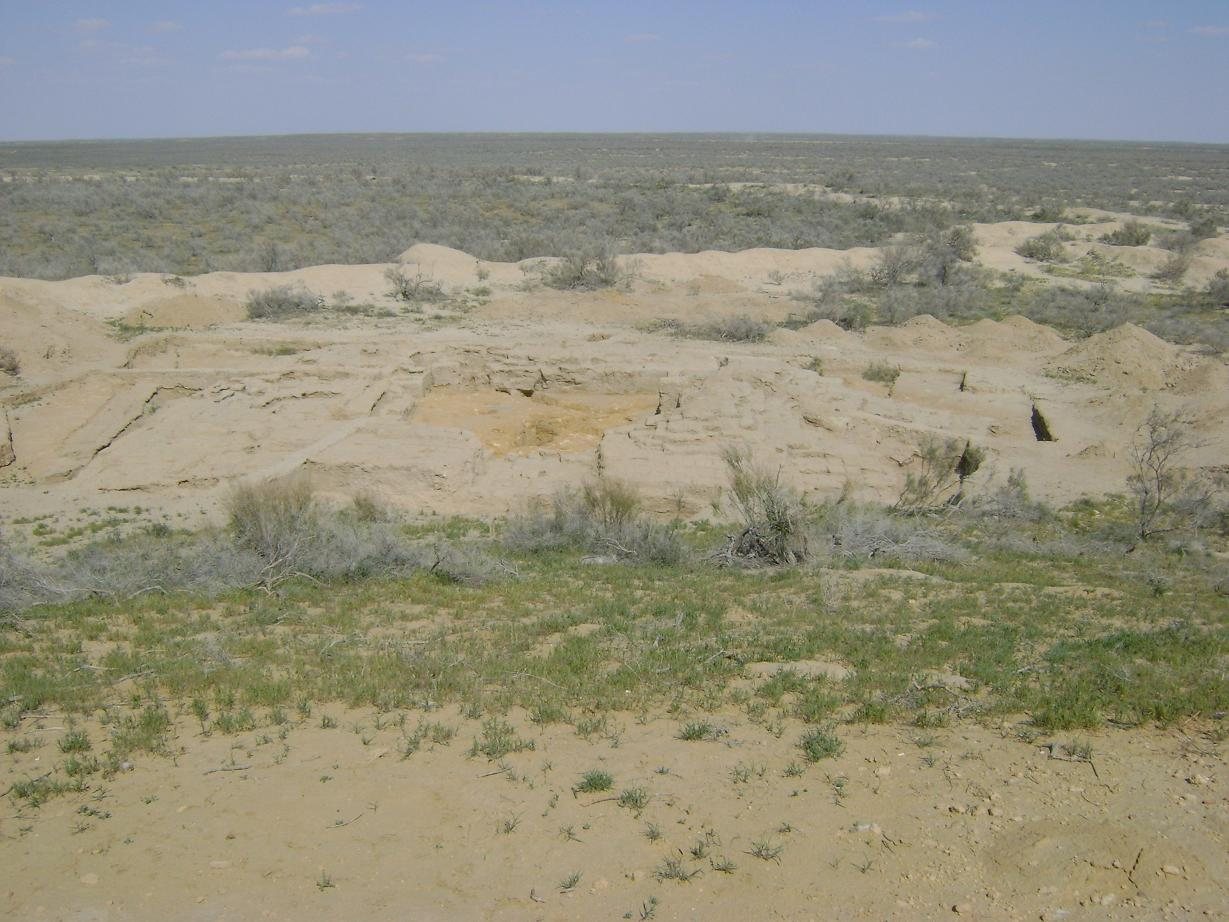
The settlement extends across a natural rise with an oval plan, about 850 by 600 metres and roughly 15–20 metres above the surrounding land. The Zhanadarya channel curves around the rise, while the wider site covers about 2.8 square kilometres. Defensive and funerary structures occupy the high ground.
Defensive layout
Walls, moat, and entrances
Two lines of defensive walls or earthen ramparts enclosed the settlement, with a moat beyond them. The moat measured about 30–50 metres across and 3–5 metres deep. The walls were about 5 metres thick and reached 10–12 metres in height. Entrances stood on the south and west sides. Mud-brick towers had narrow openings through which defenders could shoot, and a passage 1.8 metres wide ran along the inner wall.
Later fortifications
A later rectangular fortification occupied the southeastern part of the settlement and enclosed older burial structures. The outer wall is heavily damaged, while the southern half of a later wall remains largely preserved. Defensive walls on the eastern side date to the thirteenth and fourteenth centuries.
Burial ground and funerary buildings
Burial mounds and refuge dwellings
Six burial mounds were identified on the high ground; four are among the site’s earliest features. They formed its earliest central group, which also had an earthen enclosure. Dwellings on the southern side served as refuges during hostile incursions and housed guards responsible for the mounds. One excavated mound stood about 3.5 metres high and was nearly 60 metres across, with a central depression about 30 metres wide. Its grave pit measured 7.5 by 7.5 metres and was 2.5 metres deep, and a passage 15 metres long entered from the south. The grave had been looted. Finds included pottery fragments, a broad-bladed iron sword with a flat hilt, a bronze arrowhead, and a half-cylinder-shaped gold object. Ten medieval burials lay outside the passage entrance.
Large circular structure in the east
A circular mud-brick funerary structure in the eastern part of the settlement measures 38.5 metres across and 8.4 metres high. Four interior rooms, each about 6 by 6 metres, were connected by passages roughly 10 metres long and 1.7 metres wide. Finds included gold ornaments, bronze and iron arrowheads, an iron knife, corroded daggers, and part of the armor of a heavily armored cavalryman known as a cataphract.
Other circular burial structure
A separate circular burial structure is assigned to the late fourth century BCE, or to the fourth–third centuries BCE. Its finds included three-bladed arrowheads of Scythian type, an early Sarmatian arrowhead, a curved iron knife, a damaged dagger, iron-buckle fragments, and an iron hook decorated with a gold line. Other objects included pieces of an ivory comb; fire-damaged glass and stone beads; large cylindrical beads of deep-blue lapis lazuli; wool textile fragments stitched with gold thread; cylindrical bronze pendants; and a bronze bell. Gold and silver ornaments included perforated round plaques, a large embossed four-petalled floral plaque, two pairs of twisted S-shaped ornaments, three gold bells, and a silver bell 2.5 centimetres long with a ridged band across it.
Square tombs
A square mud-brick tomb measured about 19.5 by 19 metres, with walls 5–5.5 metres thick. An iron arrowhead and pottery fragments place it around the third–second centuries BCE. Another square structure stood within the area of an older mound.
Surface graves and inscribed vessel
Another form of burial was marked by shallow surface depressions 18–20 metres across and up to half a metre deep. One excavated grave had a rectangular pit nearly 5 metres deep, with burial chambers extending east and west and sealed with mud bricks. Three people were buried there. A man had a belt carrying a long iron sword and a knife; a woman and another man were placed one above the other nearer the wall. The grave also contained stone and gold beads and decorative appliqués. A ceramic vessel from the burial bears five undeciphered signs and a potter’s mark. Dated to the fourth–second centuries BCE, the inscription has been compared with ancient Sogdian and Issyk burial inscriptions.
Two-room tomb in the southwest
A two-room tomb in the settlement’s southwestern part was built of especially strong mud brick. It contained scattered human bones, including a woman’s skull, along with a gold bead and round gold appliqué, a fragment of a bronze mirror, part of a bone comb, blue glass and Egyptian-paste beads, ten carnelian beads, and three-sided arrowheads. Pottery from this tomb and another structure dates to the third–second centuries BCE.
Armor fragments
Fire-damaged iron armor plates came from looted funerary remains and a nearby building to their northwest. The square plates were no more than 2 millimetres thick. Narrow, elongated plates formed flexible sections for the arms, legs, and sides; a 40-centimetre belt-like section made of 14 plates protected the waist. The armor fragments were used to reconstruct the armor of a Saka-Apasiac warrior.
Medieval dwellings
An excavated area of about 300 square metres beside the southern wall revealed a dwelling with several occupation layers and four rooms. Its domestic features included storage jars, pots, bottles, glazed pottery fragments, a hearth, a tandoor, or clay oven, and a drainage installation. These remains date approximately to the ninth–twelfth centuries CE, while the uppermost layer belongs to the twelfth–thirteenth centuries. Some jars had been stacked for storage. Their surfaces were generally plain, though some bore patterns of concentric circles.