Chandravalli: An Archaeological Settlement in India
Site at a Glance
- Popularity
- High
- Country
- India
- Primary era
- Classical
- Eras represented
- Iron Age, Classical
- Civilizations
- Unclassified
- Site type
- Settlement
- Remains
- Town
On this page10 sections
History
Chandravalli is an archaeological settlement west of Chitradurga, India. People inhabited the area from the Iron Age onward, and it became the first capital of the Kadamba dynasty, an early ruling dynasty of Karnataka. Its name is interpreted as meaning moon-shaped, though it may instead come from Chandrahasa, a king of Kuntala who was said to have ruled the area.
Early settlement and the Kadambas
Excavations distinguish two principal cultural phases. The earlier, relatively limited phase is megalithic, a term for prehistoric traditions associated with large-stone monuments or burials; its remains chiefly represent a later stage of that phase. A wider and more varied early historic phase, associated with the emergence of written records, appears to have begun around the 3rd century BCE and continued into the 3rd century CE. The settlement’s development extended from prehistoric times through the Vijayanagara period.
A rock inscription associated with Mayurasharma, founder of the Kadambas, is dated to 345 CE. It states that he built a lake at Chandravalli. Roman coins and rouletted pottery, decorated with patterns made by a notched tool, have been interpreted as evidence of commercial contacts with the ancient Roman world.
Later dynasties and archaeological investigations
Inscriptions on nearby hillocks belong to the Chalukya and Hoysala periods, while coins connect Chandravalli with the Satavahanas, Hoysalas, the Vijayanagara Empire, and Mysore rulers. These include southern Indian dynasties and, in the case of Vijayanagara, a later South Indian empire.
Lead coins brought to light during the digging of a water canal first drew attention to the site. In 1909, R. Narasimhachar excavated test pits and reported coins, pottery, and beads; B. L. Rice and R. Shamashastry also took part in excavation work that year. Around 1929, M. H. Krishna investigated more than 30 locations. In 1947, Mortimer Wheeler led more systematic excavations involving the archaeological departments of the governments of India and Mysore, under the guidance of the Archaeological Survey of India.
Remains
Settlement and housing
Chandravalli occupies a valley formed by Chitradurga, Kirabanakallu, and Jolagudda, at the foot of hills in a semi-arid landscape of scrub vegetation. A perennial stream runs through the valley, which is surrounded by hill valleys. The excavated settlement measured about 730 by 730 metres, covering approximately 53.3 hectares. Its housing complex had brick walls, covered stone drains, compacted red-gravel floors, and brick fireplaces.
Cave temple and lake
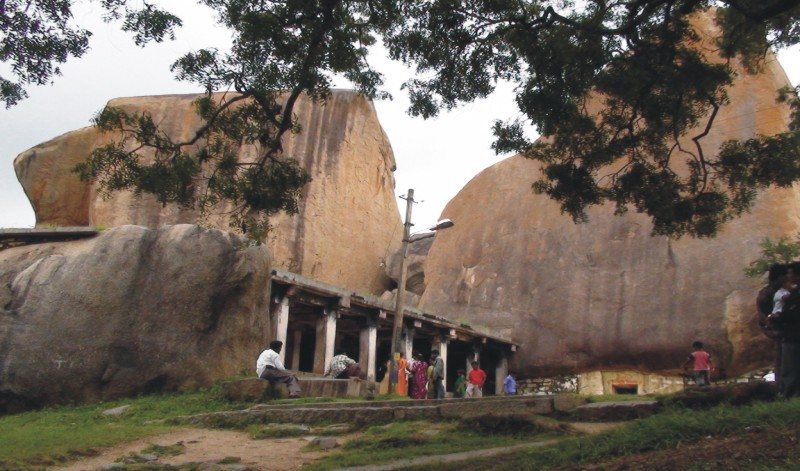
The crescent-shaped Chandravalli cave temple, also known as Ankali Mutt, lies between two large monolithic rocks, each formed from a single block of stone. It is about 3 kilometres from Chitradurga. Saints from Ankalagi, in Belgaum, came to meditate there; the word mutt refers to a religious monastic institution. A lake lies nearby, with forest around it. The rock inscription associated with Mayurasharma is located in the Bhairaweshwara temple.
Excavated objects and burials
Pottery
Pottery from the site includes megalithic wares, vessels with a russet-coloured coating, red-and-black ware, and rouletted ware. Painted decoration includes lines and geometric patterns such as crosshatching, dotted lines, and hatched triangles. Some red-and-black vessels bear white designs, while other vessels have incised decoration around their necks. The forms include funnel-lidded vessels, carinated bowls with an angular change in profile, and three-legged vessels.
Coins and personal objects
Excavated coins include lead and mixed-metal issues of Satavahana rulers and subordinate chiefs, along with coins of Krishnaraja Wodeyar III of Mysore, Krishnadevaraya of Vijayanagara, and Viraraya of the Hoysala kingdom. Foreign coins include silver denarii, Roman silver coins, of Augustus, as well as coins of Augustus and Tiberius and a coin of Wu, an emperor of China’s Han dynasty, dated to the 2nd century BCE. Other finds include Neolithic stone objects, iron and household objects, ornaments, and glass and ivory bangles. Beads were made from precious stones, ivory, and conch shell.
Burials
Two megalithic stone cists, or stone-lined burial chambers, were found. One held a skeleton; the other appeared to contain the legs of a sarcophagus. Other burial finds included pots containing animal bones and teeth, and a Roman bulla, a pendant worn around the neck.