Talietumu: A Fortified Tongan Settlement on Wallis Island
Site at a Glance
- Popularity
- Medium
- Country
- France
- Primary era
- Medieval
- Eras represented
- Medieval
- Civilizations
- Tongan
- Site type
- Military
- Remains
- Fort
On this page4 sections
History
Tongan settlement and fortification
Talietumu, also known as Kolo Nui, is a fortified Tongan settlement in the Mu’a district of Wallis Island, France, built around 1450 during the expansion of the Tu’i Tonga Empire, the polity governed by Tonga’s hereditary paramount rulers. It was the last Tongan stronghold on Uvea before the Tongans were defeated.
Construction is attributed to the Ha’avakatolo family during the rule of Ga’asialili. Father Henquel, a Catholic missionary and chronicler of Wallisian history, identifies Ga’asialili as the second ruler of the first dynasty. The Ha’avakatolo family, originally from Tonga, is said to have arrived with the Ha’amea, who served as Ga’asialili’s guards. The family established Finekata’s residence at Vaimalau and built two houses there, Talietumu and Mito.
Abandonment and restoration
The fort was abandoned sometime in the seventeenth or eighteenth century and fell into ruin. French archaeologists Daniel Frimigacci, Jean-Pierre Siorat, and Maurice Hardy of the French National Centre for Scientific Research spent several years restoring the central platform with original techniques. Their work was completed around 1997.
Remains
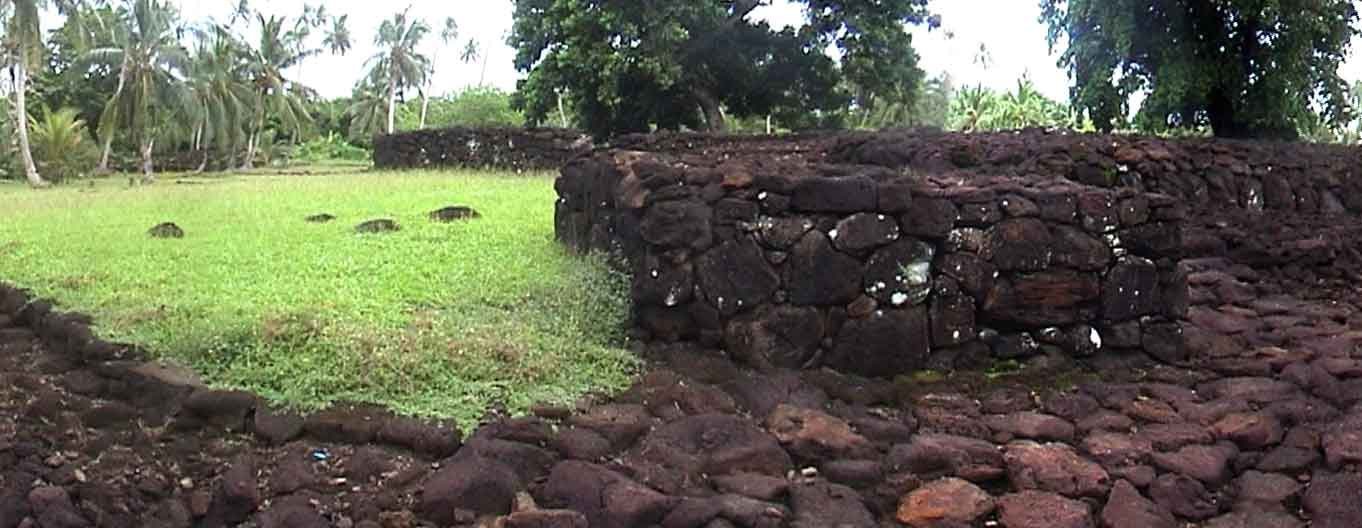
A strong defensive wall of basalt encloses the fort and has several entrances. Within the wall are preserved buildings and other structures, as well as lawns. Raised, stone-paved walkways extend from the central platform through the settlement.
The raised platform at the center, also called Talietumu, is a marae or mala’e, a Polynesian sacred or ceremonial place. It has an elongated circular form and stands on a circular base associated with a palisade. After restoration, the platform measured about 5 m high and 80 m long.