Zbraslav Monastery: A Cistercian House and Royal Burial Place in Czechia
Site at a Glance
- Popularity
- High
- Country
- Czechia
- Primary era
- Early Modern
- Eras represented
- Medieval, Early Modern, Modern
- Civilizations
- Austria-Hungary, Habsburg, Habsburg Austria, Holy Roman Empire, Kingdom of Bohemia
- Site type
- Domestic
- Remains
- Castle
On this page13 sections
History
Zbraslav Monastery was a Cistercian house in Zbraslav, now part of Prague, Czechia, founded by King Wenceslas II in 1292. The Cistercians were a Catholic monastic order. Wenceslas intended the monastery to serve as a burial place for his dynasty, the Přemyslids, who ruled medieval Bohemia. Over the centuries, the complex passed from royal and monastic use to industry and, eventually, a castle.
Foundation and royal burials
Zbraslav was royal property with a hunting lodge by 1268. On 20 April 1292, Wenceslas II established a monastery there with Tobias of Bechin, bishop of Prague. Twelve monks led by Abbot Conrad arrived from Sedlec, and further monks came from Sedlec and Waldsassen. The abbey belonged to the Cistercian lineage of Morimond, with Sedlec as its parent house, and lay within the Diocese of Prague, the area governed by its bishop. Thirty-five abbots led the community during its history.
The first stone of the permanent monastery was laid on 3 June 1297. In the enclosure planned for the church, Wenceslas knighted 240 men. Work advanced quickly, and the monastery was nearly complete by 1305. On 23 June that year, Abbot Ota held one of the church’s first masses for the burial of Wenceslas, the founder. Construction halted in 1307 after Wenceslas III redirected royal funds to war, then resumed in 1329 following donations from Elizabeth of Bohemia. The monks regarded Elizabeth, Wenceslas II’s daughter, as their maternal benefactor and a second founder.
Zbraslav became a royal burial place. Its dead included Wenceslas II, Elizabeth, who died in 1330, Elizabeth’s daughter Margaret of Luxembourg, and Johanna of Bavaria, the first wife of Wenceslas IV. Wenceslas III, killed in 1306, was transferred there from St Wenceslas Cathedral in Olomouc in 1326. Elizabeth also commissioned seven chapels within the precincts.
The monastery’s chronicle, begun by Abbot Otto of Thuringia and completed by Abbot Peter of Zittau in 1338, recounted the history of Bohemia and the Holy Roman Empire from 1253. Peter led the monastery from 1316 to 1338. From the mid-fourteenth century, Zbraslav’s standing declined as St Vitus Cathedral, whose construction began in 1344, became the royal burial place. In 1400, Pope Boniface IX placed the parish church of St Gallus on Havlín Hill under the monastery.
Hussite destruction and recovery
On 14 August 1420, during the Hussite Wars, conflicts in fifteenth-century Bohemia associated with religious reform, Taborite forces under Václav Koranda looted and burned the monastery. The Taborites were a radical Hussite group. The royal tombs were broken open and robbed, and the bones of the last Přemyslid rulers were scattered in the church. After the fighting, the monastery was rebuilt, and the bones were probably gathered together again.
King Sigismund distributed the monastery’s estates among secular lords after the destruction. From the mid-sixteenth century, the monks recovered or bought back much of their former property. The abbey’s endowment had included towns and villages, along with an annual grant of 400 marks of silver from Wenceslas II in 1304. The Cistercians also settled forest lands, while exchanges and later acquisitions changed the extent of the monastery’s holdings.
Seventeenth-century damage and dissolution
Further attacks damaged Zbraslav over the next two centuries. Nassau troops looted it in 1611. During the Thirty Years’ War, the European conflict of 1618 to 1648, imperial-Hungarian auxiliaries plundered the monastery, and Swedish troops commanded by General Banér devastated it in 1639. Another invasion caused serious damage in 1645. Construction of a new monastery church began in 1640.
The convent buildings underwent a Baroque renewal, using a European artistic style that flourished in the seventeenth and eighteenth centuries. Plans by Jan Blažej Santini-Aichel were completed by František Maxmilián Kaňka in 1732. A burial vault for the abbots was completed in 1743. In 1785, reforms under Joseph II, a Habsburg ruler whose measures included suppressing many monasteries, ended Zbraslav’s monastic life. Thirty-nine monks lived there at the time. The estates passed first to the Court Chamber, a Habsburg fiscal authority, and later came under state administration for the Religious Fund, which received property from suppressed religious institutions.
Sugar production and industrial change
After the dissolution, the former convent became a sugar refinery in 1787, while the abbot’s residence was adapted for estate administration and the church became a parish church. Other parts of the complex were used for grain storage, chemical production, and brewing. The refinery was the first of its kind in the Kingdom of Bohemia. In 1786, the Court Chancellery recruited Josef Edler von Sauvaigne to establish it. The buildings were leased to Fries & Co in June 1787, and the first boiler was fired in September. The enterprise later gained imperial privileges and grew to eight kettles and 75 workers.
A new sugar concern took over in 1796, but production stopped in 1803 after unsuccessful efforts to use beet-based methods and syrup from Hořovice. The Napoleonic Wars, European conflicts associated with Napoleon from 1803 to 1815, also made the business unprofitable. Anton Richter received a sugar-making concession and bought buildings at Zbraslav in 1812. After production ceased in 1815, he returned in 1818 and resumed sugar-making alongside chemical production. Heinrich Herz joined him in 1819, became independent in 1823, and Franz Ferdinand Kolb later became Richter’s partner.
In 1824, the sugar refinery and chemical works became separate businesses. The chemical works made products including sulfuric and hydrochloric acids, alum, and creosote. Richter’s refinery produced more than 12,000 historical weight units of refined sugar annually and ranked among the largest in the Habsburg monarchy, the central European realm ruled by the Habsburg dynasty. In 1832, Richter established a beet-sugar factory at Zbraslav. His factories were among the monarchy’s technically advanced sugar works and helped drive the transition from cane sugar to beet sugar. By 1845, three sugar factories operated in the former monastery buildings. A separate plant at Klein-Kuchel moved its operations into Zbraslav’s vacant brewery after problems with water supply and raw materials.
Sugar-making eventually declined as serfdom ended, farmers gained freedom to sell their produce, and cooperative and joint-stock beet-sugar factories developed. The old monastery and brewery buildings increasingly obstructed industrial modernization in the 1860s. In 1875, Karl Friedrich zu Oettingen-Oettingen und Oettingen-Wallerstein, who had taken over his family’s properties in 1861, bought the former sugar factory and ordered its factory buildings, chimney, and chapel of St John the Baptist demolished. The chapel had been used for sugar storage and as a hayloft.
Castle conversion and later use
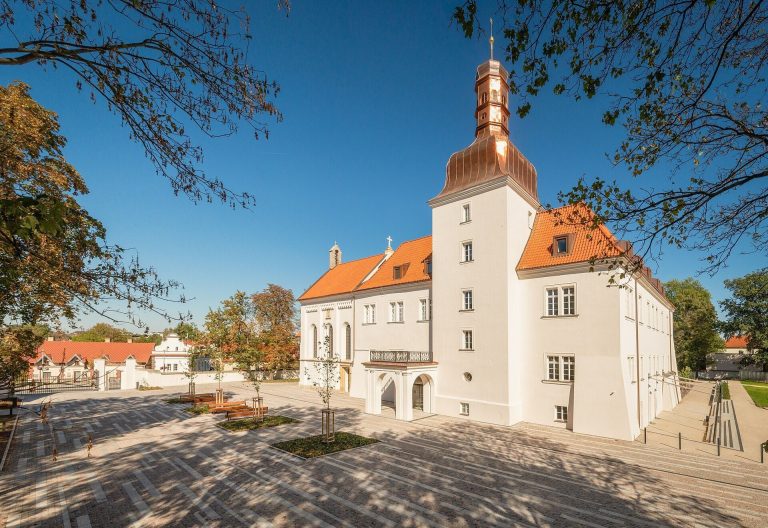
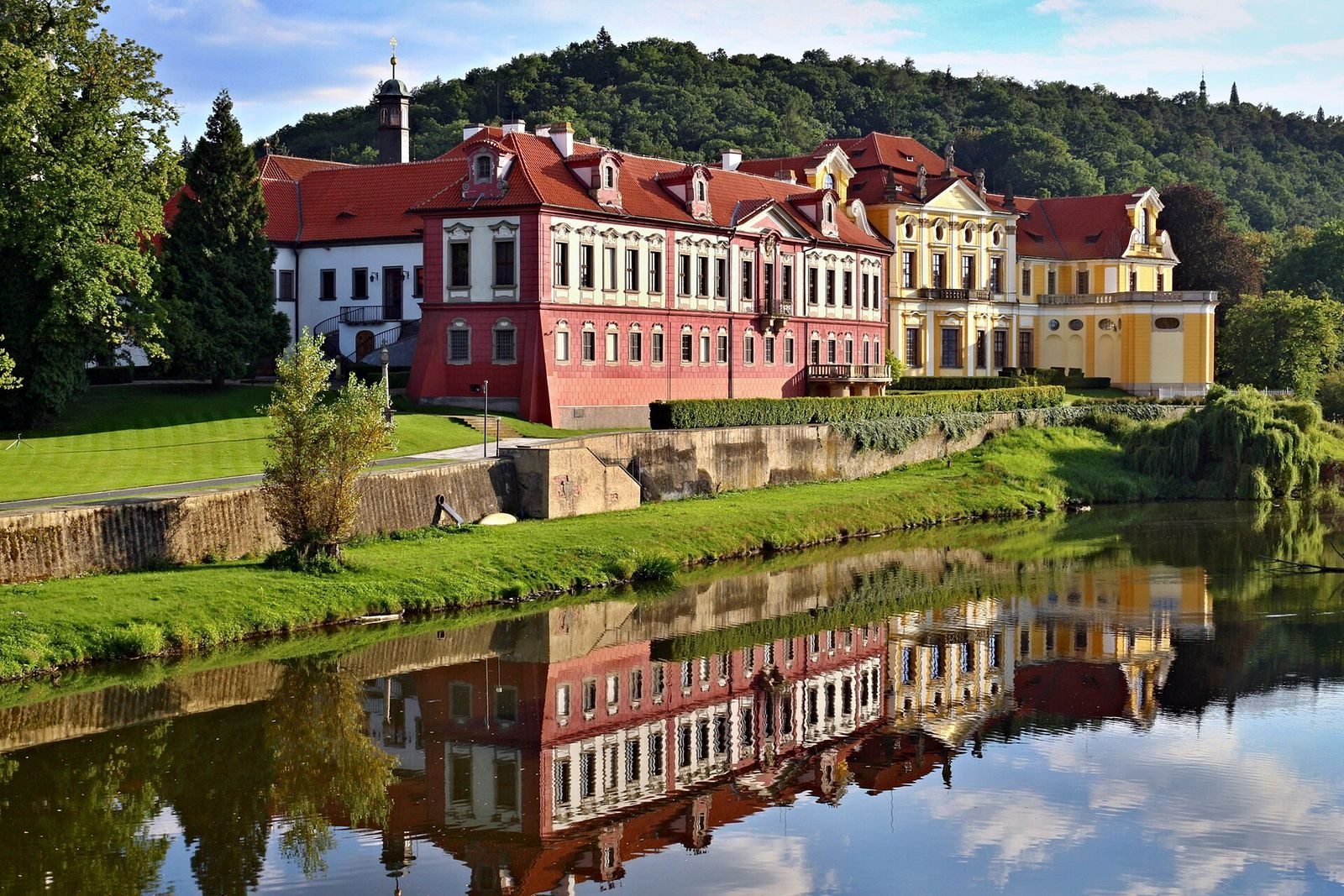
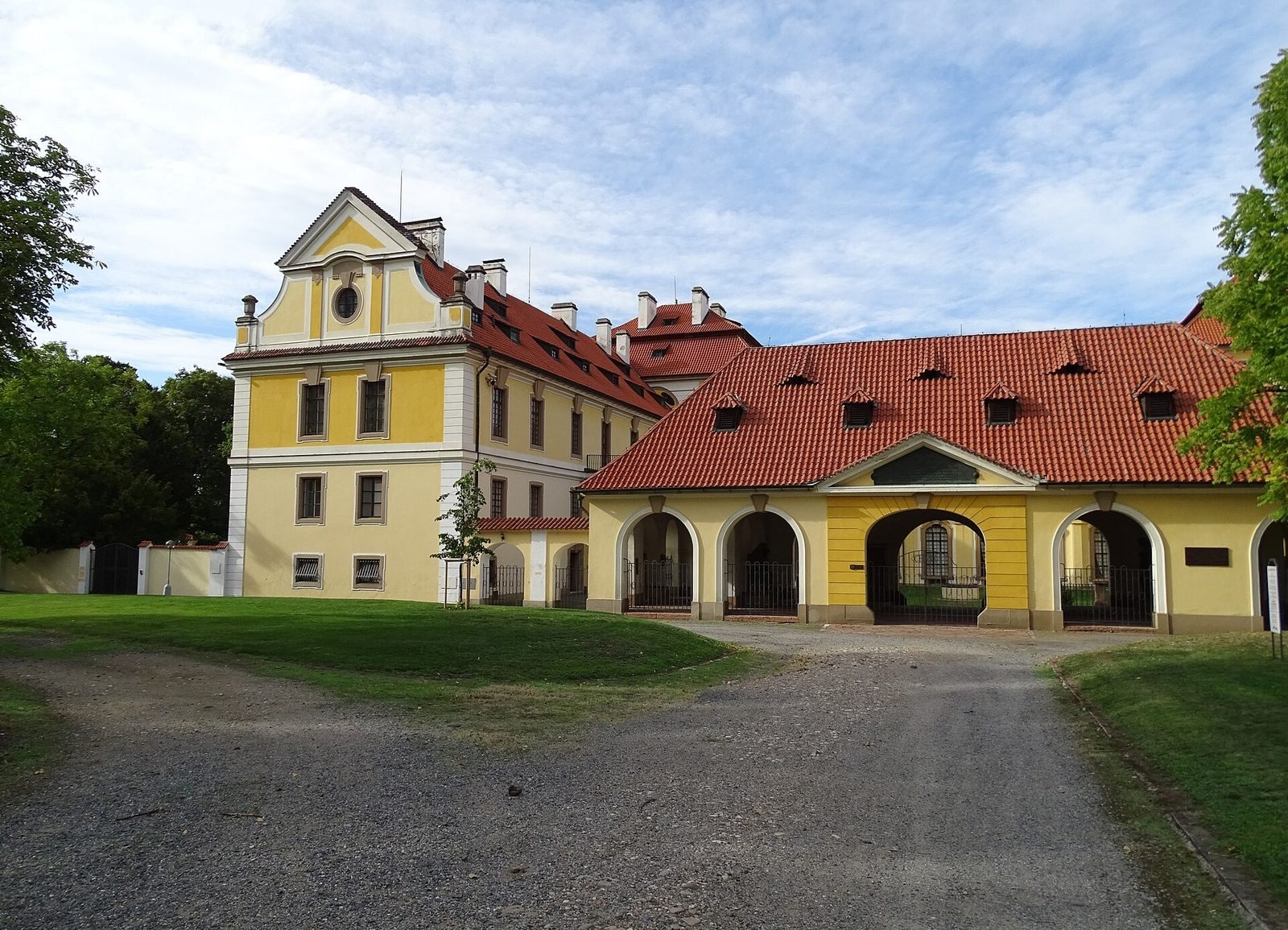
Friedrich Kraft Heinrich zu Oettingen-Oettingen und Oettingen-Wallerstein had acquired the monastery complex with its estate in the mid-1820s. In 1910, industrialist Cyril Bartoň-Dobenín purchased the site. Between 1911 and 1925, he had the former monastery buildings converted into a three-part castle, a project designed by Dušan Jurkovič. The Bartoň-Dobenín family was dispossessed in 1948, and the complex was returned to the owners’ heirs in the 1990s. It is protected as a national cultural monument.
The complex also served cultural and institutional uses. Part of the National Gallery in Prague’s Czech sculpture collection was exhibited there from 1940, and the gallery’s Asian art collection was housed in the buildings until 2009. A deposit collection of the National Museum Library is also kept in the complex.
Remains
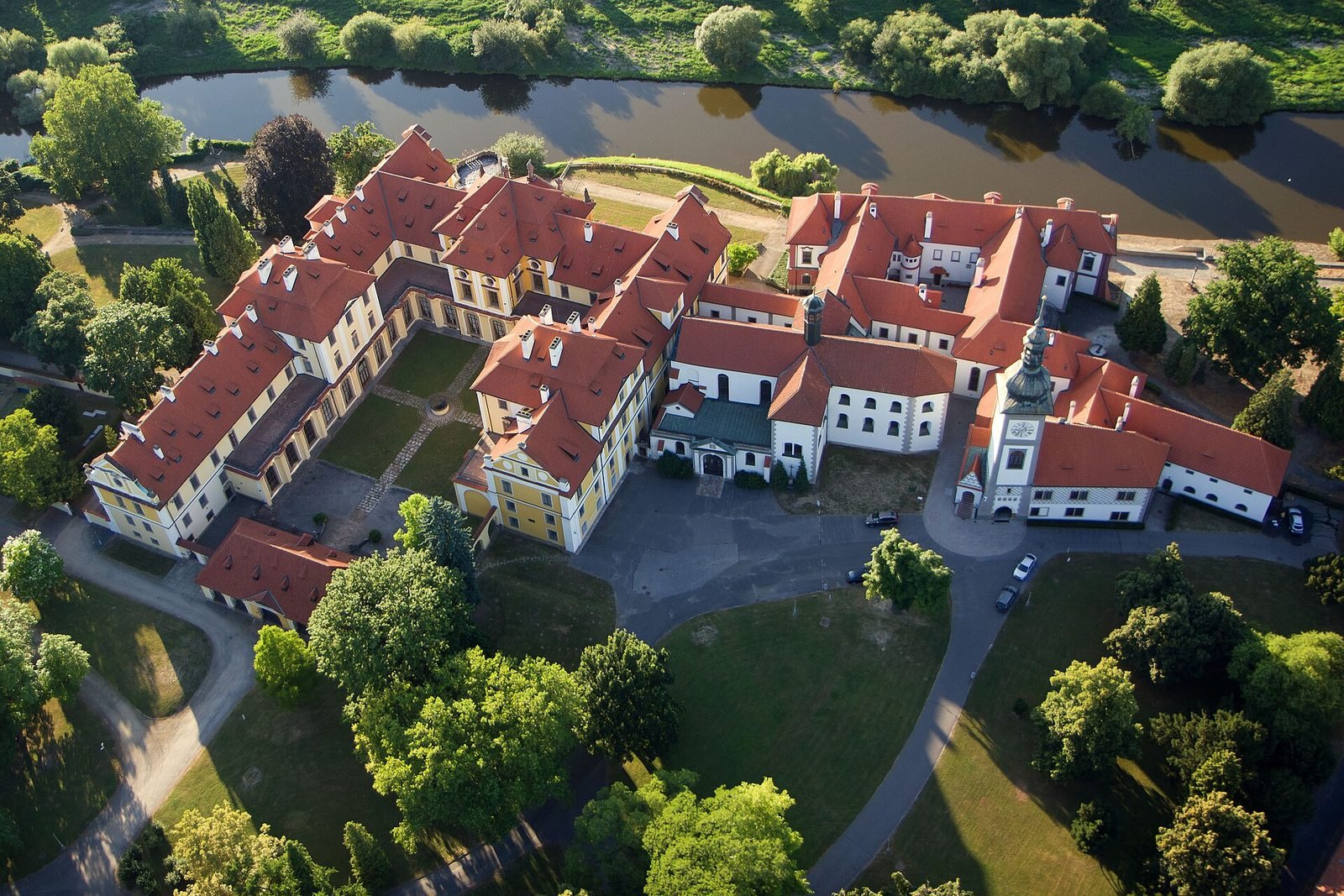
The former monastery site lies near the meeting of the Vltava and Berounka rivers. Its physical form combines evidence for the medieval monastic plan with the later castle complex and the church built on the hunting lodge site.
Monastic plan and castle grounds
Medieval monastery
The first permanent monastic church was a basilica, a long church with a central nave and side aisles, dedicated to the Virgin Mary. A drawing of the medieval monastery was found in 1850 in the top ornament of the church tower at Horní Mokropsy. Excavations carried out in 1924–1926 and 1977–1978 confirmed the drawing’s accuracy, providing evidence for the former arrangement of the buildings.
Castle and park
Jurkovič’s conversion shaped the former monastery into a three-part castle complex. The buildings are surrounded by a park containing numerous statues.
Church and burial places
Church of St James the Greater
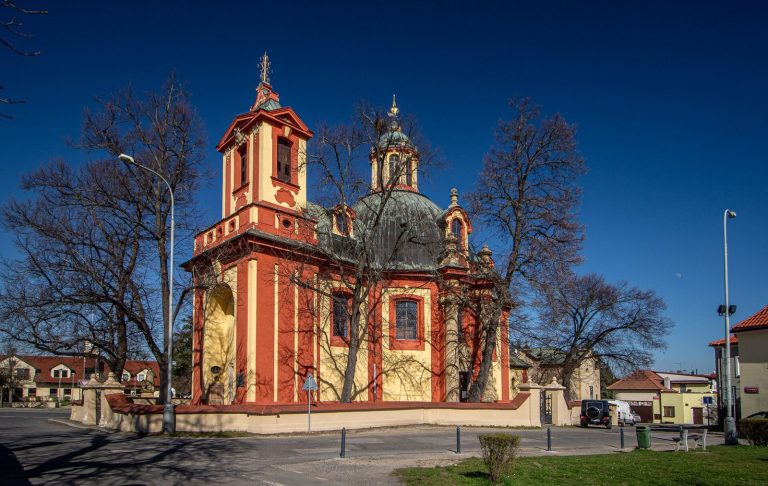
The Baroque Church of St James the Greater was built in 1650 on the site of the hunting lodge’s chapel. Its artworks include the Zbraslav Madonna, a Gothic painting from the 1340s. Gothic was a medieval European artistic and architectural style. The church also contains paintings by Karel Škréta and Petr Brandl.
Royal and monastic burials
The church’s presbytery, the sanctuary around the high altar, contains the reburied remains of members of the Přemyslid dynasty beneath its floor. In the choir, the area traditionally used by clergy or singers, a vault for the abbots lies in front of the high altar. The Přemyslid bones were gathered as a collection by the seventeenth century and displayed in the church sacristy during the eighteenth century in a glass-fronted case lined with velvet and gold braid. Maximilian Millauer challenged their authenticity. Later examination by Czech palaeoanthropologist Emanuel Vlček established that bones attributed to Wenceslas II were genuine; other bones probably belonged to one of his daughters, likely Elizabeth of Bohemia. On 23 June 1991, the remains were ceremonially transferred to the Church of St James and reburied beneath the presbytery floor.