Diu Fortress: A Portuguese Coastal Stronghold in India
Site at a Glance
- Popularity
- High
- Country
- India
- Primary era
- Early Modern
- Eras represented
- Early Modern
- Civilizations
- Portuguese
- Site type
- Military
- Remains
- Fort
On this page9 sections
History
Diu Fortress is a Portuguese coastal stronghold at the eastern end of Diu Island, India, built in 1535–1536 to protect Portugal’s spice trade and secure a military foothold. The fortress, formally called Fortaleza de São Tomé (Fortress of Saint Thomas), became a focus of repeated conflict between Portuguese and Gujarat forces.
Before Portuguese rule
Diu Island was held by the Chavda Rajputs in the ninth century, followed by the Vaghela dynasty, and later became part of the Gujarat Sultanate, a Muslim-ruled state that controlled Gujarat before Mughal power reached the region. Portugal’s attempts to establish a trading post began in 1513 under Alfonso de Albuquerque, but did not succeed. Portuguese forces had also tried to seize the island in 1501, 1521, and 1523. In 1531, Nuno da Cunha led an expedition of 100 vessels and 8,000 men, including 3,000 Portuguese, which bombarded Diu without securing a foothold. Attacks in 1532 and 1533 also failed.
Portuguese construction and the early sieges
In 1534, Martim Afonso de Sousa negotiated with Gujarat’s Sultan Bahadur Shah for Portuguese military aid against Humayun, ruler of the Mughal Empire, a Muslim-ruled power that governed much of the Indian subcontinent. An agreement in 1535 permitted Portugal to build a fort at Diu and station a garrison there. It also confirmed Portuguese control of Bassein Island, acquired in 1533, where the Portuguese had built another fort. Construction at Diu began on 20 November 1535 under Nuno da Cunha, then governor of Portuguese possessions in India, and was completed in 1536. The Portuguese demolished existing fortifications and strengthened the new works through 1546.
Relations with Bahadur Shah worsened after the fort was established, and he was killed in a confrontation with Portuguese forces in 1537. After a Portuguese-backed claimant to the Gujarat throne was defeated, Portugal made a temporary truce with the new sultan. In 1538, Gujarat forces and an Egyptian fleet, supported by the Ottoman Empire, a major Muslim-ruled power centered in Anatolia, besieged the fortress. Gujarat’s force was led by Coja Sofar, while António da Silveira commanded the Portuguese defenders. A Turkish force fielded 66 ships and 20,000 soldiers. A fleet of 24 small Portuguese galleys arrived with supplies. The besiegers mistook it for the advance of a larger relief force and withdrew; Martim Afonso de Sousa also brought aid to the defenders. The attackers lost 1,200 dead and 500 wounded, while only 40 of the 400 Portuguese garrison survived.
The 1545–1546 siege and rebuilding
Gujarat’s Sultan Mahmud III, Bahadur Shah’s nephew, made further attempts to take Diu in 1545 and 1546. During the five-month siege of 1546, Coja Sofar again led the besieging force, while João Mascarenhas commanded the Portuguese defense. Reinforcements and supplies reached the fort by sea on 11 November, and a naval force led by João de Castro secured victory. Coja Sofar and Fernando, João de Castro’s son, died during the siege.
The fighting left the fortress walls in need of rebuilding. João de Castro sought a loan of 20,000 pardaus, a currency used in Portuguese India, from Goa’s municipal chamber, offering his beard as security. The chamber approved the loan but rejected the proposed pledge. Master builder Francisco Pires carried out the rebuilding; before coming to India, he had worked on Fort São Sebastião in Mozambique.
Portuguese rule, decline, and Indian capture
Portugal retained Diu, Daman, and Goa after 1546, and Portuguese rule in Diu lasted from 1537 until 1961. In 1670, armed raiders from Muscat pillaged the fort and town. The Dutch made repeated efforts to capture Diu in the late seventeenth century. From the eighteenth century, the island’s economic importance declined as British development favored nearby cities in Kathiawar. The opening of the Suez Canal diminished Diu’s strategic value by the end of the nineteenth century, and the fortress fell into neglect.
In 1960, the Portuguese garrison at the fort numbered 350. Indian forces captured Diu on 19 December 1961 during Operation Vijay, India’s military campaign to end Portuguese rule in Goa, Daman, and Diu. The Portuguese had run out of ammunition and could not receive reinforcements. The fortress walls were involved in the Lancha Veja episode, during attacks supported by two jet squadrons. A Martyrs Memorial near the Collectorate office commemorates Indian soldiers killed in the capture. The Archaeological Survey of India’s Vadodara Circle administers the fort, which is recognized as a monument of national importance and as a heritage site reflecting Portuguese influence. In 2009, it was named to a worldwide list of seven wonders of Portuguese origin.
Remains
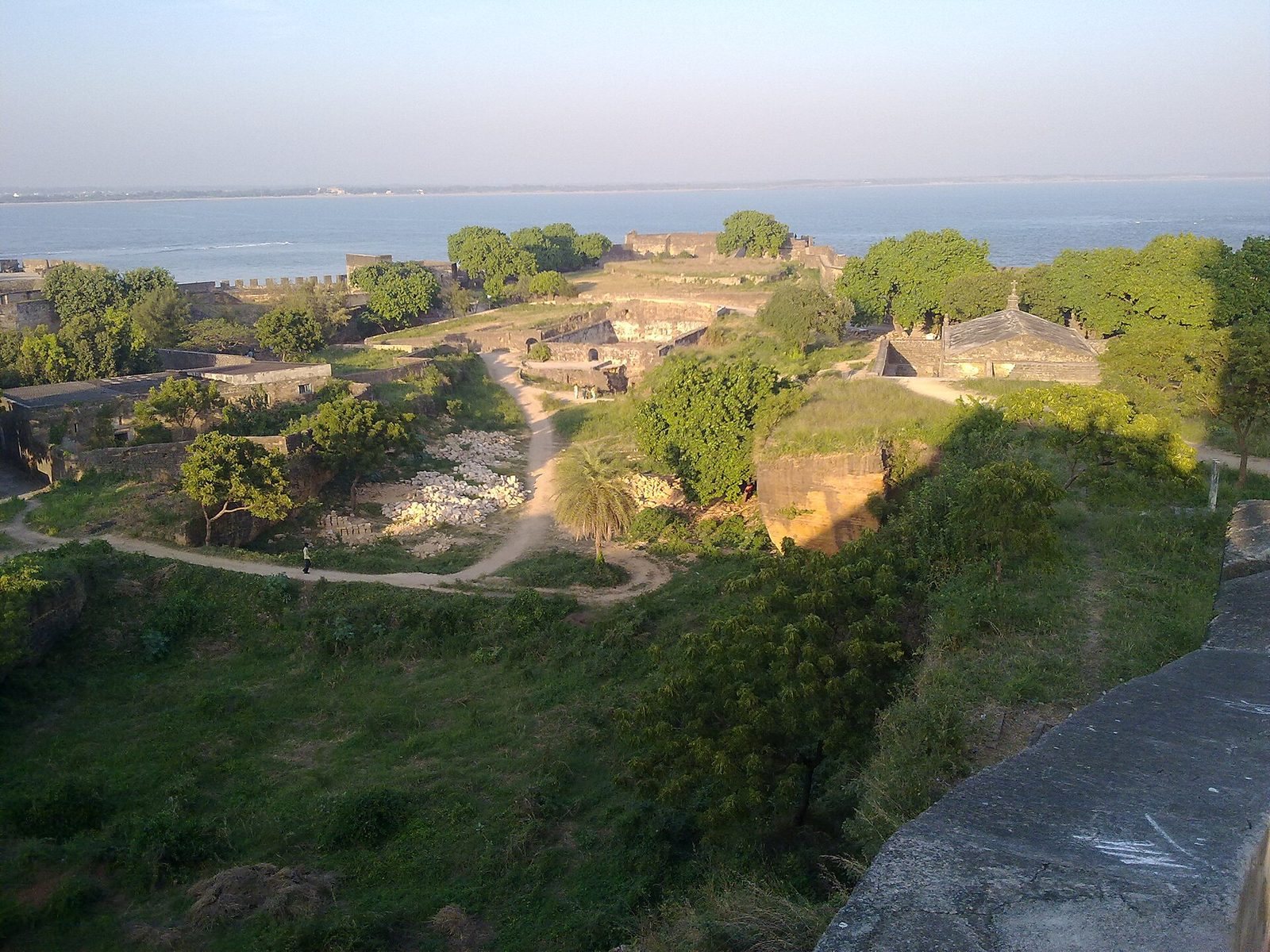
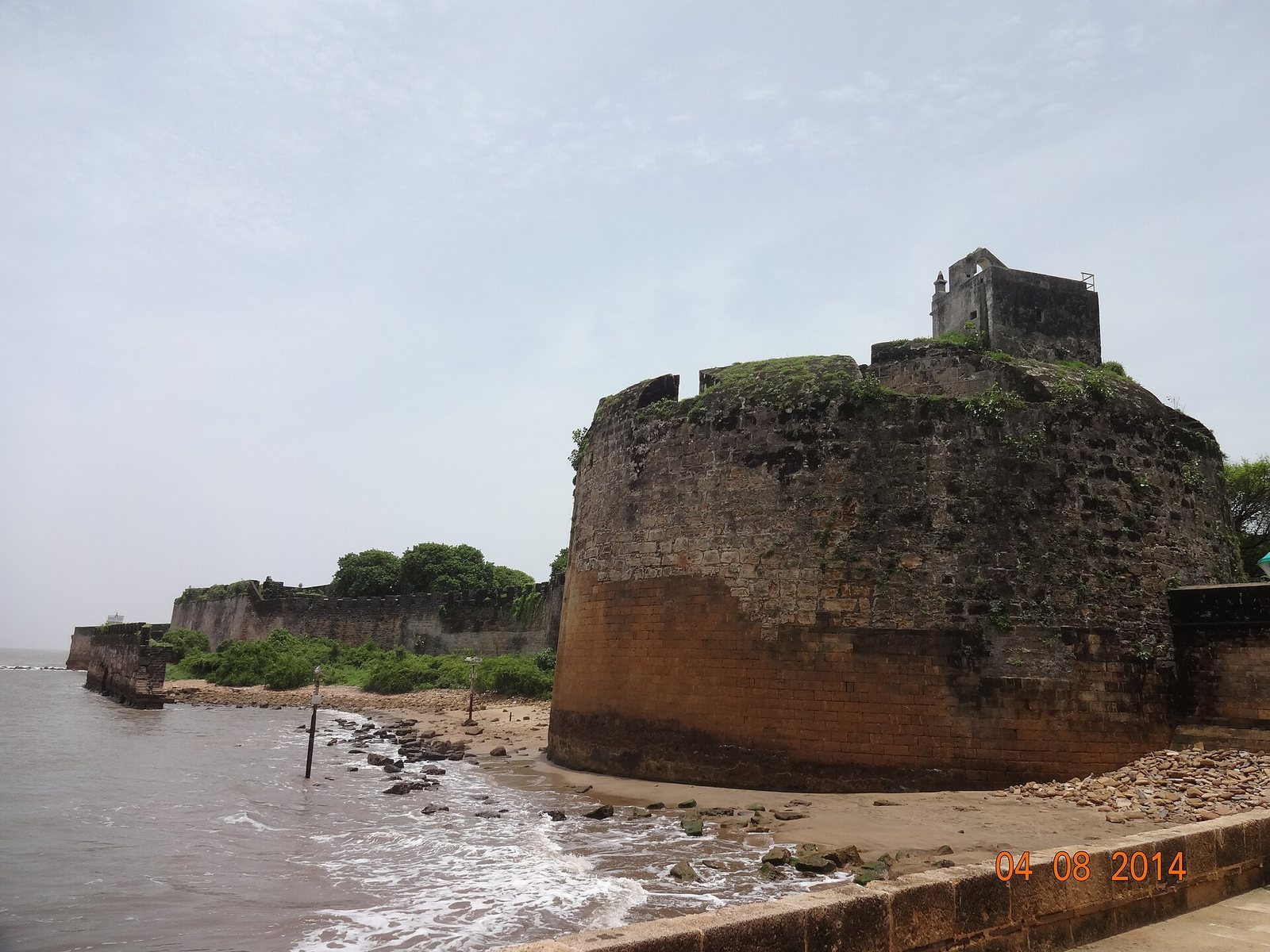
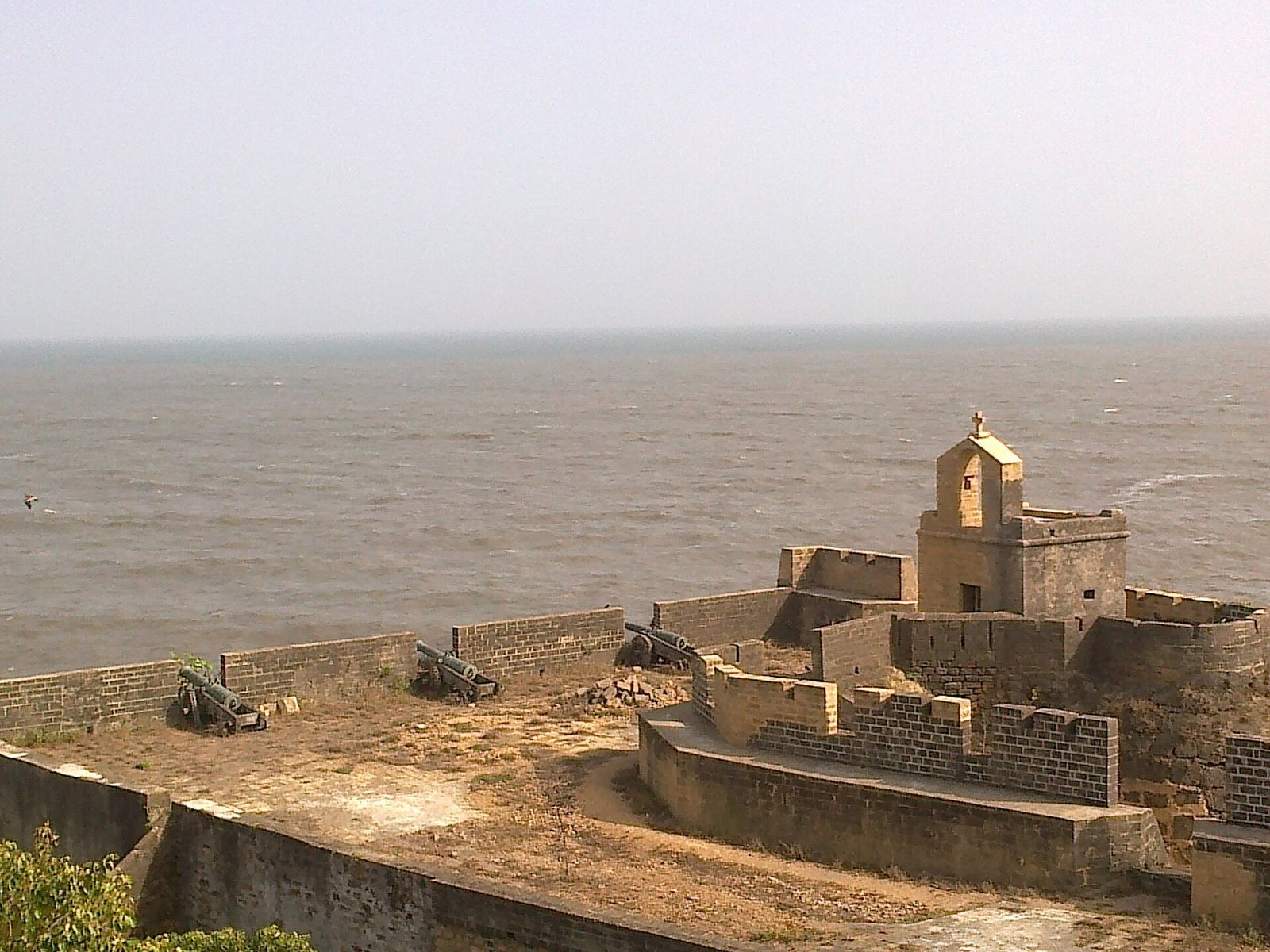
Diu Fortress is a large coastal complex built of sandstone and lime mortar. The sea borders it on three sides, and its outer wall follows the coastline. The fort’s landward wall reflects an early Renaissance design, a style drawing on forms from classical antiquity. The fortress formed part of a wider island defense network of forts, bastions, and bunkers across Diu’s 40 square kilometres.
Walls and defensive works
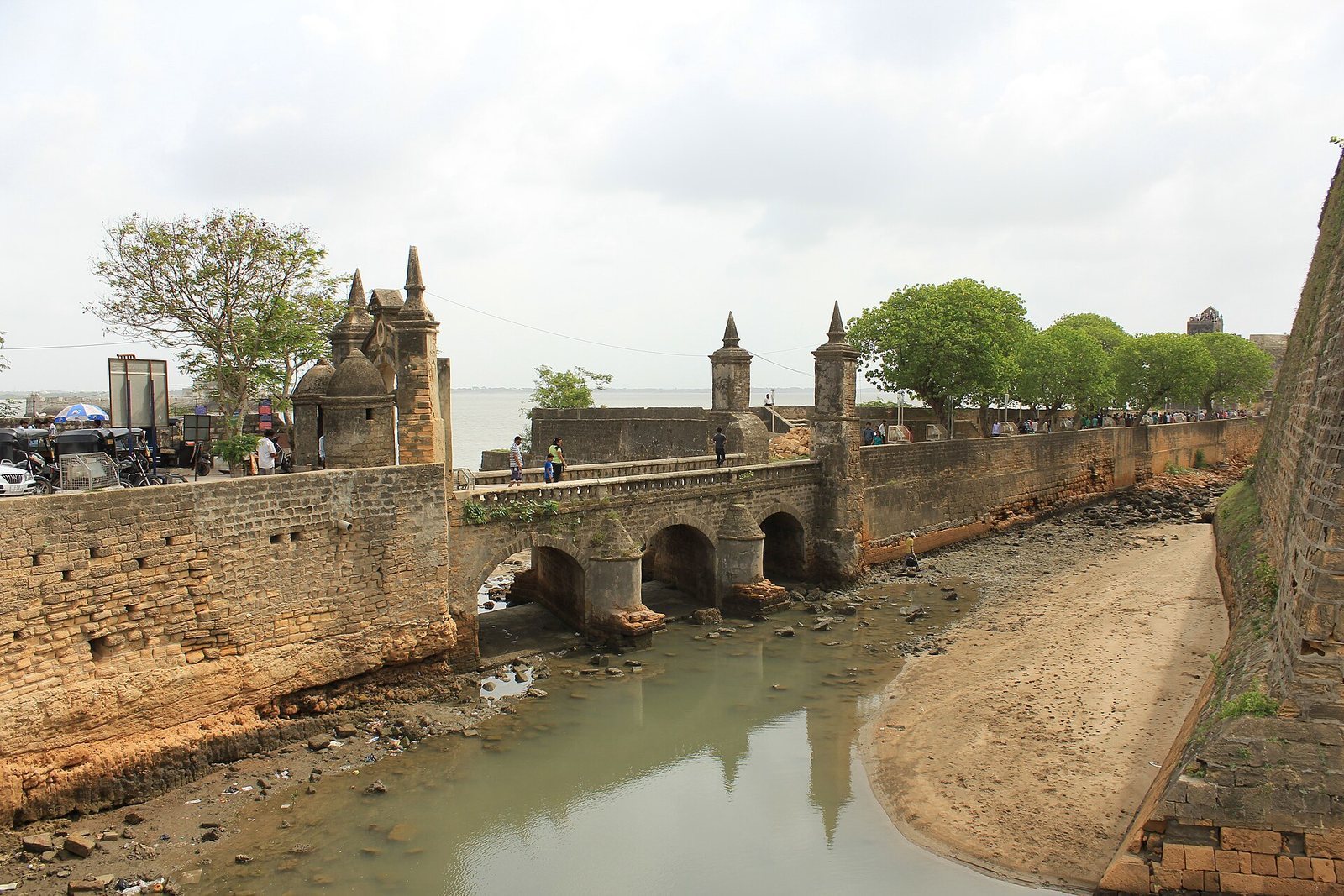
An inner wall carries bastions, projecting structures designed to support defensive fire, with positions for guns. A double moat lies between the walls; the outer ditch is tidal, meaning its water level is affected by the tides. A further moat, cut through sandstone, separates the fortifications from the castle. A bastion first built by the sultan stood in a deep-water channel beside the walls and was strengthened by the Portuguese. On the landward side, the outer moat formed the first defensive line. The Bastion of São Domingo protected the Gate of Arms, while the Bastions of São Nicolau and São Filipe also guarded the approach. The inner seaward defenses included the Chato Bastion to the southeast and the Bastion of Santa Luzia to the east.
Entrances and surviving features
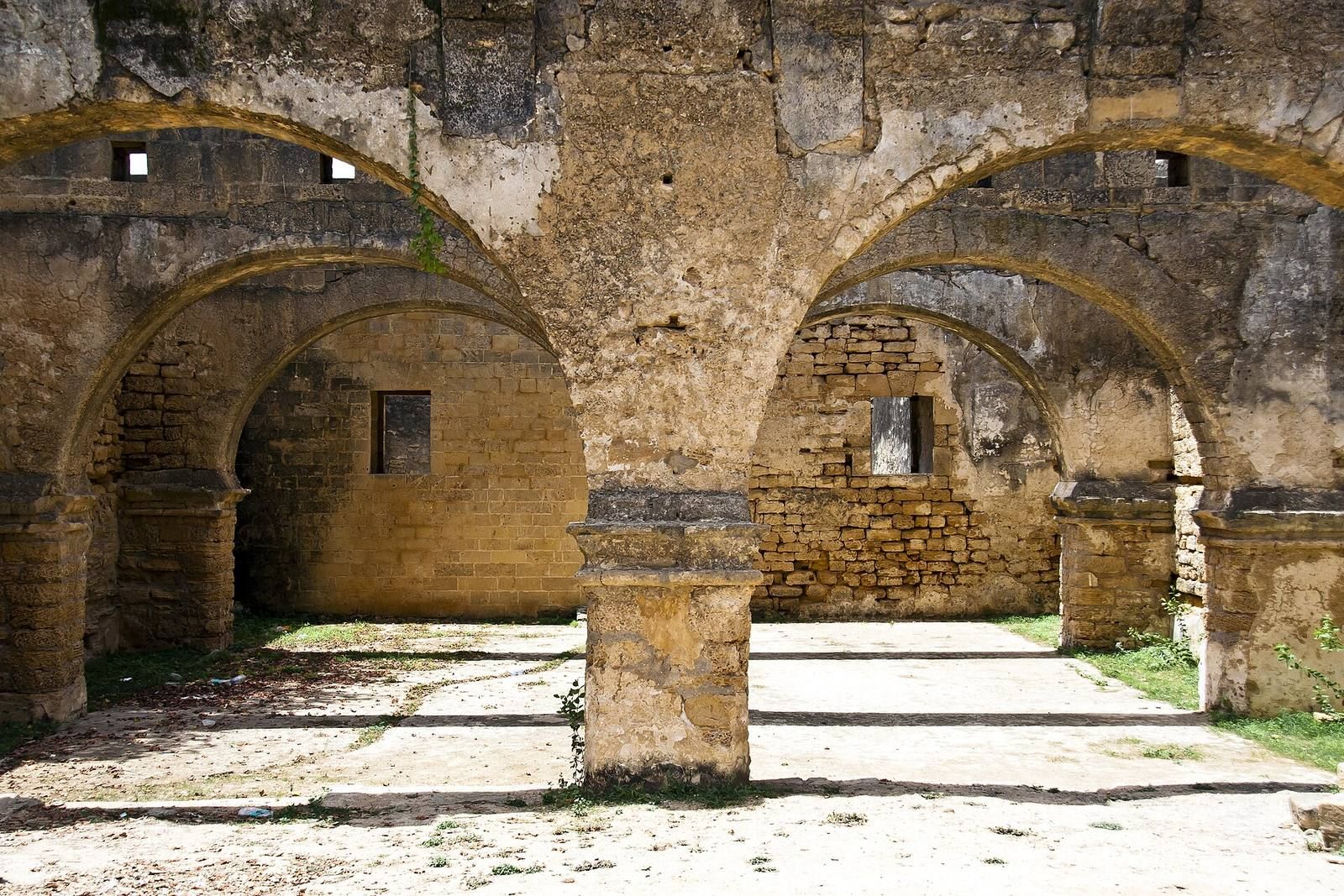
Three gates provided entry to the fortress. The main entrance has five large windows with stone galleries on its front wall, and a Portuguese inscription is set into the gateway. The adjoining bastion is called St. George. Two bridges connect the fort and town, with a permanent bridge providing access to the fortress. A jetty lies on the northwestern side, and a large lighthouse stands at one end. Cannons remain on top of the fort, including well-preserved bronze examples; iron shells are scattered around the grounds. Paths through the gardens are bordered by old cannons. The surviving fabric includes partial ruins of walls, gateways, arches, ramps, and bastions. A stone model made by Deuchande Narare in 1894 was acquired by the Naval Museum in 1992.
Fort across the water
Panikotha Fort stands in the sea opposite Diu Fortress and can be seen across the water from it.