Horne Church in Varde: A Romanesque Church in Denmark
Site at a Glance
- Popularity
- Very Low
- Country
- Denmark
- Primary era
- Medieval
- Eras represented
- Medieval, Early Modern, Modern
- Civilizations
- Danish
- Site type
- Religious
- Remains
- Church
On this page13 sections
History
Foundation and medieval development
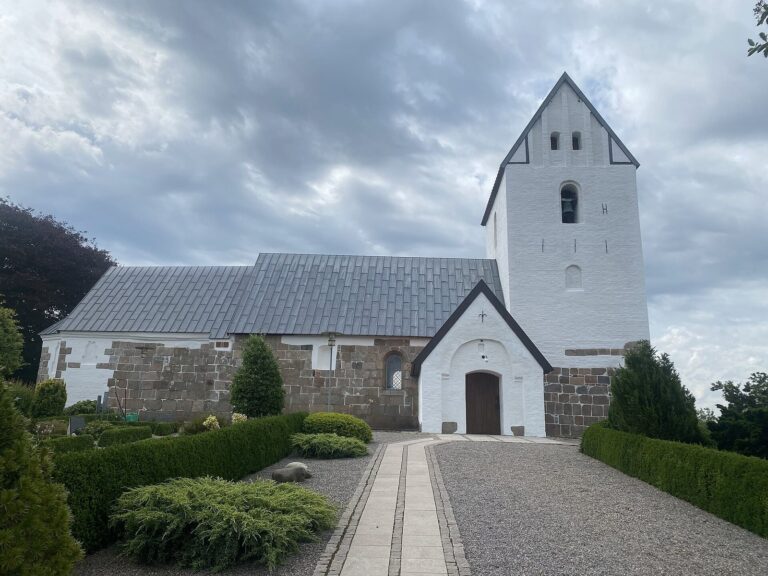
Horne Church in Varde is a medieval church in Horne, Denmark, built in 1100 in the Romanesque style, a medieval European tradition of substantial masonry and rounded arches. It was dedicated to Saint Lawrence, a Roman deacon executed in AD 258 and revered as a Catholic saint. The dedication reflects the Catholic devotion to saints that shaped everyday religious life before Denmark’s 1536 Reformation replaced Catholic church order with Protestantism. A local legend connects the church’s name with Horns Rev, a reef off Denmark’s western coast.
The church is part of Horne Parish and the Thorstrup-Horne Pastoral District, within Varde Deanery, a smaller church district, and the Diocese of Ribe, the district under a bishop’s authority. In the first half of the fifteenth century, vaults were added to the nave. A local farmer was said to have paid for this work. Later additions included a tower and a porch.
Eighteenth-century condition and repair
By the eighteenth century the church was in poor condition. Its owner blamed shortages of building materials on the Great Northern War, a major northern European conflict fought from 1700 to 1721. The Teilmann family of Nørholm manor took ownership in 1742, and the church was subsequently restored to good condition.
Restoration
A major restoration in 1887–1888 addressed structural problems and revealed decoration on the chancel and nave vaults. The church was restored again in 1976, with changes to its interior flooring.
Remains
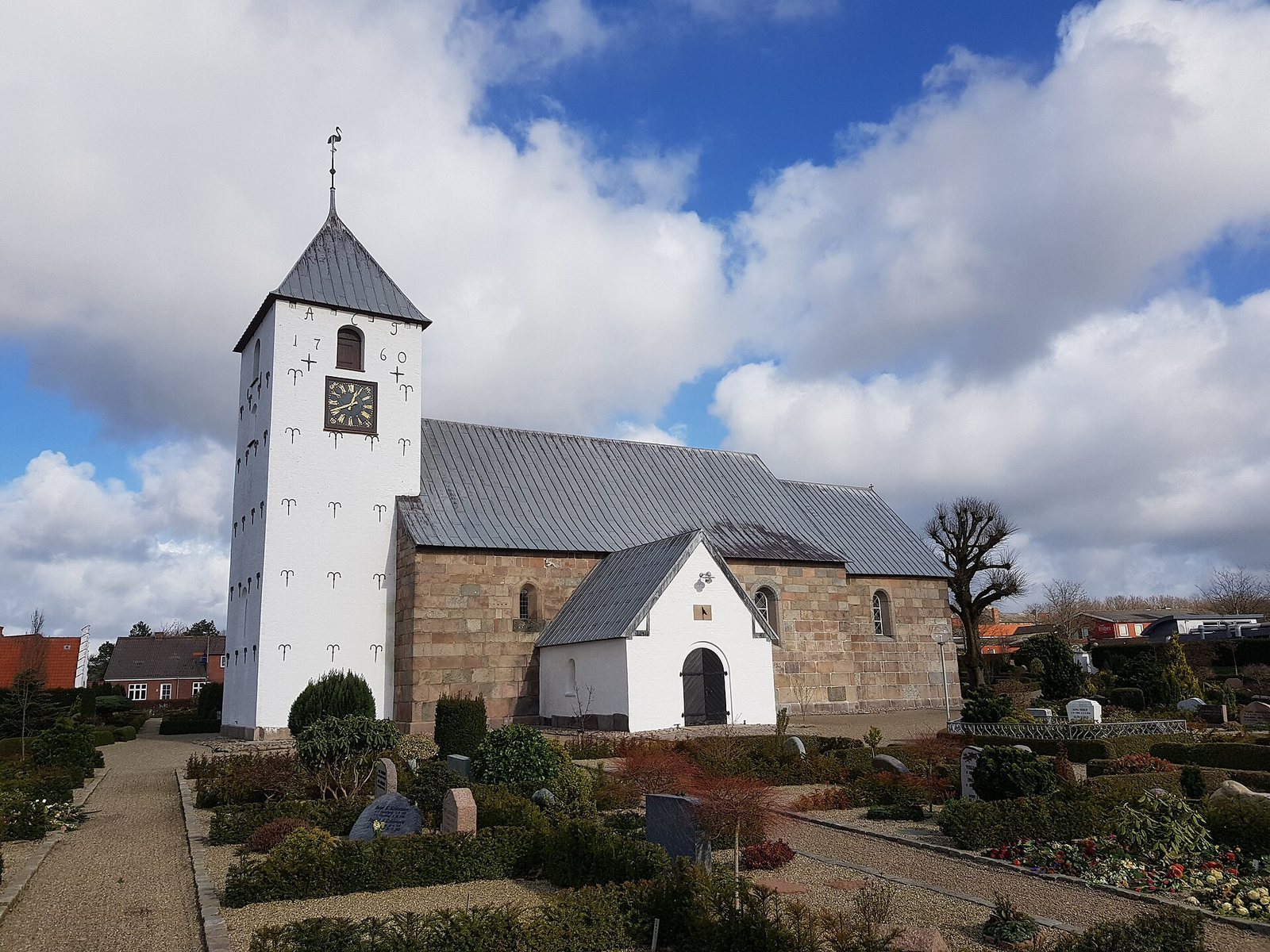
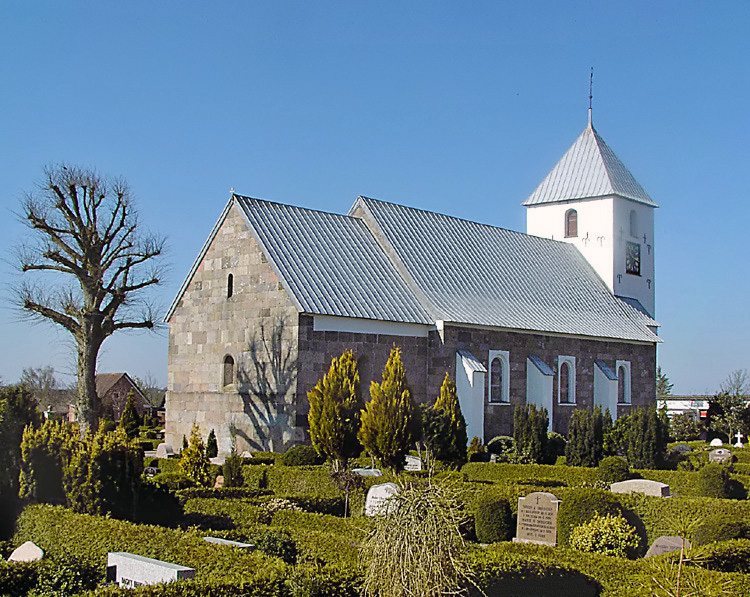
The church’s surviving core is formed by its chancel and nave, built of large, squared granite blocks. A later tower and porch, decorated vaulted interiors, and features in the churchyard preserve evidence of successive changes to the site.
Romanesque core
The chancel and nave have large, round-arched windows fitted with small panes of glass. During the 1887–1888 restoration, workers dismantled and rebuilt the chancel gable, strengthened the foundations, and reopened windows that had been blocked.
Tower and porch
The tower dates to the late medieval period, around 1300–1500. Its weather vane depicts a crane, a motif also used in the Teilmann family coat of arms. The vane was first mentioned in 1862 and may have been installed around 1760, when the tower was remodelled. Crane imagery also appears on churches at Ansager, Tistrup, and Thorstrup that were owned by proprietors of Nørholm. The porch was probably built in the mid-sixteenth century. Its brickwork rests on a base of squared granite blocks, and its bricks are larger than ordinary bricks.
Interior
Painted vaults
The chancel and nave vaults bear painted patterns, with red and white chevrons on their ribs and arches. Four coats of arms, probably from the early sixteenth century, include one with three red roses on a white field, likely belonging to the Lange (Munk) family. The decoration may be the work of the artist known as the Lily Master, named for his frequent use of lily motifs and active at churches in the region between 1501 and 1518. A Latin inscription gives 11 December 1517 as the date the work was completed. A priest’s description from 1687 mentions four household marks, simple identifying signs associated with a person or family, which may have served as the artist’s signature, as well as a depiction of a plough.
Flooring
The 1976 restoration introduced yellow brick flooring and pine boards beneath the pews.
Churchyard
Wall and entrances
Large, irregular blocks of slag are built into the churchyard wall. They are associated with bog-iron extraction, an industry in the area from 500 BC to the seventeenth century. Large white masonry pillars mark the cemetery entrances; the pillars are several centuries old, while the gates between them date from the early twentieth century.
Runestone
A tenth-century runestone now stands in the cemetery. It was once kept in the garden at Nørholm and was incorporated into the churchyard wall. Its inscription has three possible readings, identifying Tue, descendant of Ravn, as the maker of the mound; naming Ravnunge-Tue as its maker; or naming Raununge-Tue as the maker of Thyra’s mound. Investigations indicate that the Horne area was wealthy and important, making it plausible that a local magnate commissioned the stone.