Holy Trinity Church, Kostinino: A Russian Orthodox Church
Site at a Glance
- Popularity
- Low
- Country
- Russia
- Primary era
- Early Modern
- Eras represented
- Early Modern, Modern
- Civilizations
- Russian
- Site type
- Religious
- Remains
- Church
On this page7 sections
History
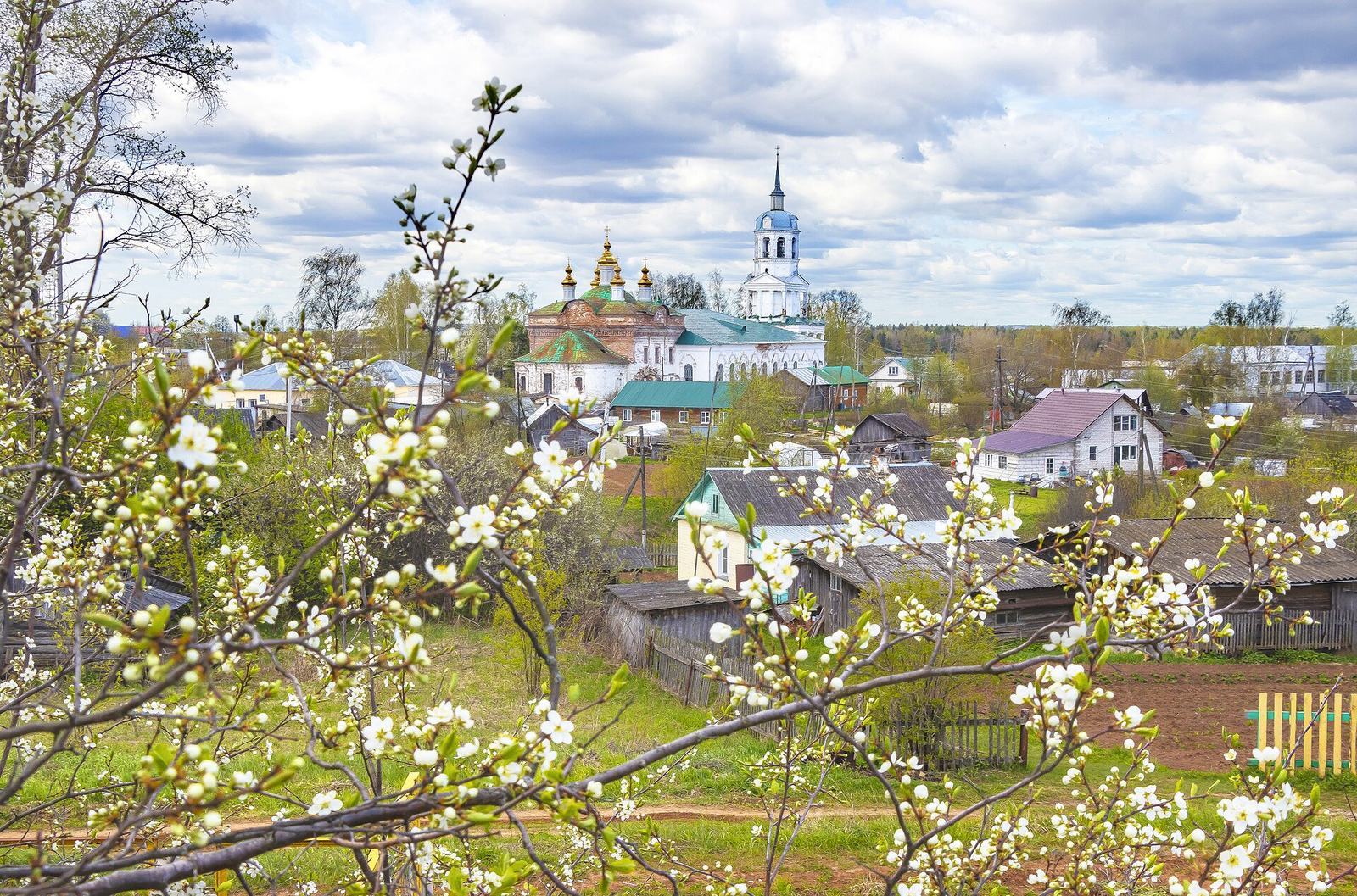
Holy Trinity Church in Kostinino, Russia, is a Russian Orthodox church whose present brick building dates to the nineteenth century and follows the Classicist style. It remained open throughout Soviet rule, the only church in the Kirovo-Chepetsk district to do so.
The churchyard and early church
A churchyard at Kostinino had an unheated wooden church dedicated to the Archangel by 1615. Such churches were traditionally used in warmer seasons. In 1680, an archbishop, a senior bishop, authorized construction of a stone church. The church’s foundation is dated to the 1690s, and the first white-stone building stood by 1693.
In 1728, a bishop authorized a chapel to St Nicholas the Wonderworker, also known as Nicholas of Myra, a Christian bishop and saint. The chapel was established in 1750 in the refectory, an attached hall that could also serve as a worship space, of the Archangel church. The wooden church was dismantled in 1754. In 1760, the central dome was covered with wooden shingles and painted green, while the four smaller domes received gold leaf.
Nineteenth-century rebuilding
During a major reconstruction, the Archangel church’s refectory and its St Nicholas chapel were demolished to their foundations. A new heated stone church, suitable for use in cold weather, was built from 1856 to 1860 and dedicated to the Life-Giving Trinity, the Christian belief in one God in three persons. The rebuilding was probably financed by a Kostinino merchant who headed the provincial customs administration and was the progenitor of a wealthy branch of Vyatka merchants and factory owners.
Clergy and recognition
For a century and a half, the church’s clergy came from the Vasnetsov family. The church belongs to the Russian Orthodox Church and is part of the First Vyatka Deanery, a grouping of local parishes, within the Vyatka and Slobodskaya Diocese. A presidential decree of 20 February 1995 placed it on the federal list of cultural heritage monuments of federal significance.
Remains
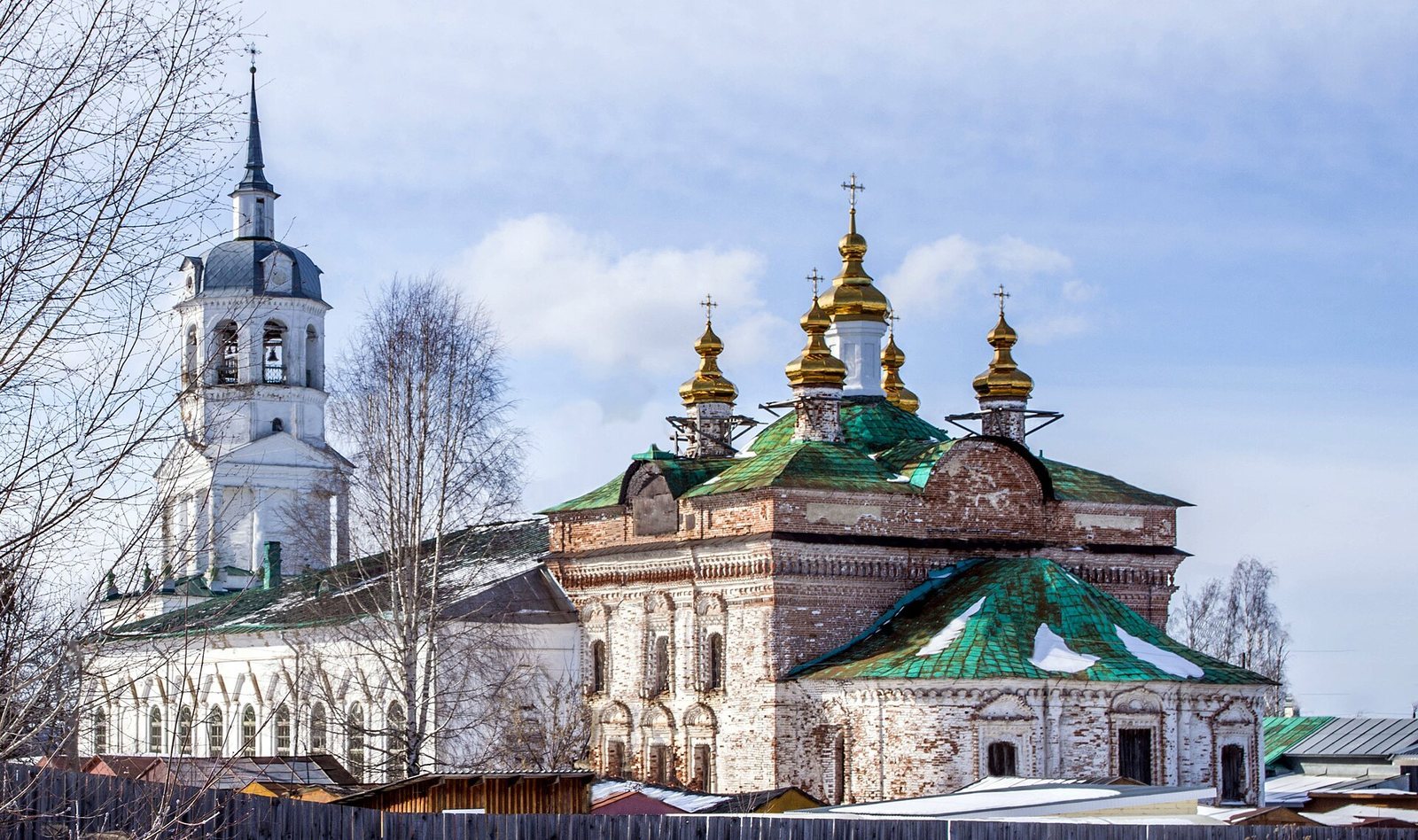
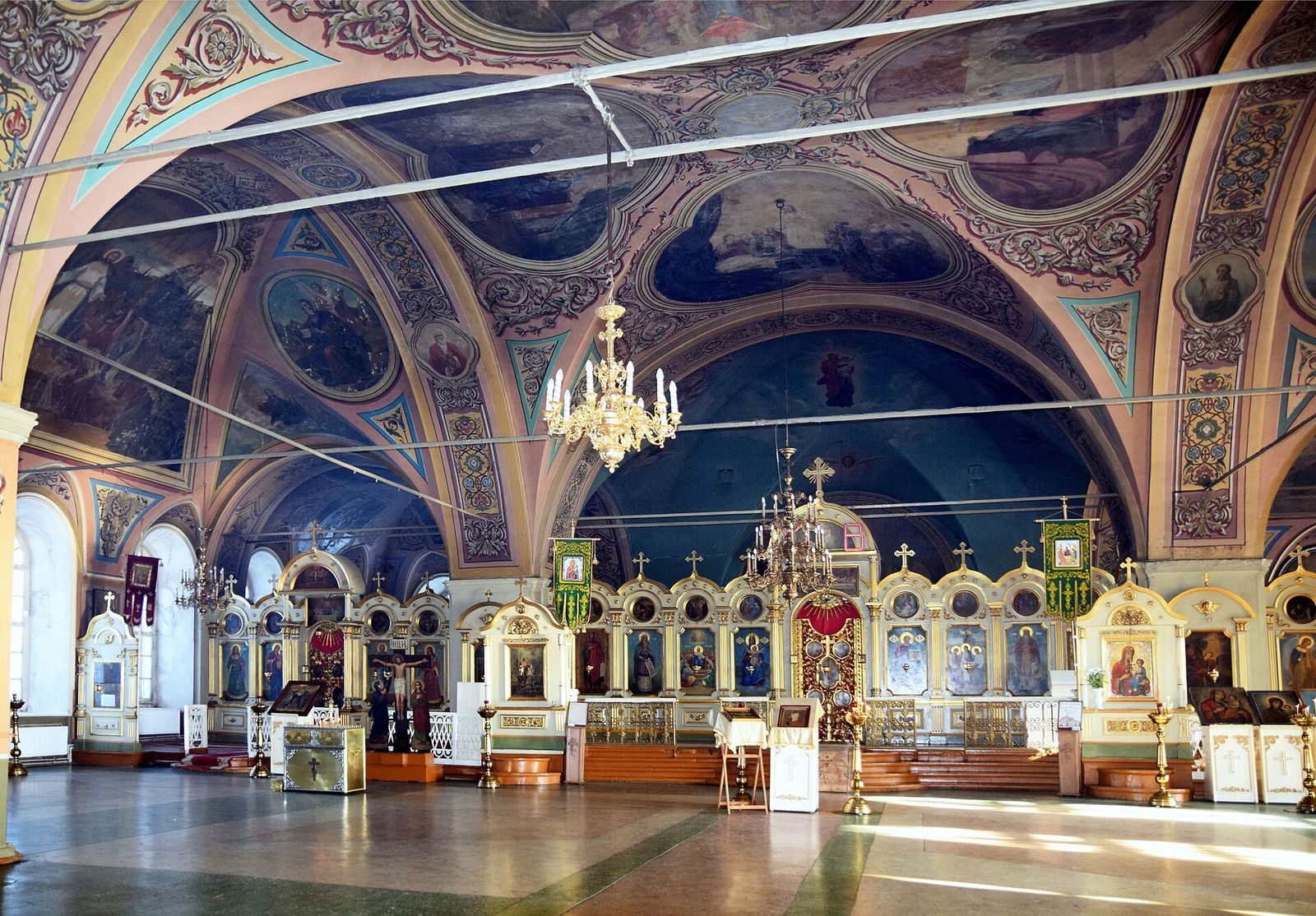
The brick church has façade sections of different dates, corresponding to the unheated church, bell tower, and refectory. Its overall style is Classicist, with forms and details also drawn from Naryshkin Baroque, a Russian architectural style combining Baroque forms with earlier Russian traditions. The church has chapels dedicated to the Archangel Michael, St Nicholas the Wonderworker, and the Iveron Icon of the Mother of God, an Orthodox image of the Virgin Mary associated with the monastery of Iviron on Mount Athos.
Main body and apse
The square main body is divided into tiers by its façade decoration. Pairs of half-columns, columns partly attached to a wall, mark the second tier, separated by tooth-shaped projections; narrow vertical bands mark the lower tier’s corners. The south façade is more richly ornamented than the north. Window frames end in elaborate or simpler kokoshniks, curved or gabled decorative forms used above windows and other architectural elements. The apse, a projecting semicircular end of the church, has windows framed like those on the south façade. Columns mark the joins between its semicircular sections, while a band of small arches and rounded ornament runs beneath a relatively plain projecting cornice.
Bell tower
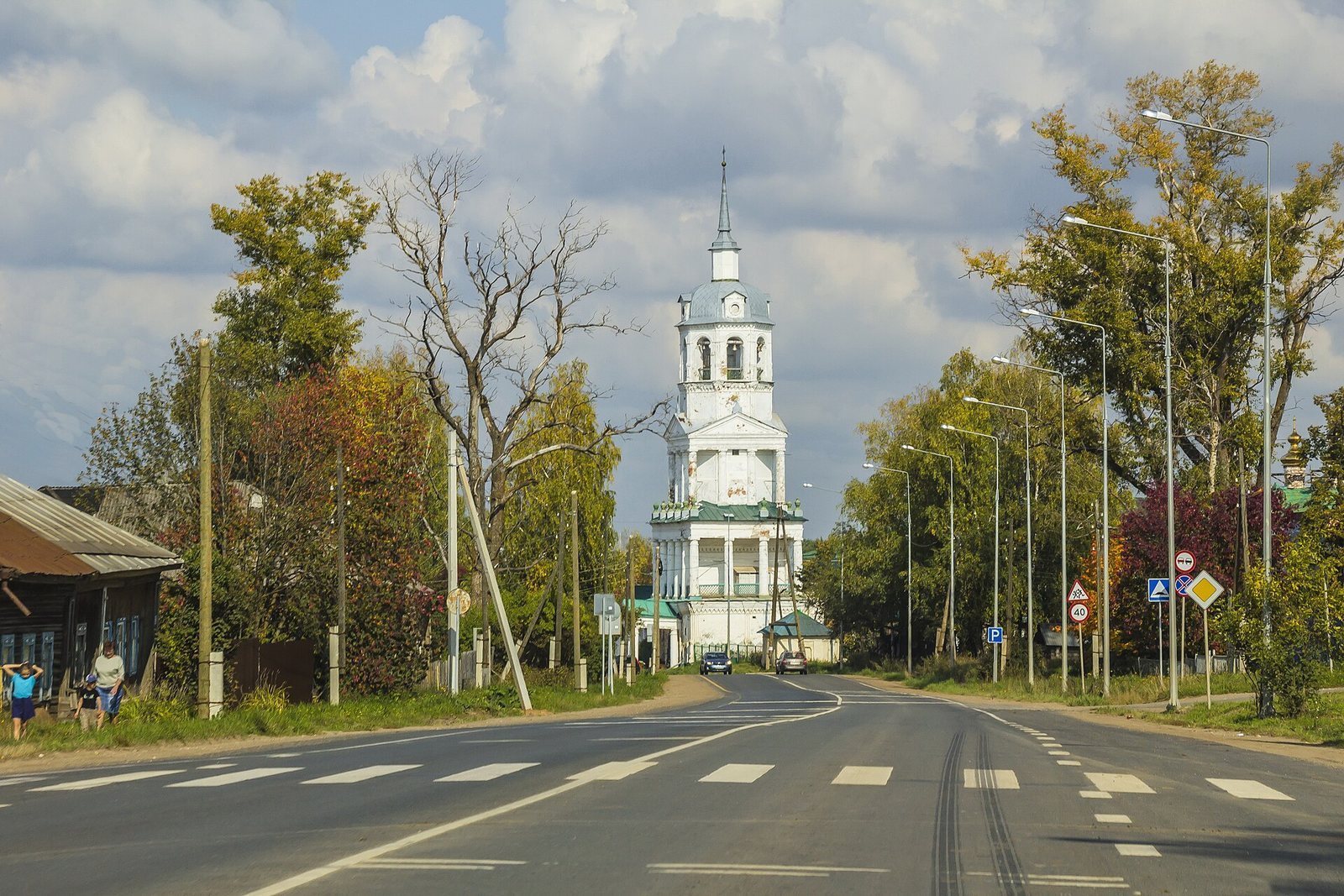
Restoration altered the bell tower’s exterior. Its lowest level has a columned porch topped by a triangular gable. The two levels above have substantial rows of columns, with another triangular gable at the third level. Above them, an eight-sided bell chamber has arched openings; a spire rises from a many-sided base.