Inka Wasi: An Inca Fortress and Administrative Center in Peru
Site at a Glance
- Popularity
- Medium
- Country
- Peru
- Primary era
- Early Modern
- Eras represented
- Iron Age, Classical, Medieval, Early Modern
- Civilizations
- Chavín, Inca, Wari
- Site type
- City
On this page14 sections
History
Inka Wasi is an Inca archaeological complex in the Cañete Valley of Peru. Built in the Inca architectural style, its construction is tentatively dated to around 1500. It developed from a local capital into a fortress and coastal administrative center.
Before Inca rule
Small settlements occupied the site during the Chavín and Wari periods, earlier Andean cultures. Before the Inca conquest, Inka Wasi was the capital of the Huarco, a local polity.
Conquest and Inca development
From 1446 to 1450, the Huarco resisted Inca forces led by the emperor Pachacutec. After four years of conflict, Pachacutec ordered a fortress built at the site. It became a strategic base for Inca expansion northward and for controlling the conquered Chincha and Lima-Rímac polities.
As Inca territory grew, the fortress’s military importance diminished. Pachacutec’s son and successor, the emperor Túpac Yupanqui, selected the coastal site as a residence, and its development continued for ten years. Tradition holds that it was planned as a new Cusco, with streets and plazas modeled on the Inca capital. That intended name did not last; Inka Wasi means “House of the Inca.”
Coastal center and later history
Inka Wasi became an important coastal center for administration and trade. The valley supported varied fruit and vegetable crops without terrace farming. Surplus crops and dried produce went to highland regions of the Inca Empire, and more than 1,000 people are thought to have worked storing food in the site’s storehouses. After Huarco territory was fully occupied, the emerging Huacones-Vilcahuasi increasingly eclipsed Inka Wasi as the valley’s principal Inca administrative center. The site was abandoned around 1529.
Extensive excavations in the 1980s, led by archaeologist J. Hyslop, examined both Inca activity and Huarco remains. Inka Wasi is designated Cultural Heritage of the Nation in Peru.
Remains
Layout and construction
The complex covers about 8 hectares at an elevation of approximately 400 metres, in Paullo, Lunahuaná District, Cañete Province, Lima Region. It is divided into lower and upper sections. Its buildings use stonework finished with plaster, and the overall plan divides the space into four regions, reflecting the four-part organization of the Inca world.
Lower section
Defensive and military buildings
Ruins of defensive works and numerous barracks-like buildings occupy the lower section. Separate buildings served military personnel and ordinary soldiers.
Religious structures and columns
Walls belonging to religious buildings remain in satisfactory condition. Excavations in 2013 uncovered 64 circular columns, an unusual architectural form in Inca building.
Upper section and civic spaces
Residential buildings and storehouses
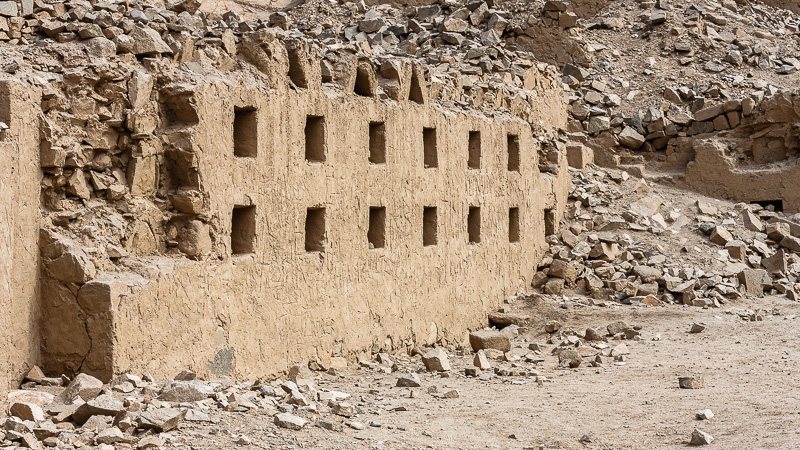
The highest part of the complex contained a residential area for civilians. The trapezoidal imperial palace survives as walls. Storehouses in this area could each hold up to six tonnes of food.
Ceremonial spaces
A ceremonial plaza contained a sacred well and served ceremonies honoring Inti, the Inca sun deity. A school for the nobility stood nearby. On a hill beside the plaza are the ruins of a building associated with women selected for service to the Sun, a religious and state role in Inca society.
Cemeteries and market
The complex had separate cemeteries for the nobility and commoners, as well as a market.
Record-keeping finds
In 2014, archaeologists led by Alejandro Chu found 25 quipus, knotted-cord devices used for record keeping. The cords were in very good condition and came from a dedicated storage area rather than a tomb.