Shanidar Cave: A Neanderthal and Prehistoric Burial Site in Iraq
Site at a Glance
- Popularity
- Very High
- Country
- Iraq
- Primary era
- Stone Age
- Eras represented
- Stone Age
- Civilizations
- Unclassified
- Site type
- Burial
- Remains
- Necropolis
On this page21 sections
History
Shanidar Cave is a prehistoric cave site in Goratu, Erbil Governorate, Iraq. Its deposits preserve the remains of Neanderthals, an extinct human group that lived across parts of Europe and western Asia, as well as evidence of later prehistoric activity and burial. The Neanderthal remains are generally dated to about 65,000 to 35,000 years ago, and discoveries at the cave have shaped discussion of how Neanderthals treated injured group members and their dead.
Neanderthal occupation and burial
The cave’s Neanderthal remains came from deposits associated with the Mousterian, a stone-tool tradition commonly linked to Neanderthals and other Middle Paleolithic populations. These deposits date to about 60,000 to 44,000 years ago. The cave’s burials and human remains have prompted differing interpretations of Neanderthal care and mortuary practices.
Shanidar 1’s healed injuries led researchers to suggest that other members of his group may have helped him live with serious disabilities. This has informed debate about social support, but the injuries cannot establish the group’s motives or organization. Shanidar 2’s burial has been interpreted as a possible ritual farewell. Worked stone points lay above the grave, and a large fire was lit nearby. Split animal bones and seeds have prompted suggestions of a funerary meal and, more tentatively, an early alcoholic drink.
Shanidar 3’s rib injury has been proposed as a stabbing or projectile wound, possibly reflecting violence between people or between species. The cause and agent remain uncertain, as does whether his burial was intentional; he may instead have died in a rockfall. Shanidar 4 became known as the flower burial after pollen found around the body was interpreted as evidence that flowers had been placed there. The idea helped renew debate about Neanderthal burial and prompted speculation that the man had been a healer or shaman. Other explanations include pollen carried by burrowing Persian jirds or nesting bees. The plants do not all flower at the same time today, complicating the idea that they were gathered together. The pollen’s origin remains disputed, although burials made at the cave over an extended period have been interpreted as evidence of deliberate mortuary practice.
Later prehistoric burials
Later communities also buried their dead in the cave. Solecki attributed one cemetery to the Natufian, a late Epipaleolithic culture of the Levant. A later burial phase belongs to the proto-Neolithic, a term for periods associated with the transition toward farming communities, rather than proof of established agriculture. An infant and an adolescent female found with grave goods have been interpreted as a possible mother and child. Their deaths may have been connected with childbirth or an infection after birth.
Excavation and new discoveries
Ralph Solecki first investigated Shanidar Cave in 1951. He returned in 1953 under the auspices of Iraq’s Directorate General of Antiquities and the Smithsonian Institution, and the first human remains, possibly those of a Neanderthal infant, were found that year. Further excavations in 1956–57 and 1960 reached 14 metres into the deposits and covered about one-tenth of the cave. Working with Kurdish workers and teams associated with the University of Michigan and Columbia University, Solecki’s excavations recovered the first nine numbered Neanderthal individuals between 1957 and 1961. Work then stopped for years because of war.
In 2006, Melinda Zeder recognized leg and foot bones from Shanidar as a tenth Neanderthal individual while sorting the site’s animal-bone collection at the Smithsonian. Shanidar 11 and Shanidar 12 were discovered in 2018. Renewed excavation began in 2014 under the Kurdistan Directorate of Antiquities, directed by Tim Reynolds. The work was interrupted by the advance of the Islamic State, a militant organization, and resumed in 2015. In 2020, researchers announced Shanidar Z, an adult woman dated to more than 70,000 years ago.
Shanidar 3’s skeleton is held at the National Museum of Natural History in Washington, D.C. Shanidar 1, 2 and 4–8 were kept in Iraq and may have been lost during the 2003 invasion. Casts of remains are held by the Smithsonian Institution, while the National Museum of Iraq in Baghdad was badly looted in 2003.
Remains
Cave and archaeological sequence
Cave form
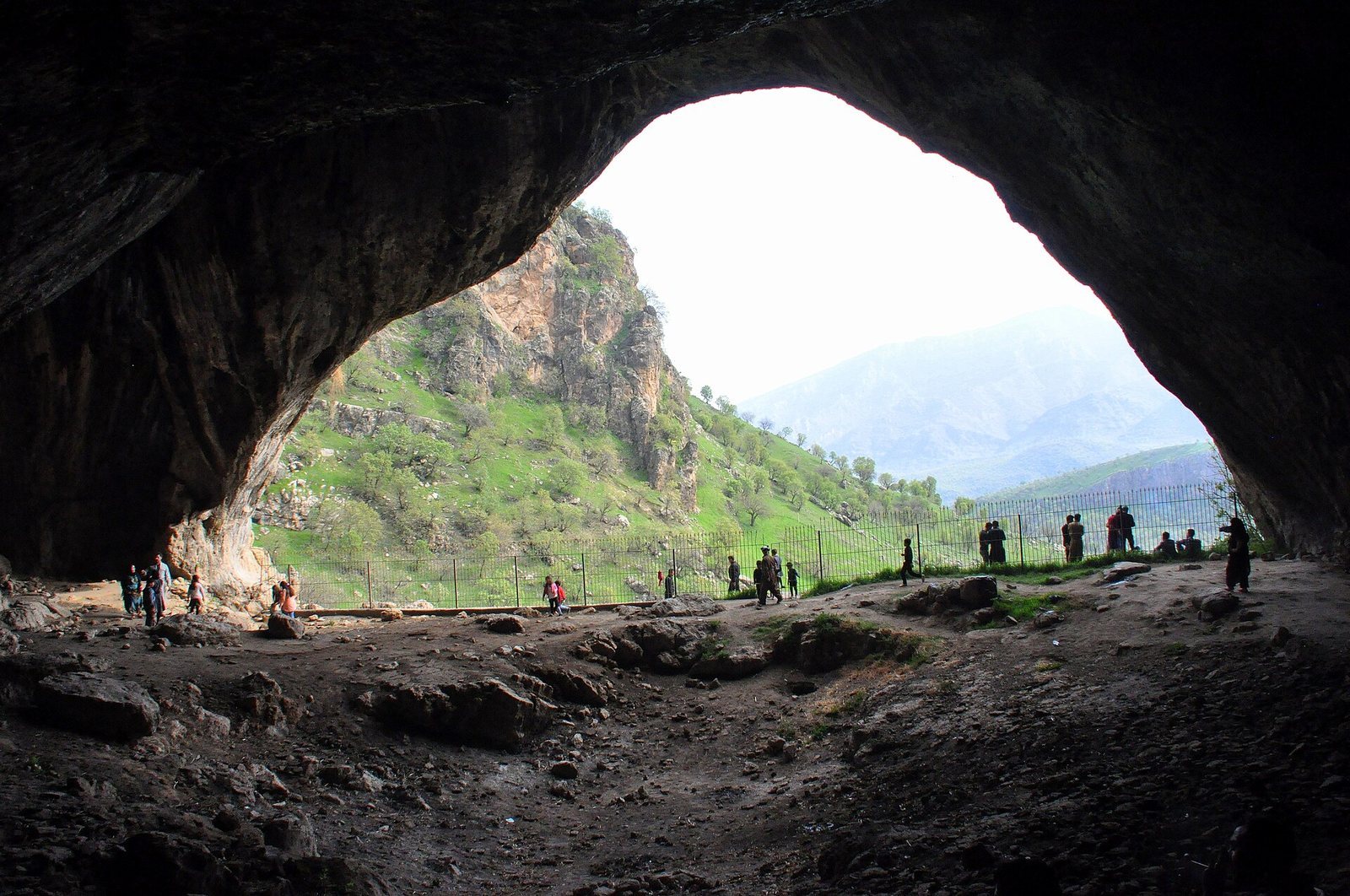
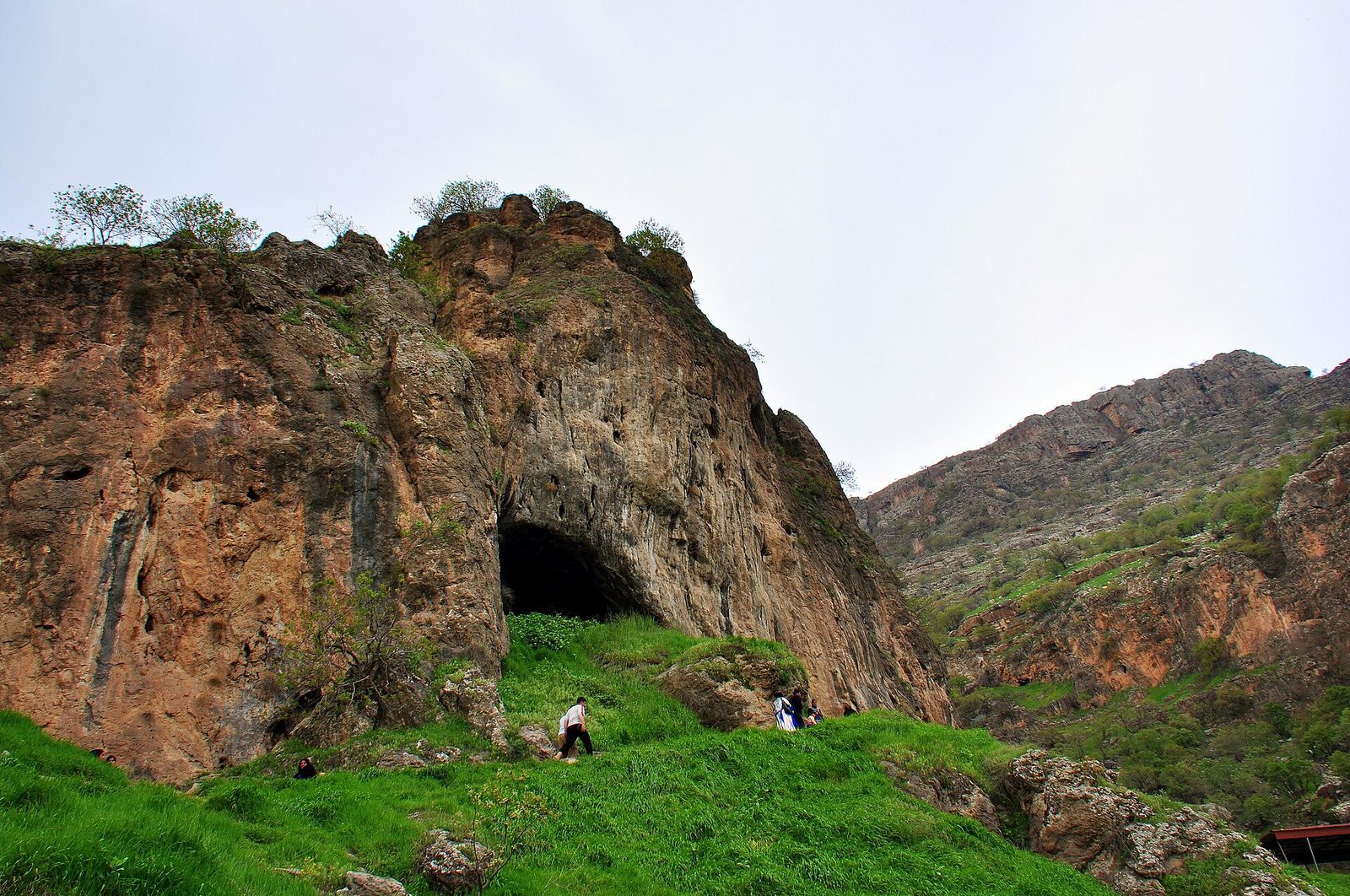
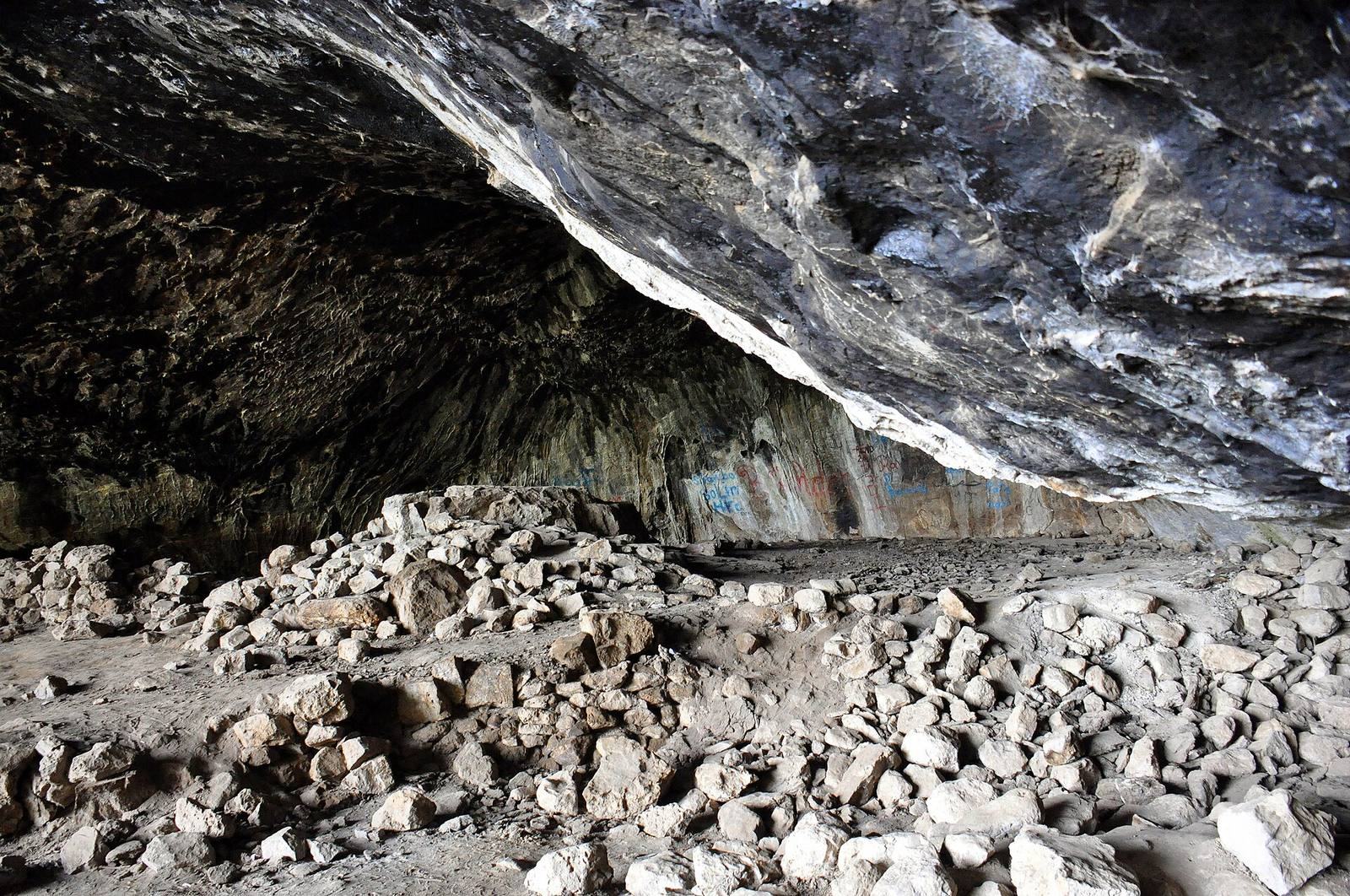
Shanidar Cave lies on Bradost Mountain in the Zagros range, about 800 metres from the Great Zab River. Its entrance is roughly triangular, about 25 metres wide and 7.9 metres high. The cave extends about 40 metres in length and 53 metres in width, with a ceiling about 13 to 14 metres high. A side passage extends about 30 metres.
Deposits and early material
Excavations exposed a sequence of deposits about 14 metres deep. Layer D contains Mousterian material; layer C has Baradostian material, a regional archaeological designation for a stone-tool assemblage, and dates to about 33,000 to 27,000 years ago. Layer B includes Zarzian material, another regional archaeological designation, and later proto-Neolithic deposits. Layer A belongs to the Holocene, the current geological epoch that began after the last major glacial period.
Layer D yielded hundreds of stone tools, including points, side-scrapers and flakes. Some points and scrapers were made on small river pebbles without the Levallois method, which prepares a stone core to produce flakes or points of planned shape. Associated animal remains include wild goats, wild boar, tortoises, deer, roe deer, wolves, foxes and bears. The tortoises include spur-thighed tortoises.
Neanderthal remains
Shanidar 1
Shanidar 1 was an adult male, estimated to have been 30 to 45 years old and about 170 centimetres tall. His skull had a cranial capacity of approximately 1,600 cubic centimetres. A blow crushed and fractured the bone around his left eye, likely leaving him partly or wholly blind on that side. His right arm was atrophied and fractured in several places, and the lower arm and hand were missing. The cause is uncertain and may have been a condition present from birth, childhood illness or injury, or amputation. A fracture of the fifth neck vertebra may have impaired the arm’s muscles. He also had two broken legs and deformed lower legs and feet, consistent with a painful limp. Bony growths partly blocked one ear canal and completely blocked the other, indicating substantial hearing loss. Other growths on the partial skeleton have supported a diagnosis of diffuse idiopathic skeletal hyperostosis, a condition involving abnormal bone formation around ligaments and tendons.
Shanidar 2
Shanidar 2 was an adult male about 30 years old and an estimated 157 centimetres tall. He lay on his right side and had slight arthritis. His skull and bones were crushed, probably by falling rock; the skull had been compressed by about 5 to 6 centimetres. Many bones were missing, and tooth marks on the left shin may have been made by scavengers. A small pile of stones and worked points made from chert, a fine-grained toolmaking rock, lay over the grave.
Shanidar 3
Shanidar 3 was an adult male estimated to have been 40 to 50 years old. His remains were associated with the burial context of Shanidar 1 and 2. A penetrating wound in his left ninth rib had begun to heal, showing that he survived it for at least several weeks; a corresponding mark was noted on the eighth rib. Degenerative damage in his right foot is consistent with painful, restricted movement. His skeleton is displayed at the National Museum of Natural History in Washington, D.C.
Shanidar 4 and the pollen
Solecki found Shanidar 4 in 1960, about 15 metres inside the cave and 7.57 metres below the surface. Bones of Shanidar 6 were mixed with his remains. The deposit lay about two metres below the levels containing Shanidar 1, 3 and 5, making Shanidar 4 older; his imprecise date is probably earlier than 50,000 years ago. The adult man, estimated to have been 30 to 45, lay on his left side with his body flexed. A right rib, identified as the seventh or eighth, was fractured.
Soil samples taken around and directly beneath the skeleton contained more than 1,000 pollen grains from at least eight plant types. Three samples came from directly beneath the body, two especially rich in pollen; those two were 68 centimetres apart. Identifications include yarrow, cornflower, bachelor’s button, St Barnaby’s thistle, ragwort, grape hyacinth, horsetail, hollyhock, centauries, a small blue-flowered lily and Ephedra. Some of these plants have traditional medicinal uses, and some researchers proposed that the Ephedra might have come from bedding.
Shanidar 5
Shanidar 5 was recovered from layer D in 1960, about 4.5 metres below the excavation’s fixed reference point. The adult, thought to have been a man aged about 40 to 50, was associated with the rockfall that killed Shanidar 2. The recovered bones included a skull, four teeth, a vertebra, eight ribs and other fragments. Their broken, scattered arrangement may reflect disturbance by animals. Radiocarbon dating placed Shanidar 5 at about 46,000 years ago. Erik Trinkaus and colleagues reconstructed the skull from 1976, completing the work in 1994. An early proposal that the skull had been deliberately reshaped was rejected after a misplaced fragment was corrected. The skull also has patches of abnormal thickening on its inner surface, along the frontal crest and near the front of a major channel within the skull.
Shanidar 6 to 10
Shanidar 6 and 7 are represented by fragmentary skulls, teeth and partial skeletons. Shanidar 8 was an adult with a partial, fragmentary skeleton, while Shanidar 9 was an infant represented only by vertebrae. The infant’s remains were found as Shanidar 4 was being removed in a block of surrounding sediment for transport to Baghdad. Shanidar 6, 7 and some other remains came from a compressed block. Shanidar 1, 2, 3, 5 and 7 were also described as individual burials. Shanidar 10 is represented by leg and foot bones from the cave’s animal-bone collection.
Shanidar Z
Shanidar Z is represented by the upper body of an adult uncovered during renewed excavation. The remains may belong with lower limbs previously classified as Shanidar 6. Researchers dated Shanidar Z to more than 70,000 years ago and identified the individual as a woman in her mid-40s or possibly older. During renewed work, researchers also considered the position of Shanidar 1’s skull and lower jaw potentially non-natural.
Later deposits and burials
Earlier cemetery
One cemetery contained 35 individuals and was dated to about 10,600 BCE. Solecki attributed it to the Natufian culture. Its remains form part of the cave’s later burial evidence.
Layer B and snail remains
Layer B includes numerous land-snail shells. They may indicate that snails formed part of the diet around 12,000 years ago, although cultural and environmental explanations have also been proposed.
Layer B1
Layer B1, dated to about 10,146 BCE, contains Zarzian material. The broader later deposits also include animal remains and evidence of changing food practices.
Layer B2 cemetery and associated finds
Layer B2, dated to about 8650 BCE, contains 26 burials holding 35 bodies. The graves include an infant and an adolescent female found with grave goods, possibly a mother and child. The human remains show skull trauma and dental signs of nutritional problems, interpreted as evidence of substantial stress. The distribution of grave goods has been taken to suggest emerging social differences, although the community has also been described as broadly egalitarian.
Other B2 finds include animal remains, heavy grinding stones, mortars, pestles, small stone tools called microliths, a copper pendant and a semicircular stone structure. Animal remains point to hunting wild goats, boar, deer, fallow deer and freshwater turtles, as well as fishing. Possible early control or domestication of sheep has been proposed but remains disputed; selective hunting has also been suggested as an explanation.