Cathedral of the Transfiguration of the Savior: A Diocesan Church in Kholmogory
Site at a Glance
- Popularity
- Medium
- Country
- Russia
- Primary era
- Early Modern
- Eras represented
- Early Modern, Modern
- Civilizations
- Russian
- Site type
- Religious
- Remains
- Cathedral
On this page16 sections
History
The Cathedral of the Transfiguration of the Savior is a Russian Orthodox cathedral in Kholmogory, Russia. Its dedication recalls the Transfiguration, the Christian event in which Jesus was revealed in divine glory to three disciples. Archbishop Athanasius (Lyubimov), a senior Orthodox bishop, initiated the project and directed its design for the newly established Kholmogory and Vazha diocese, with work beginning on 11 May 1685 and concluding in 1691. The cathedral served the diocese while Kholmogory was the bishop’s seat, before the diocese was transferred to Arkhangelsk. Its design drew on Moscow architectural models while retaining older structural features.
Consecration and diocesan life
Assistant craftsmen in stonework and bell-making, Fyodor and Ivan Stafurov, supervised the construction. The cathedral was consecrated on 28 July 1691 and became the first stone church in Kholmogory. Before Athanasius’s appointment, the churches in the diocese had been wooden. The cathedral’s annual liturgical feast is observed on August 6/19.
Tsar Peter I, also known as Peter the Great, visited in 1693. Afterward, the existing icon screen was replaced by a five-tier iconostasis, a screen of icons separating the sanctuary from the main worship space. Peter is also credited with paying for the new screen. The cathedral became a burial place for Kholmogory’s bishops, beginning with Athanasius. During the eighteenth century, members of the Brunswick family, a German princely house, were confined in a residence directly opposite the church.
Repairs and changing use
In 1816–1817, the church was covered with iron, its domes painted green, and its roof painted red. The Holy Governing Synod, the Russian Orthodox Church’s central governing body under the Russian Empire, allocated funds for repairs in 1883–1884. In later years, John of Kronstadt, a Russian Orthodox priest later venerated as a saint, supplied money for urgent work from donations he had received from worshippers.
Closure, conservation, and renewed worship
The Bolsheviks, the revolutionary Marxist faction that took power in Russia in 1917 and established Soviet rule, closed the cathedral in 1920. It was subsequently plundered and deteriorated, narrowly escaping complete destruction. From the second half of the twentieth century, work focused on conserving rather than fully restoring the building. Metal ties were used to brace its walls, and the bell tower was restored. Funding remained limited; public funding was associated with the 2011 tercentenary of Mikhail Lomonosov’s birth. Lomonosov was an eighteenth-century Russian scholar and scientist.
Orthodox religious life in Kholmogory began to revive in 1997, when an affiliated community of the Antonievo-Siysky Monastery, an Orthodox monastery in the Arkhangelsk region, was established. A parish followed in the village in 1998, and services have been held in two smaller churches beside the cathedral. From August 2017, the cathedral formed part of a bishop’s compound that also includes other churches and the grounds of a former monastery. The cathedral is protected as a federal cultural heritage monument of Russia.
Remains
The stone cathedral stands on a rise within the former Kholmogory kremlin, the fortified central complex of a Russian town. It is 42 metres high and has six interior pillars. It is described as the only six-pillar church north of Kargopol and as one of the largest stone churches in the Russian North. The building’s restrained exterior and older structural features reflect a design based on Moscow models.
The cathedral
Plan and exterior
The cathedral was originally crowned by five domes and has a severe, medieval appearance. Inside, cross vaults, ceilings formed by intersecting arches, are set at a single level. The spaces are nearly equal in size, while paired arches divide the areas between the altars. The roof has four sloping sides and a pronounced cornice, a projecting horizontal band, rather than the traditional curved, gable-like roof ends. Its restrained decoration includes ornamental brick bands, small tooth-like details, recessed doorways framed to create depth, and a distinctive pattern around the windows.
Roof details, porches, and doors
A description from 1701 notes scale-like coverings over the curved roof ends, a central roof section boarded on all four sides, and openwork hanging ornaments between the roof ends and at the corners. The ornaments were painted in oil colours. Stone porches with vaulted ceilings stood on the west, north, and south sides; those on the north and south replaced exterior steps. The doorways had double doors, including crafted wooden doors with mica panels in their upper halves, circular motifs, crosses, and gilded borders, as well as iron doors with chains and locks. The doors bore varied ornamental plant designs.
Interior and fittings
The five-tier iconostasis had a projecting ledge between its second and third levels that carried a chronicle of the church’s construction. Its icons included images transferred from an earlier Transfiguration church in Kholmogory and newly painted saints. A senior priest and a deacon, both named Fyodor, also painted the church walls.
Present condition
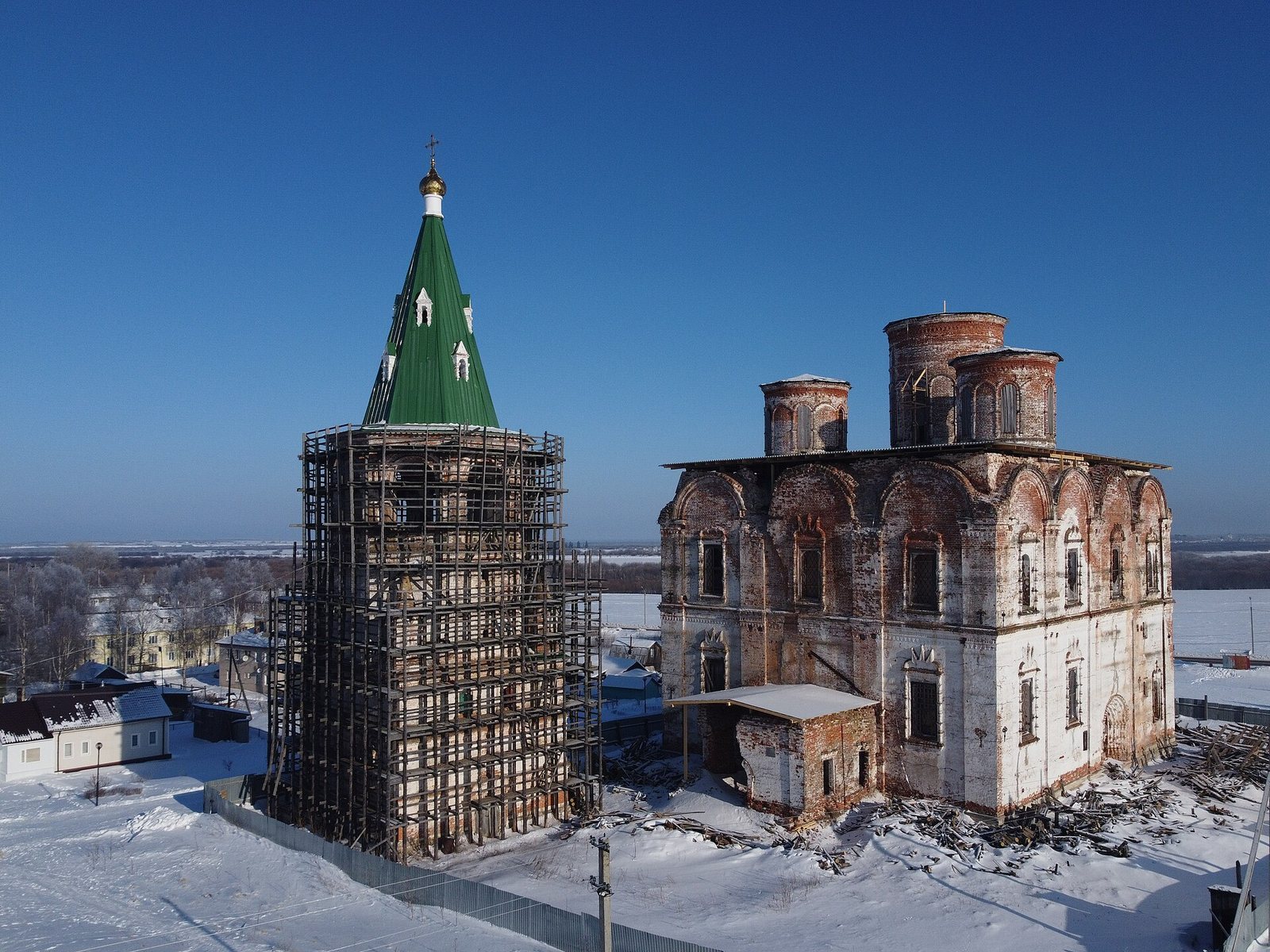
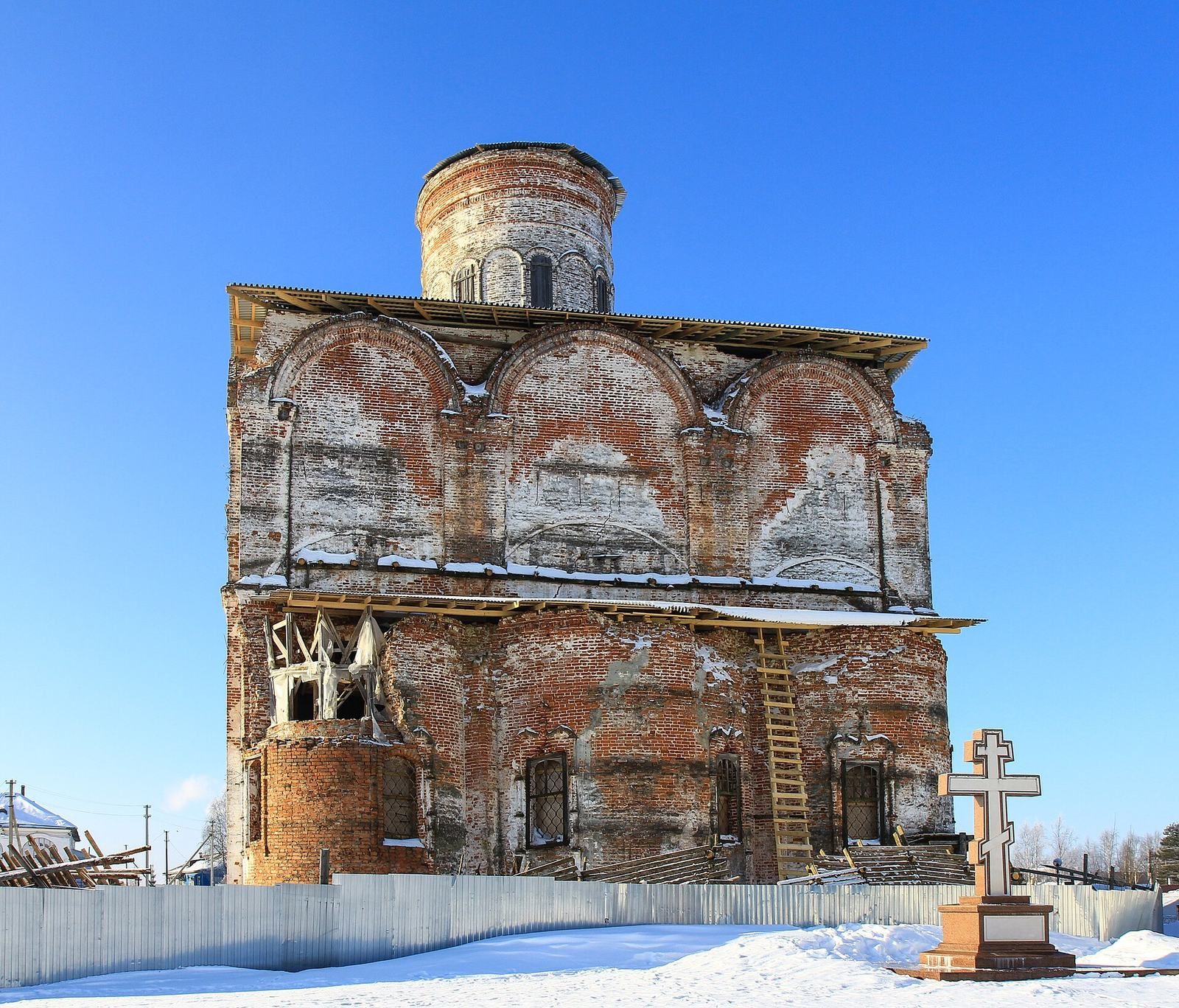
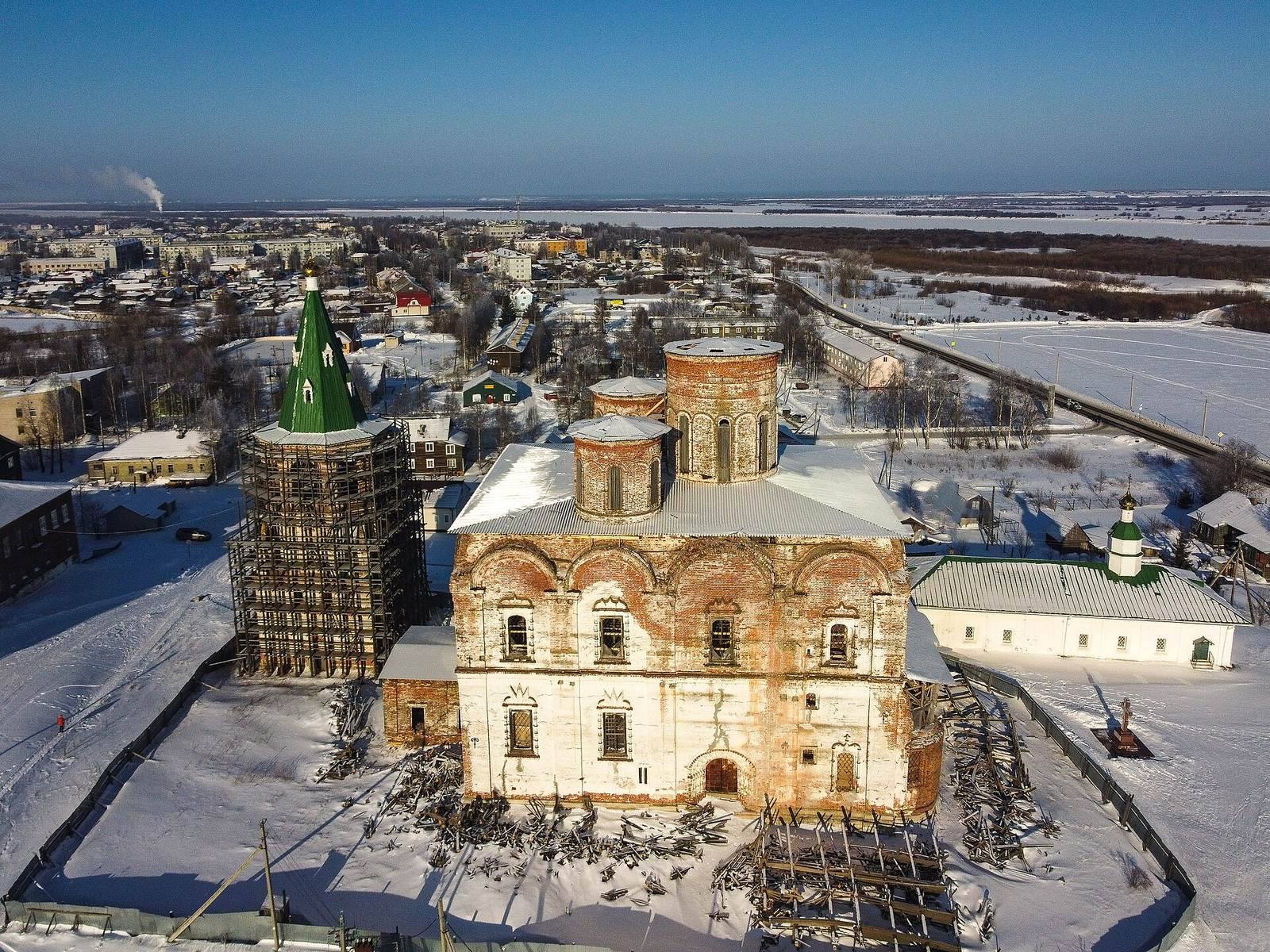
Three of the cathedral’s five drums, the structures that support domes, survive, with their upper sections truncated. A crack running the full height of the building threatened its stability. The cathedral remains under conservation and restoration. In 2016, water entering through the damaged roof froze on the vaults in winter, putting them at risk.
Bell tower
The low bell tower stands west of the cathedral and was built in 1681–1683, before the cathedral itself. Its tent-shaped roof rises above a square base with small pointed turrets at the corners. The tower has two clock faces and a decorative band below the bell level. Its walls were once painted with ornamental designs in varied colours. A telescope mounted on the tower made it the first observatory in the Russian North. Eleven bells have been placed there, and the tower is in better condition than the cathedral.
Enclosure and associated buildings
Stone enclosure
A stone enclosure built around the cathedral in 1891 marks the boundary of its immediate grounds.
Bishop’s compound
The nearby bishop’s compound, built by Athanasius, included a house church, a chapel within a residence, and a separate small bell tower. Its façades carried decorative ornamentation.
Later churches
Two smaller churches stand beside the cathedral and were built later. One is dedicated to the Twelve Apostles, Jesus’s principal disciples. The other is dedicated to the Holy Spirit, the third person of the Christian Trinity, and St Nicholas of Myra, an early Christian bishop venerated in Eastern Orthodoxy.
Former monastery grounds
The bishop’s compound also includes the grounds of the former Dormition women’s monastery, an Orthodox convent dedicated to the commemoration of the Virgin Mary’s death.