Fort Wint: A Coastal-Artillery Fort at Subic Bay
Site at a Glance
- Rating
- 4.8
- Popularity
- Very Low
- Country
- Philippines
- Primary era
- Modern
- Eras represented
- Modern
- Civilizations
- Unclassified
- Site type
- Military
- Remains
- Fort
On this page9 sections
History
Fort Wint is a coastal-artillery fort on Grande Island at the entrance to Subic Bay in the Philippines. Built by the Philippine Department of the U.S. Army and completed in 1910, it formed part of the harbor defenses of Manila and Subic Bays. The fort was named for Brigadier General Theodore J. Wint, a U.S. Army officer.
Construction and training
The fort was part of a wider program of coastal defenses built between 1907 and 1920 in response to recommendations by the Taft Board, a U.S. military panel that reviewed harbor defenses. The work preceded the 1922 Washington Naval Treaty, an arms-limitation agreement that restricted fortifications in specified Pacific territories.
Under the National Defense Act of 1935, U.S. legislation on military organization and preparedness, Fort Wint was used for coastal-artillery training. Garrison units associated with it included the 91st and 92nd Coast Artillery, whose Philippine Scouts were U.S. Army units recruited primarily from Filipinos; the 60th Coast Artillery, an anti-aircraft unit; and the 2nd Coast Artillery of the Philippine Army. A battery of the 60th was stationed at the fort.
World War II
In July 1941, Army-controlled mines were placed in Subic Bay’s ship channel and operated from Fort Wint, while the Navy laid mines alongside the channel. In December, the Navy ordered the bay entrance fully closed with naval mines. The fort’s artillery was obsolete by the time hostilities with Japan began.
During the first week of January 1942, as Allied forces withdrew to the Bataan Peninsula, Fort Wint was ordered abandoned. Its crews were reassigned to other American positions in Manila Bay. The order was reportedly caused by a mistake by the commander of the Northern Luzon Force, and the fort consequently took no part in the later siege of the island forts. U.S. forces recaptured it in March 1945, during the campaign to retake the Philippines, when the fort sustained substantial damage.
Postwar uses and change of control
After the war, Grande Island and the remains of Fort Wint became part of the U.S. Naval Base Subic Bay. For many years, U.S. Navy Special Services operated the island as a resort for U.S. military personnel and civilians in the Philippines.
In 1975, during Operation New Life, a six-month rescue mission following South Vietnam’s fall on April 30, Grande Island sheltered and processed thousands of South Vietnamese refugees. The island was rehabilitated afterward and returned to resort use until 1991, when the U.S. base lease expired. The bases closed around the time Mount Pinatubo’s eruption caused damage, and the naval base shut in 1992. After repairs, the Philippine Subic Bay Free Port Zone Authority restored the island for resort use.
Remains
Fort Wint’s coastal defenses were divided among five batteries on Grande Island, with a total of 14 artillery pieces. The named batteries held guns of different sizes and mounting types, and some of the fort’s artillery remains in place while other guns were transferred to forts in Washington State.
Gun batteries
Battery Warwick
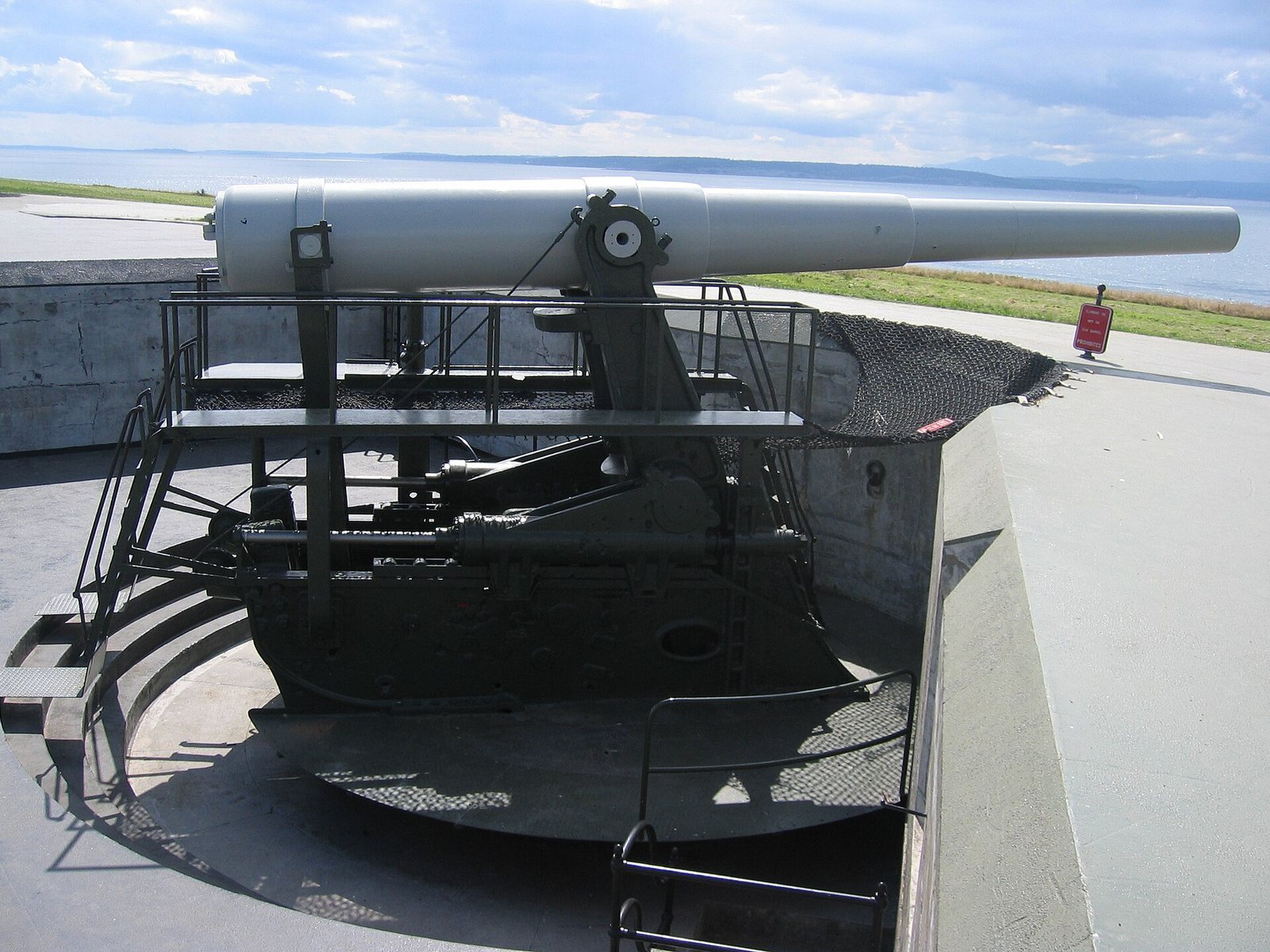
Battery Warwick held two 10-inch M1895 disappearing guns, which could be lowered behind their emplacements after firing to reduce their exposure. Buffington-Crozier carriages mounted the guns and allowed this movement. In the 1960s, the U.S. Navy dismantled the pair and sent them to Fort Casey in Washington State for renovation and display.
Batteries Hall and Woodruff
Each of these batteries held two 6-inch M1905 guns on disappearing carriages. Battery Hall’s guns remain in place.
Batteries Flake and Jewell
These batteries were armed with four 3-inch M1903 guns on pedestal mounts. The guns were removed and divided between Forts Flagler and Casey, where they remain on display.