Hosh el-Kab Fort: An Alwa-Era Fort in Sudan
Site at a Glance
- Popularity
- Very Low
- Country
- Sudan
- Primary era
- Medieval
- Eras represented
- Medieval, Early Modern, Modern
- Civilizations
- Christian Nubian Kingdoms
- Site type
- Military
- Remains
- Fort
On this page8 sections
History
Alwa Rule and Abandonment
Hosh el-Kab Fort is a fort on the left bank of the Nile in Khartoum State, Sudan, built in the second half of the sixth century under the Kingdom of Alwa, a medieval Nubian kingdom in what is now Sudan. The fort remained inhabited until the mid-seventh century. Afterward, it was no longer maintained and was abandoned for roughly a millennium.
Funj-Period Settlement
A small group later settled among the ruins during the Funj period, the era of the Funj Sultanate of Sennar, a Sudanese polity that ruled from the sixteenth to the nineteenth century. The site was uninhabited in 2018.
Remains
Fort Enclosure
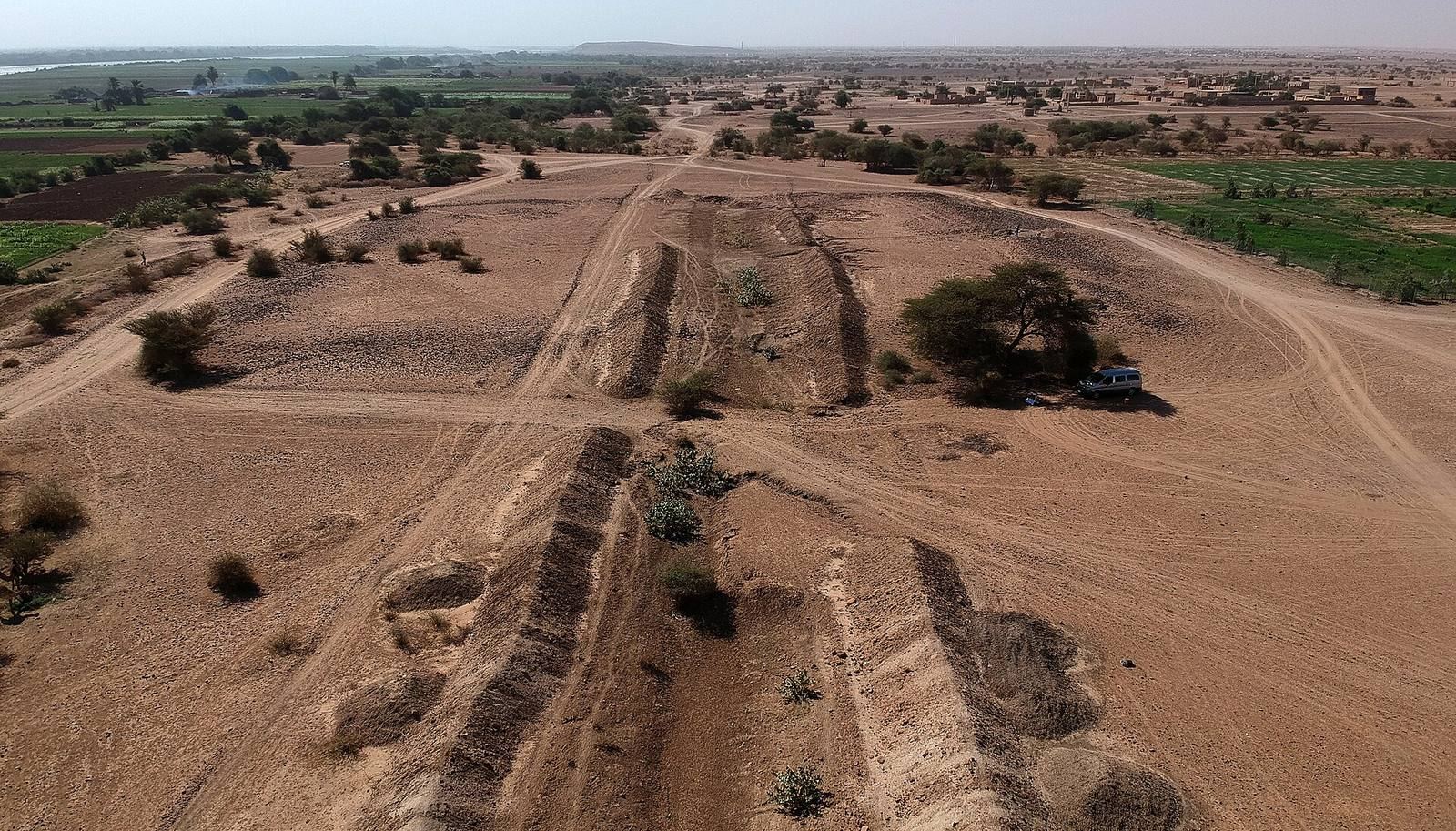
The ruined fort lies about 500 meters from the Nile and 40 kilometers from the meeting of the White and Blue Nile. It is the largest known regular fort in the Middle Nile Valley. Its quadrilateral enclosure measures 97 by 88 meters internally. Irregular stones set in mud mortar form the walls, which were reinforced by 13 projecting defensive structures at the corners and at regular intervals. An eastern gate faced the river, while a western gate opened toward the desert. In 2018, the walls stood about 0.7 meters high. A north–south irrigation channel, 10 meters wide, cuts across the fort; it was dug in 2013–2014.
Interior and Later Structures
Buildings within the enclosure
Geophysical research in 2018 identified structures along the inner faces of the fort walls, as well as separate buildings within the enclosure.
Funj-Period Remains
Buildings and stone structures from the Funj period are concentrated mainly in the southeastern part of the fort. Some were built directly over the remains of the defensive walls.