Saint Mary of Help Basilica, Brezje: Slovenia’s National Pilgrimage Center
Site at a Glance
- Popularity
- Medium
- Country
- Slovenia
- Primary era
- Modern
- Eras represented
- Modern
- Civilizations
- Austria-Hungary, Habsburg, Holy Roman Empire
- Site type
- Religious
- Remains
- Basilica
On this page13 sections
History
The Church of Saint Vitus and the Marian image
Saint Mary of Help Basilica, Brezje, is a Catholic church in Slovenia whose present neo-Renaissance building was constructed from 1889 to 1894 while preserving an earlier Marian chapel. It developed from a Church of Saint Vitus and became the country’s national pilgrimage center.
A church dedicated to Saint Vitus stood at Brezje by the fifteenth century as a subsidiary church of Mošnje parish, with Mass held there three times a year. A presbytery, the part of a church around the main altar, was added in the mid-seventeenth century. A chapel dedicated to Saint Anthony Abbot followed later that century and was in place by 1685.
Between 1794 and 1798, the main altar was restored and received a new painting of Saint Vitus by Leopold Layer, a painter from Kranj. In 1796, Mošnje parish priest Urban Ažbe commissioned Layer to copy a Marian image he had seen in the Cathedral of Saint James in Innsbruck. The image represents Mary Help of Christians, a title for the Virgin Mary in Catholic devotion. Its date of creation is uncertain, though it is thought to have been made around this period. A chapel for it was built beside the church in 1800, and the painting was installed there in 1814.
Growth of the pilgrimage and construction of the basilica
Three healings were attributed to the Marian image in 1863 and 1864, followed by further claims of miracles. The chapel consequently drew increasing numbers of pilgrims. A request for formal recognition as a pilgrimage center was rejected in 1866, but the diocese appointed a chaplain to care for pilgrims. The Ljubljana–Tarvisio railway, completed in 1870, made travel to Brezje easier. After visiting in 1876, Bishop Johann Baptist Zwerger proposed enlarging the church. At first, the sacristan’s house was raised to provide more room for visiting clergy.
Mošnje parish priest Franc Kumer initiated plans for a new Church of Saint Vitus. Architect Robert Mikovics’s designs received diocesan approval in 1887 and government approval in January 1888; builder Franc Faleschini was chosen for the work. Bishop Jakob Missia blessed the foundation stone on 9 October 1889. The plan kept the Marian chapel intact within a new domed chapel. The old church was gradually taken down, with its final remnant removed in 1892. The new building was complete by 1894 and was blessed on 30 July by Jožef Razboršek, dean of Radovljica.
A bequest from Frančiška Ovijač of Ljubljana provided for a Franciscan monastery beside the church. Its foundation stone was laid in 1897, and the monastery was built the following year. In 1898, Bishop Anton Bonaventura Jeglič entrusted the church to the Franciscans, members of the Catholic religious order founded by Saint Francis of Assisi. Missia consecrated the church on 7 October 1900, with Jeglič, Bishop Jakob Trobec, and a large congregation present. On 1 September 1907, Jeglič crowned the Marian image before about 30,000 pilgrims.
War, restoration, and changing status
The First World War cost the church three of its four bells. Steel bells took their place temporarily in 1918, followed by new bronze bells in 1932. In the late 1930s, the area in front of the church was arranged to designs by architect Jože Plečnik.
During the German occupation in 1941, the authorities prohibited worship in the church on 23 April and expelled the Franciscans. They returned after the war. To protect the Marian image from destruction, it was kept away from Brezje from 1941 to 1947, first at Trsat and then in Ljubljana’s Cathedral of Saint Nicholas. In 1955, the Cyril and Methodius Association of Catholic Priests of the People’s Republic of Slovenia placed a memorial plaque on the church wall for clergy killed by fascists; the Franciscans removed it in 2014.
The church’s exterior was renovated in 1965. Franc Jenko changed the organ’s key-to-pipe mechanism from mechanical to pneumatic in 1968 and expanded it to 47 selectable groups of pipes. In 1973–74, the presbytery of the Marian shrine was renovated under architect Tone Bitenc, in keeping with the Second Vatican Council, a major Catholic Church council held from 1962 to 1965. The work also included gilding capitals and decorative bands in the nave.
Pope John Paul II granted the church the title of minor basilica on 5 October 1988, an ecclesiastical distinction conferred by the pope. He visited and prayed there on 17 May 1996. In 1999, the Slovenian Bishops’ Conference named Brezje the country’s national pilgrimage center; the formal proclamation followed on 1 January 2000. Since 1999 the basilica has been directly subordinate to the Archdiocese of Ljubljana. It serves the adjacent Franciscan monastery and functions as a national and diocesan pilgrimage center. Its principal feast, Mary Help of Christians, falls on 24 May. Other major annual gatherings include a June pilgrimage for sick, disabled, and elderly people and the Feast of the Assumption on 15 August.
Remains
The basilica’s architecture
Plan and dimensions
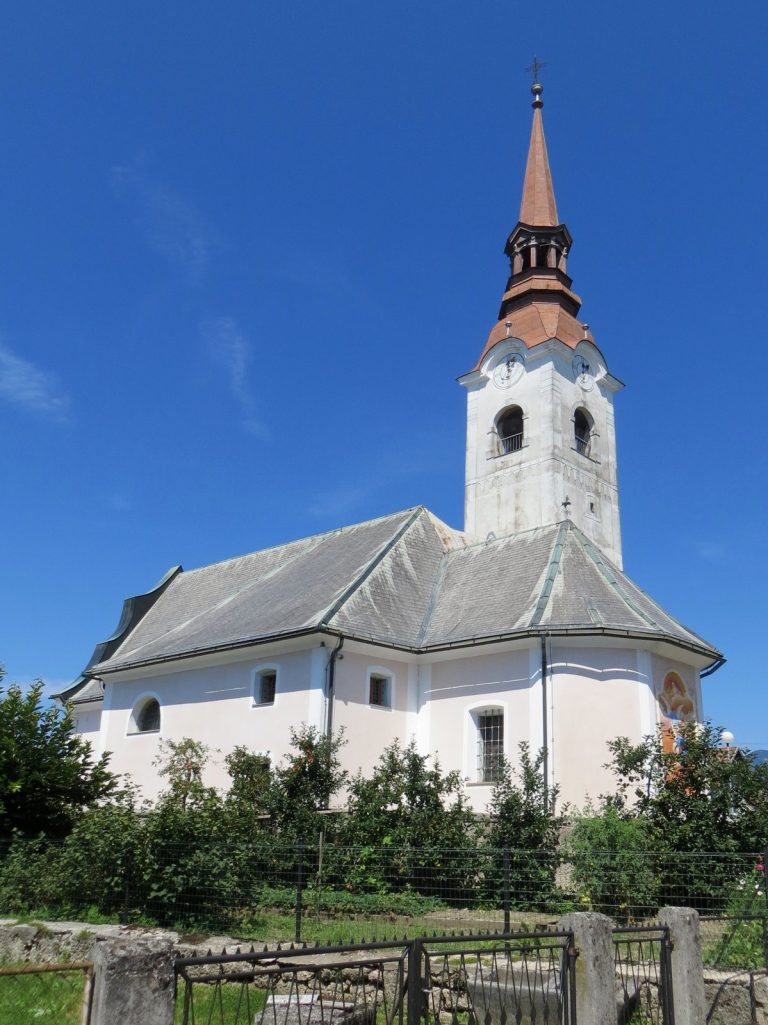
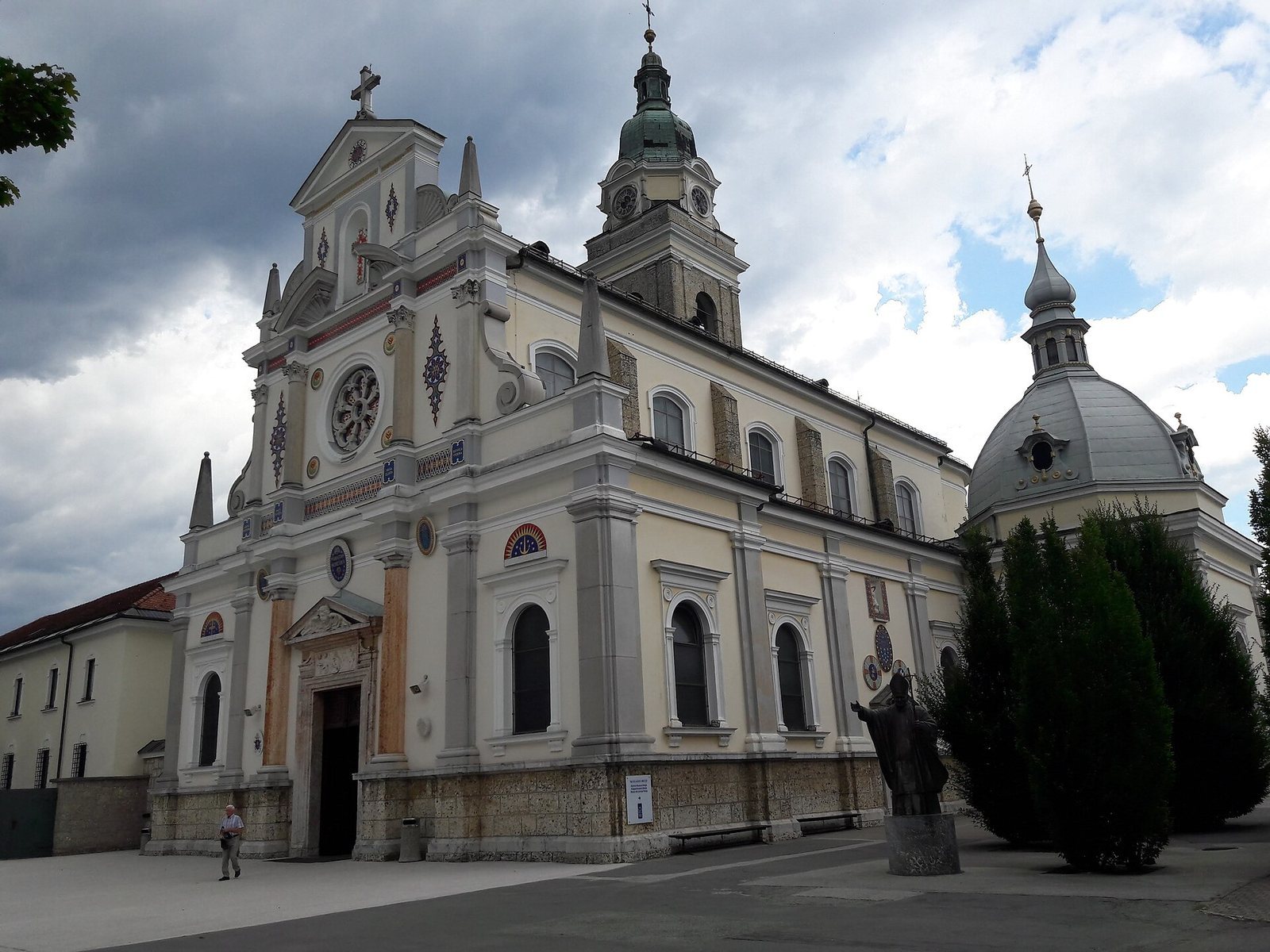
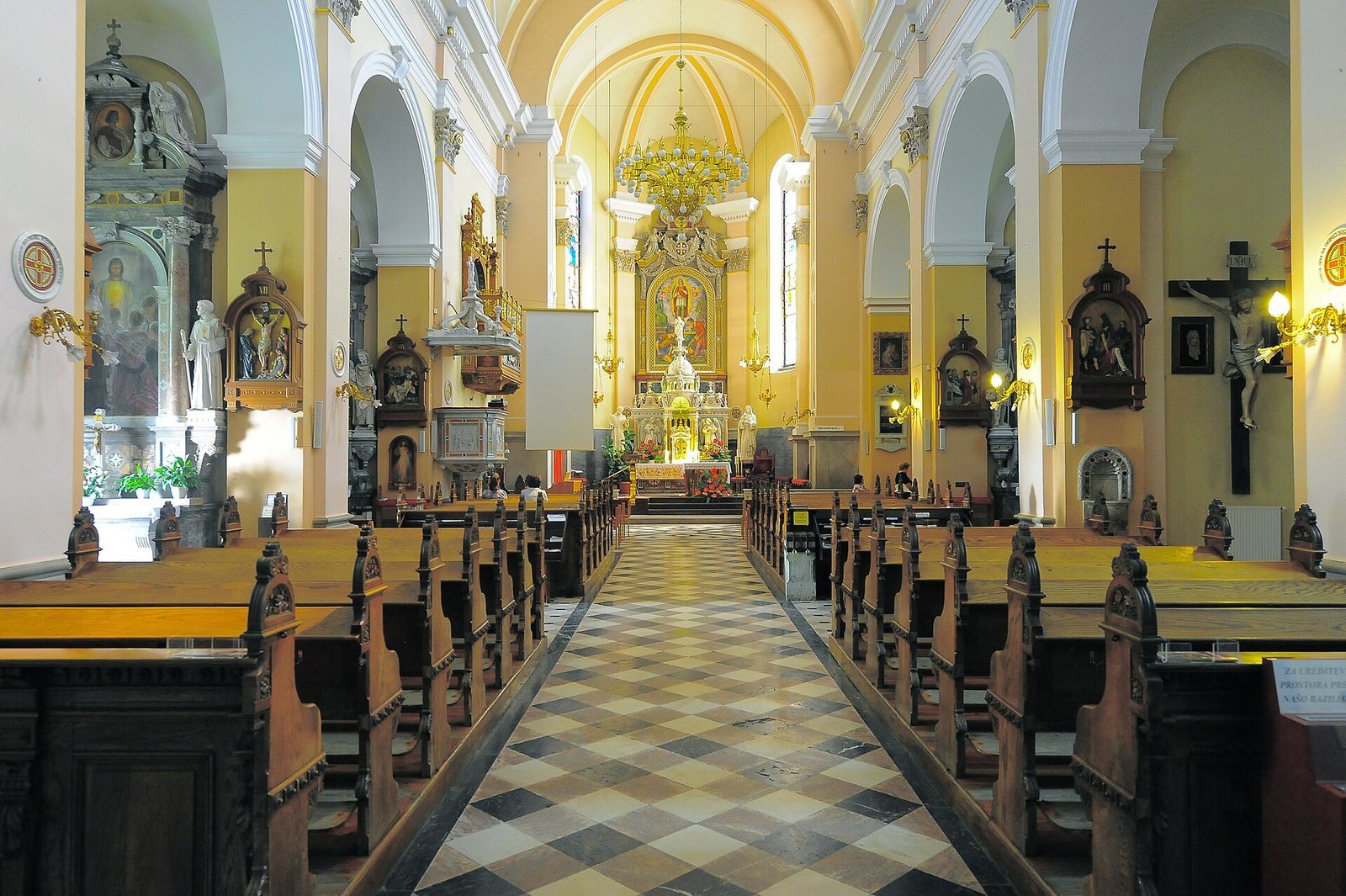
The present church is in the neo-Renaissance style, which revives forms associated with Renaissance design. Its exterior has the form of a three-aisled basilica, with a central nave flanked by two side aisles. Inside, each side aisle is divided twice, creating six side chapels. The building measures 39 metres long and 19 metres wide, with a stated height of 17 metres and a floor area of 540 square metres. It has a dome and a bell tower.
Façade and entrance
Architect Ivan Vurnik designed the façade, which includes a rose window, mosaic inscriptions, and patterned decoration. Janez Resman carved the entrance doors with figures from the Old Testament: Moses, David, Isaiah, Sarah, Rachel, and Judith. Angels and the Virgin Mary also appear in the carving.
Altars and interior
The white-marble main altar is dedicated to Saint Vitus and bears an image of the saint based on a painting by German artist Matthäus Schiestl. Janez Vurnik, Jožef Pavlin, Ivan Grohar, and Ivan Vavpotič made the side altars. Their dedications include Saint Anthony of Padua, Mary Help of Christians, Saint Anthony Abbot, and the Sacred Heart of Jesus.
The Marian chapel
The chapel containing the Marian image stands on the south side of the church, toward the front on the right. Its unusual arrangement places the original, smaller chapel inside a larger domed one, while the inner chapel remains a separate architectural structure. The image once had a simple wooden frame. Its altar also held statues of Mary’s parents, Joachim and Anne, and of Saints Valentine and Roch.
Architect Janko Omahen redesigned the chapel, with the work completed in 1954. Its altar of white Carrara marble was blessed by Auxiliary Bishop Anton Vovk on 8 December that year. A Latin inscription on the front dedicates it to the “most gracious Queen” in the name of Bishop Anton Ribičev of Ljubljana. The floor is Bosnian granite, and Istrian marble covers the walls. The ceiling was raised by more than a metre and perforated to improve ventilation. Layer’s original frescoes were obscured by candle and incense smoke, damp air during crowded pilgrimages, and repeated cleaning. A 1977 reconstruction added a carved image frame by woodcarver Maks Bergant and rebuilt the ventilation system to plans by Jože Kregar and Emil Fijavž.
Additional structures
Chapel of Saint Francis
A chapel dedicated to Saint Francis of Assisi stands in front of the basilica. Built in 1967 to Vurnik’s design, it takes the form of a traditional Slovenian mountain hut. Lojze Perko painted its altar image. The chapel is used for outdoor ceremonies when the number of pilgrims exceeds the basilica’s capacity.
Bell tower and statue
The basilica’s bell tower rises 53 metres. Its roof cap was replaced during renovation in 2023. A bronze statue of Pope John Paul II stands near the church.