Khara-Khoto: A Tangut Capital and Mongol-Era City in China
Site at a Glance
- Popularity
- Very High
- Country
- China
- Primary era
- Medieval
- Eras represented
- Medieval
- Civilizations
- Western Xia, Yuan
- Site type
- City
On this page16 sections
History
Khara-Khoto is a ruined fortified city in Ejin Banner, a county-level administrative division of Inner Mongolia, China. The Tanguts founded it in 1032 as a military center and capital of Western Xia, a kingdom in northwestern China. During the 11th century, it also became a prosperous center of trade.
Tangut foundation and Mongol rule
Genghis Khan, founder of the Mongol Empire, took the city in 1226. The following year, during his campaign against Western Xia, he established a large military camp there. Khara-Khoto served as a strategic base for campaigns under Genghis Khan and the successive great khans Ögedei and Möngke. The city expanded substantially under Kublai Khan, who established the Yuan dynasty, the Mongol dynasty that ruled China.
Under Yuan rule, Khara-Khoto was a junction connecting Karakorum, Shangdu, and Kumul. It also served as a stopping place on routes used by Persian and Arab merchants. About 1,550 households included Mongol, Tangut, and Chinese residents, while merchants from Persia and Arab lands stayed temporarily. Authorities built irrigation channels for nearby fields, and an office managed river and canal works.
After Toghon Temür established the Northern Yuan, the Mongol polity that continued after Yuan rule in China ended, Khara-Khoto became a base for plans to regain the Central Plain, the traditional Chinese heartland around the Yellow River. The Ejin River supplied the city’s water, sustaining an oasis in the desert. Marco Polo, a 13th-century Venetian traveler, described a city called Etzina in Tangut territory that is identified with Khara-Khoto. He wrote that people there relied on farming and livestock, and that travelers stocked provisions before crossing a desert said to take forty days to traverse. Ejin Banner takes its name from the city.
Ming conquest and abandonment
In 1372, Ming forces, representing the dynasty that succeeded the Yuan in China, reached the city. The Ming annals report that General Feng Sheng’s army arrived at Edzina and that the defender, Buyan’temur, surrendered. They also recount the flight of Yuan ruler Gyardzhipan’ and the capture of his minister and 27 other people, along with more than 10,000 horses and cattle.
Local tradition attributes the defeat to the Ming diversion of the Ejin River, which cut off the city’s water. Two different tales describe the fate of Khara Bator, a legendary commander rather than a figure established by the historical record. In one, he killed his family and himself after the water supply was cut, and Ming troops later killed the remaining defenders. In another, he escaped through a breach in the northwestern wall. The city was abandoned after the Ming victory, perhaps partly because of water shortage; finds indicate that urban life ended around 1380. Buddhist, Muslim, and Christian communities had lived in Khara-Khoto.
Exploration and archaeological work
The city’s remote location helped protect its ruins from looting. Buryat explorer Tsokto Badmazhapov recorded them in spring 1907 and sent photographs and a description to the Geographical Society in St. Petersburg. Russian explorer and archaeologist Pyotr Kozlov arrived on 1 May 1908. After gaining permission from the local Torghut lord Dashi Beile, he returned in May 1909 to excavate. His team recovered more than 2,000 books, scrolls, and manuscripts, as well as Buddhist objects; Kozlov initially sent ten chests of material to St. Petersburg.
British archaeologist Aurel Stein excavated at Khara-Khoto for eight days in May 1914. Between 1927 and 1931, Swedish explorer Sven Hedin and Chinese archaeologist Xu Xusheng led Sino-Swedish work. Swedish archaeologist Folke Bergman mapped the city and the Ejin River area, surveyed watchtowers and fortresses, and found many woodblock prints. He considered some published records of Kozlov’s and Stein’s work cursory or partly inaccurate.
Chinese archaeologist Li Yiyou and the Inner Mongolian Institute of Archaeology excavated in 1983 and 1984, recovering about 3,000 further manuscripts along with building materials, everyday objects, production tools, and religious art. The discoveries contributed to research on the Tangut language. Aleksei Ivanov identified several Tangut dictionaries, including the Chinese-Tangut glossary Pearl in the Palm, compiled in 1190.
Kozlov’s finds included about 3,500 paintings and other objects, now held by the Hermitage Museum; books and woodblock prints went to the Institute of Oriental Studies in St. Petersburg. These collections survived the Siege of Leningrad, and items thought lost were rediscovered in 1991. Objects from Stein’s work are held by the British Museum, with manuscripts in the British Library. Most of Bergman’s finds went to authorities in Beijing; some textiles and blue-and-white porcelain went to Stockholm and were later deposited at the Ethnographic Museum.
Remains
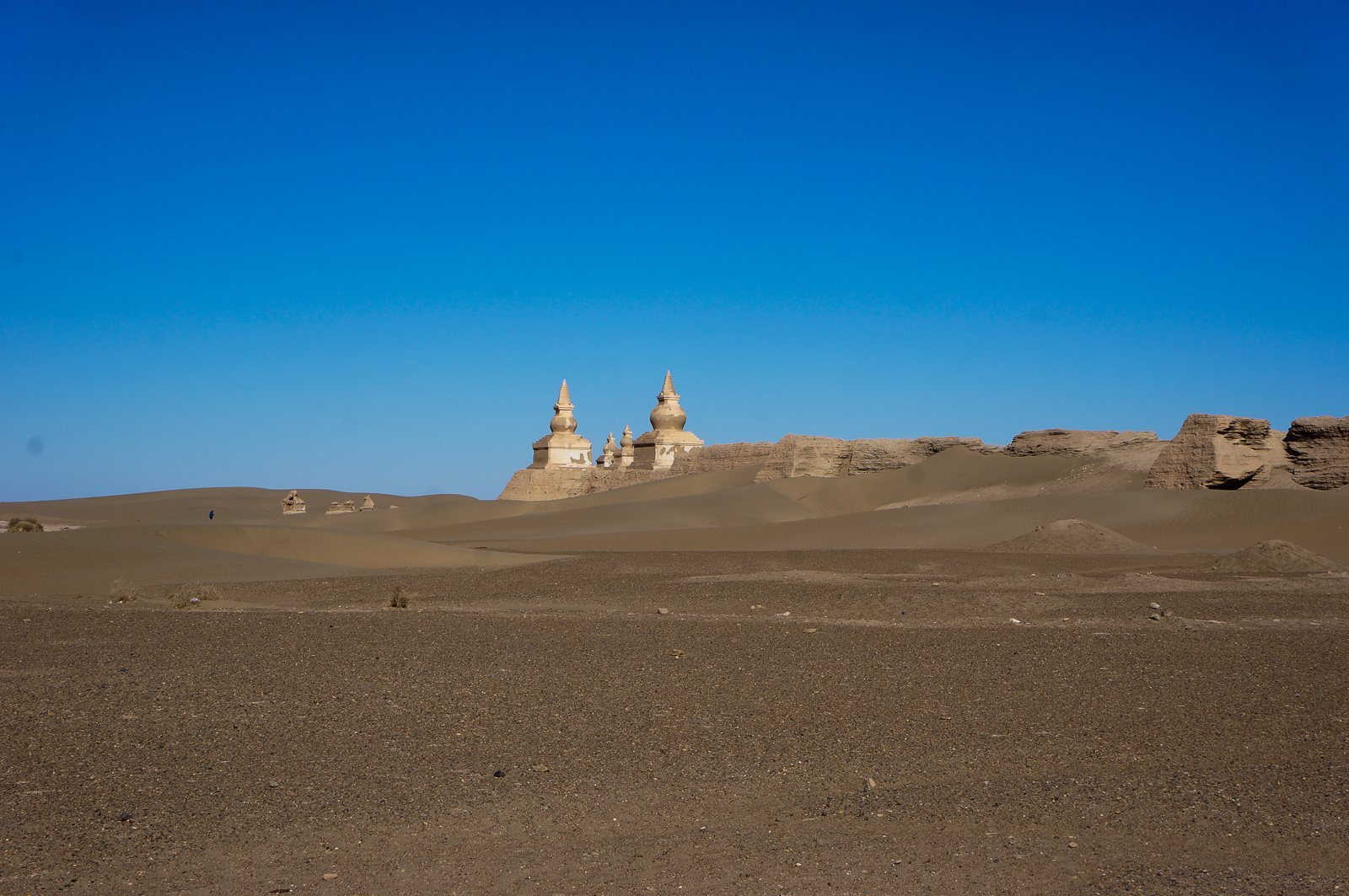
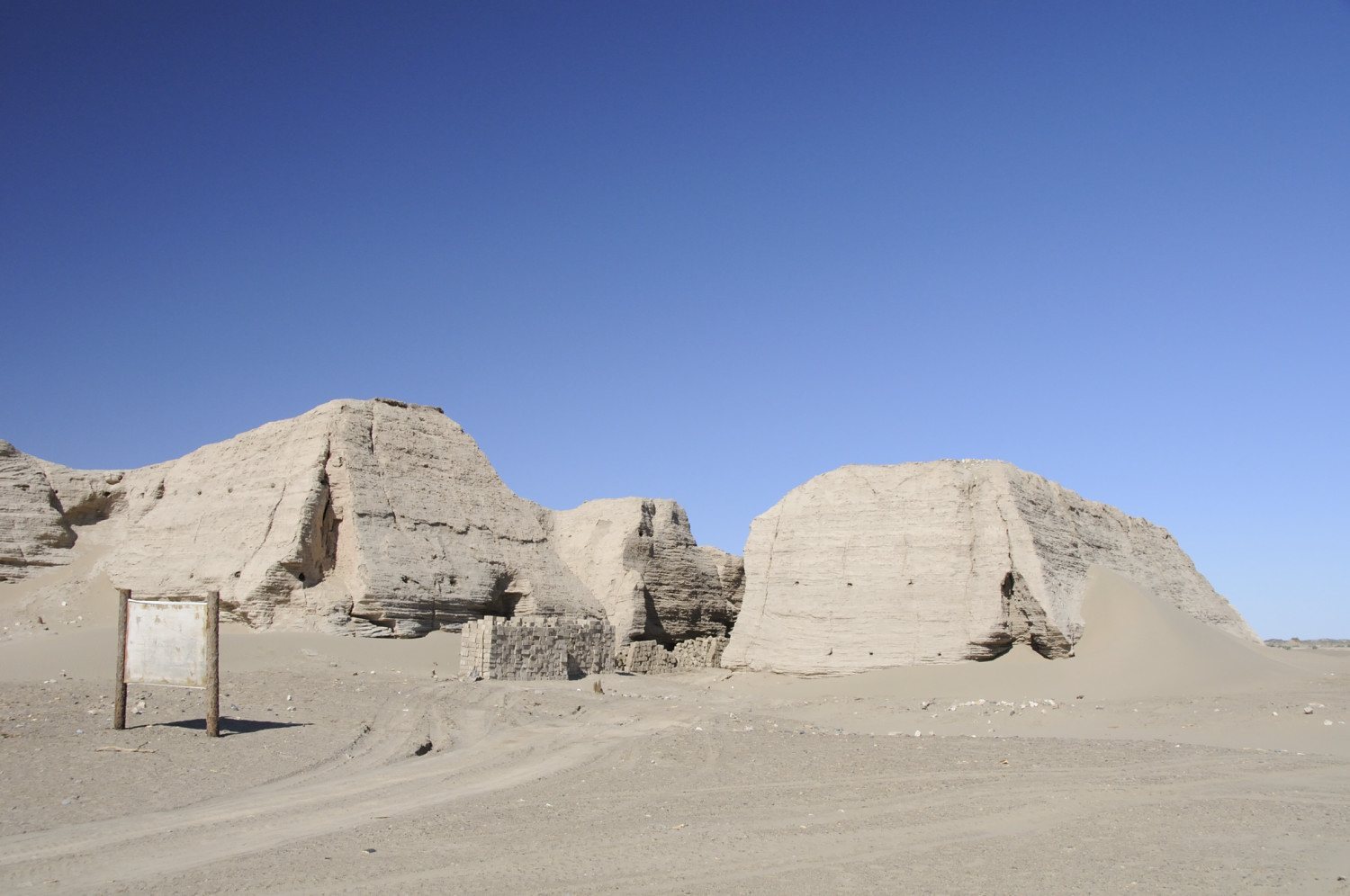
The ruins are organized around a rectangular, fortified enclosure built with earth, timber, and brick. Gates pierce the eastern and western sides, while towers strengthened the corners and walls. Settlement remains and religious structures also extend beyond the enclosure.
Walls and defenses
Outer walls
The rectangular outer walls measure about 421 metres east to west and 374 metres north to south. Surviving ramparts stand about 9.1 metres high and are about 3.7 metres thick. The walls taper from a base roughly 12 metres wide to a top about 4 metres wide, with three layers of timber reinforcement. Brickwork along the upper edge forms a toothed profile.
Gates and towers
There are two gates, one in the eastern wall and one in the western wall, each about 5.5 metres wide. Their plans bend in a G-like shape, with a southern projection described as a wing or canopy. Towers stood at all four corners. Additional towers were spaced along the enclosure: six on the north wall, five on the south, and four each on the east and west.
Northwestern wall
A breach wide enough for a rider to pass through remains in the wall. The northwestern section is lower and broader than the rest, a form associated with repairs made during the Mongol period.
Outlying remains
Settlement and stupas
Settlement remains continue beyond the walls, especially to the east, where they extend at least 100 metres. Stupas, Buddhist monuments often associated with relics or memorial observances, also stood outside the enclosure. One at the northeastern corner survives, while several others are represented by remains. Two stood to the west, though one has been completely destroyed.
A stupa excavated about 400 metres west of the walls contained around 2,000 volumes, Buddhist images, manuscripts, and metal and wooden figures. A vertical wooden post occupied the center of its base, surrounded by about 20 life-sized figures facing inward. Large Tangut-inscribed manuscripts had been stacked in front of them. The dry desert climate helped preserve the excavated materials.
Possible mosque
Remains of a building interpreted tentatively as a mosque lie just outside the southern part of the enclosure.
Objects and written evidence
Books and manuscripts
Manuscripts from the site include East Syriac Christian texts, from a historic Christian tradition linked to Syriac-speaking churches, and writing in Arabic, Mongolian, Persian, Sanskrit, Syriac, Tangut, Tibetan, Uyghur, Old Turkic, and other Turkic languages. A Chinese-style Mongolian divination book includes treatments for horse diseases and 14 lines of Genghis Khan’s teachings. Its worn condition suggests frequent use. Two printed Mongolian books use Uyghur script.
Undated documents found with Yuan paper money have been tentatively dated to 1368. The latest Chinese text from the site dates to 1371, while the latest Tangut text dates to 1212.
Everyday and commercial objects
Finds include letters, printed woodblocks, metal and paper currency, women’s ornaments, household objects, and tools used in production. A Yuan-period coin carries a warning that counterfeiters faced execution.
Paintings and decorative materials
Paintings from the site are mainly on silk and depict Buddhist subjects in Chinese and Tibetan styles. Most date to the 11th to 13th centuries, with the latest dated examples assigned to 1378–1387. Excavated material also includes fragments of batik-dyed silk and a small section of painted mud wall that indicates the use of cobalt in smalt, a blue glass pigment. Most porcelain fragments with cobalt decoration date to the 14th century.