Ninstints: A Haida Village Site on Anthony Island
Site at a Glance
- Popularity
- High
- Country
- Canada
- Primary era
- Classical
- Eras represented
- Classical
- Civilizations
- Unclassified
- Site type
- City
On this page9 sections
History
Ninstints, also known as S’G̱ang Gwaay Llnagaay, is a village of the Haida, an Indigenous people of the North Pacific coast, on Anthony Island in British Columbia, Canada. The village site dates to at least 360 CE, while evidence places human presence on Anthony Island nearly 2,000 years ago. Haida Gwaii as a whole has been inhabited for at least 10,000 years.
Haida settlement and names
The Haida name S’G̱ang Gwaay Llnagaay is commonly translated as Red Cod Island. Another interpretation links its sound to wind moving mournfully through openings in sea cliffs. In the late eighteenth and early nineteenth centuries, ship captains called the village Koyahs, after Chief Koyah. The name Ninstints came from a powerful chief of the mid-nineteenth century, reflecting captains’ practice of naming villages after their chiefs.
Ninstints was home to the Kunghit Haida, whose territory extended across southern Haida Gwaii from Lyell Island to the archipelago’s southern end. The village’s chiefs allied with the Tsimshian, another Indigenous people of the region, at Kikatla on Dolphin Island. They fought alongside them against Haida from Skidegate on Graham Island. Haida testimony describes twenty longhouses at Ninstints. Thomas Price, the last chief born in the village, became a noted Haida carver, especially in argillite, a fine-grained stone used for carving.
Maritime fur trade
The maritime fur trade brought Indigenous communities into exchange with overseas traders, particularly for sea otter pelts. George Dixon visited Ninstints in 1787 and noted Haida interest in the trade. Charles Duncan came in 1788, followed by Robert Gray and John Kendrick in 1789. Relations that had begun amicably grew hostile. In 1789, Kendrick held Chief Koyah aboard his ship until clothing taken from the vessel was returned.
Kendrick returned in 1791, when Haida attacked his ship, the Washington. Koyah was probably killed in 1795 during an attack on an American ship commanded by Captain John Boit.
Population decline and later use
Trade relations with European merchants improved in later decades, but disease and the draw of expanding trade centers led many Haida to move to places such as Masset, Skidegate and Victoria. The 1862 Pacific Northwest smallpox epidemic sharply reduced Ninstints’ population, and other introduced diseases caused further losses.
By 1875, the village served mainly as a camp. Its remaining permanent residents had moved to Skidegate by 1878, although about twenty-five people continued to use Ninstints as a winter village into the 1880s. They left during summer to hunt and fish elsewhere in the archipelago.
Protection and stewardship
Ninstints is part of Gwaii Haanas National Park Reserve and Haida Heritage Site, within the Gwaii Haanas National Marine Conservation Area Reserve. Canada designated it a National Historic Site on January 15, 1981, and UNESCO recognized it as a World Heritage Site that year under criterion (iii). This criterion recognizes places as exceptional testimony to a cultural tradition or civilization, whether living or disappeared. Haida Watchmen at traditional village sites in Gwaii Haanas help protect heritage places, encourage appropriate visitor conduct and maintain a presence on traditional territories.
Remains
Village setting and houses
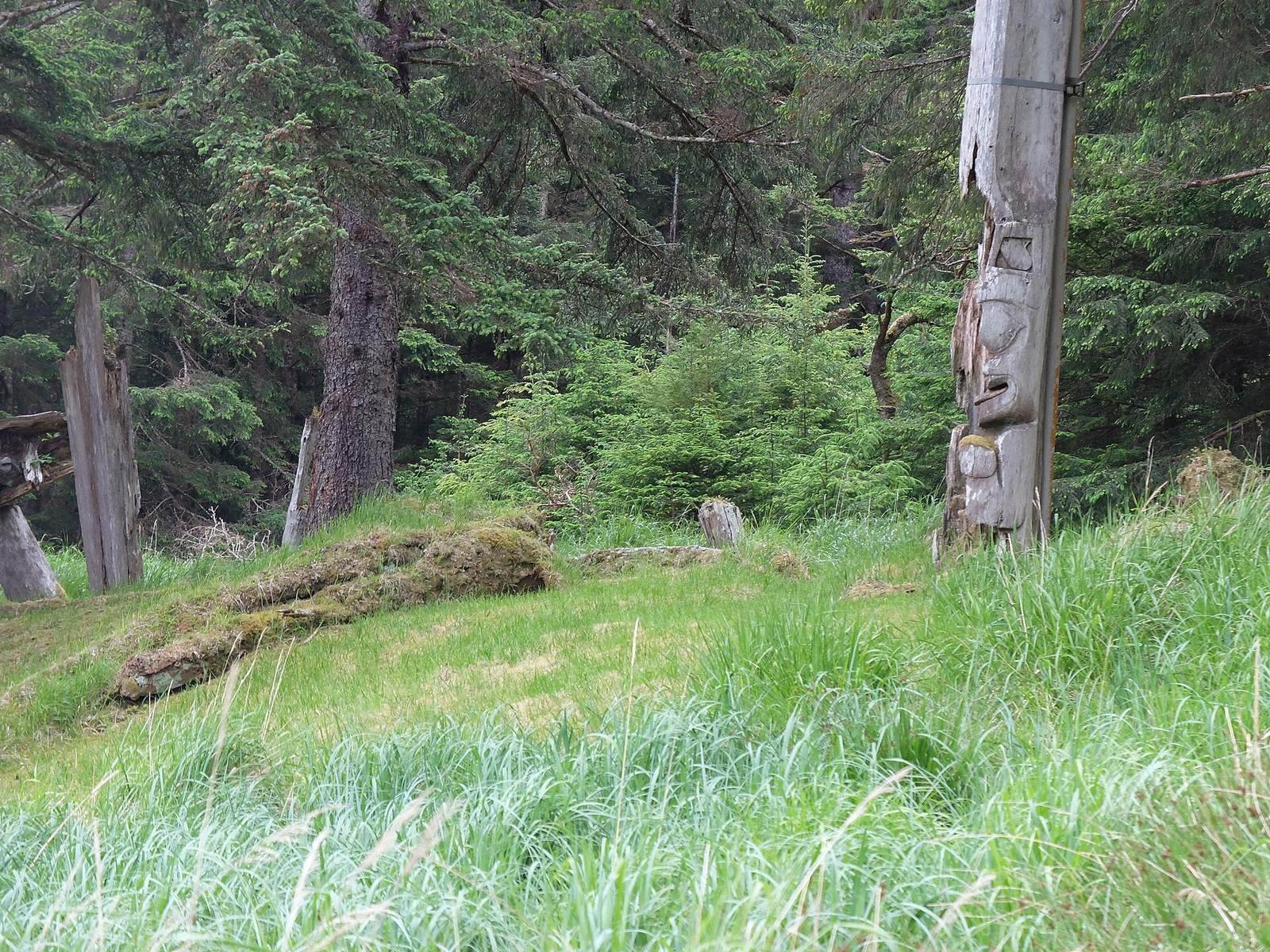
The village occupies a sheltered, rocky bay on the east side of Anthony Island, facing Kunghit Island. Remains of ten large cedar houses survive at the site, giving a sense of its former settlement. The bay’s position between Anthony Island and Kunghit Island forms part of the village’s physical setting.
Island ecology
Anthony Island’s distinctive biodiversity developed over hundreds of thousands of years. American black bears, martens, ermines and deer mice are larger than their mainland relatives. About 1.5 million seabirds nest along the archipelago’s 4,700-kilometre coastline, with roughly half found on Anthony Island. These include rhinoceros auklets, ancient murrelets, tufted and horned puffins, Cassin’s auklets and Leach’s storm-petrels. Coastal waters support salmon, herring, halibut, rockfish, mussels, crabs, sea stars and octopuses. Gray whales travel along the archipelago’s coast in spring as they migrate toward the Bering Sea; dolphins, porpoises and gray seals are also found there.
Carved poles and grave markers
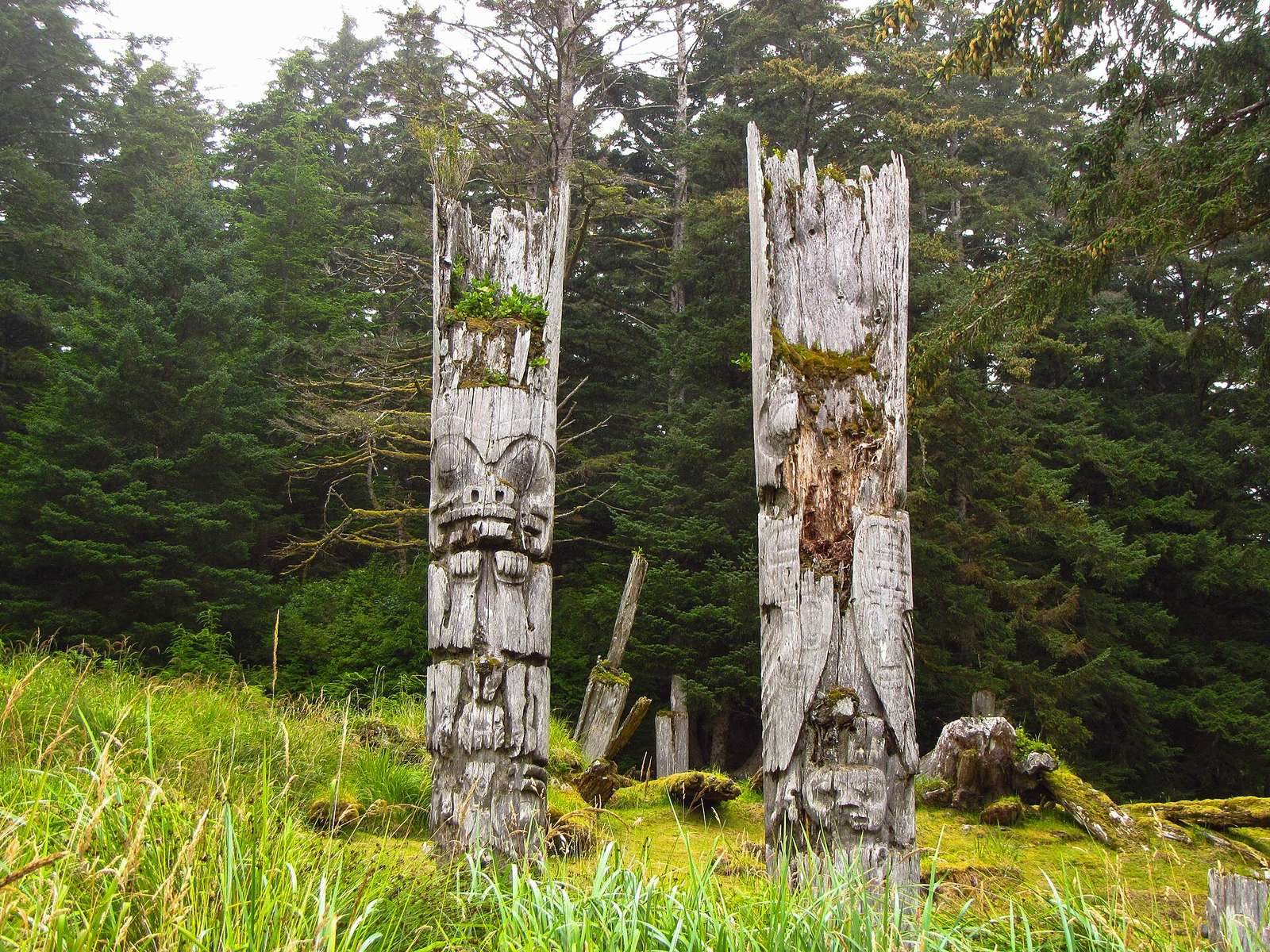
Thirty-two Haida totem poles remain in their original locations, forming the largest collection of Haida poles still in place. The carved wooden poles depict stylized human and animal forms and are regarded as important works of art. The wet temperate-rainforest climate causes the wood to decay naturally, a process Haida stewardship allows to continue. Carved grave markers associated with ancestral bones are also present.